Showing posts with label mustang. Show all posts

Tuesday, 10 February 2015

Kagbeni, Kagbeni, Kagbeni

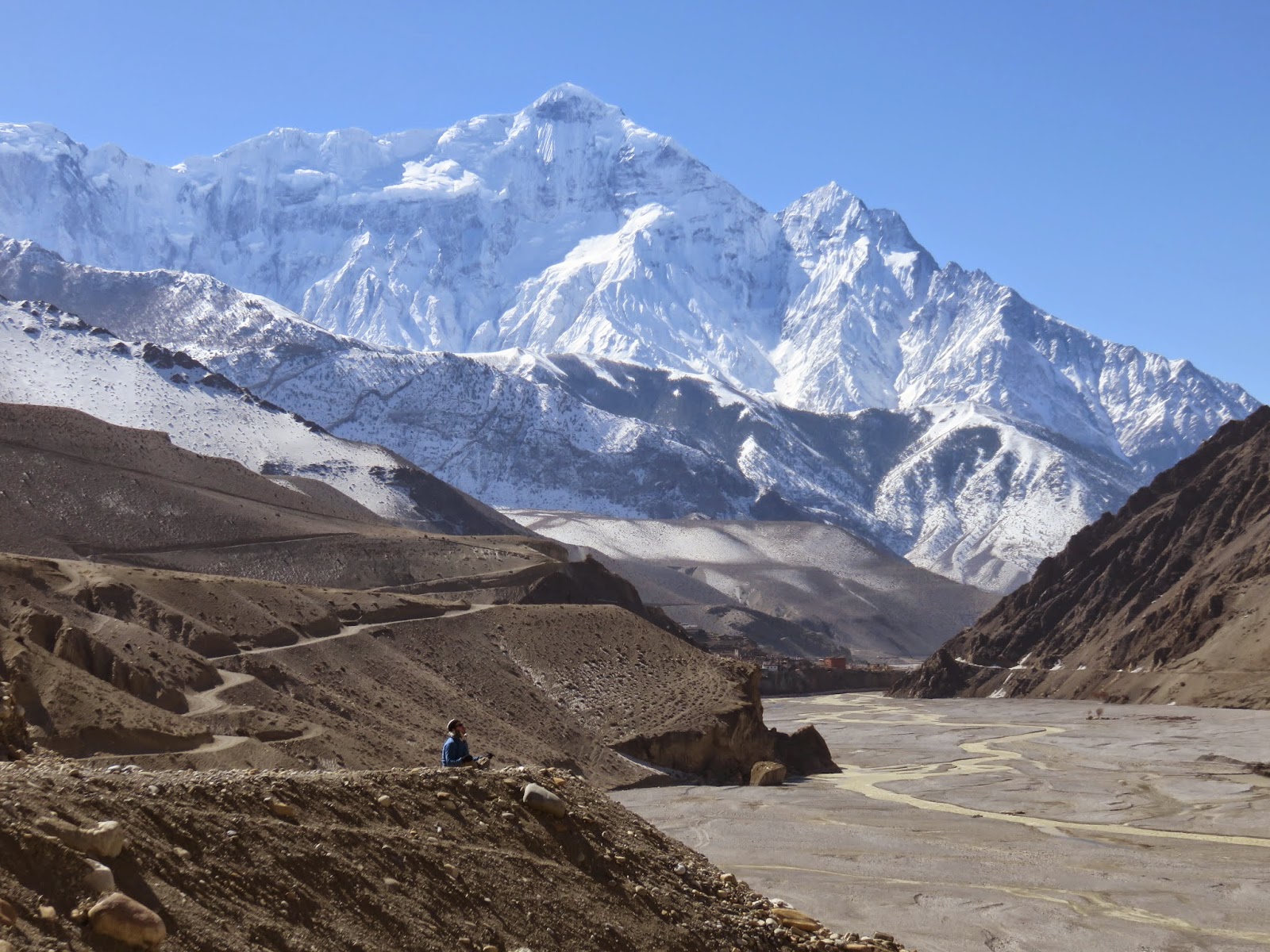
Due to our altered itinerary and our dolphin sands road climax (thus far), we found ourselves spending three nights in the small village of Kagbeni. It is located in the valley of the Kali Gandaki River.


Kali Gandaki River and mountains all around

Initially the arid landscape appeared very other worldly, especially compared to the Annapurna region. The brown valley, which reminded me of Colca Canyon in Peru, was in stark contrast with the blue sky and mostly white mountains around us. The beautiful scenery made us very excited about what would follow as we hiked further north into Upper Mustang, perhaps compounding our later disappointment!


(I will have to warn you here that this post is going to contain many photos because although Kagbeni mostly represented a place we weren’t meant to be, or a substitute for where we wished to be, I found it a really nice village with incredible and unique scenery.)

On the morning of our walk to Kagbeni, I tried my first Tibetan tea. The drink is made from the butter and milk of a yak, and though it wasn't anything to write home about, it was nice to try something new. (There was certainly not much else to look at at this point as it appeared we had stepped into a Wild Wild West movie. I couldn't even find a tumbleweed!)


On the road to Kagbeni

Passing a Kagbeni orchard

Apparently there is gold to be found

Our guide, Krishna took us around Kagbeni village and further into the valley
When we arrived at our hotel in Kagbeni I quickly found a window nook to bask in the sun and enjoy the view. I told Rob it was categorically a cat/Kat window which was confirmed the next day when we found a ginger and white cat napping in the very spot.


Room with a view
Kagbeni town and surrounds


Whilst in Kagbeni we tried to (respectfully) get some photos of the Kagbenians doing their thing. Most people were not interested in partaking, which I can understand. As we milled around town we saw scraps being given to birds, goats being herded back before sunset, men gambling in the streets and a goat's head hanging from the bridge. 


Home time!
Beautiful eyed boy


Unexplained goats head dangling from a bridge

Kagenians doing their thing


We also passed the unexpected no-hiking time with, UNO special rules (the game that keeps on giving as the dealer chooses the rules each round), reading, writing, napping and of course, eating dahl baht and drinking milk tea. We were in the midst of reading Around the World in 80-days together which we both enjoyed immensely. (No, we are not trying to speed up our journey to win a bet!)


River-side Kagbeni (Kali Mukti joins from the north-east/right)

Could be out of Game of Thrones
On our second and third night in Kagbeni, I tried hard to rest my ankle. It was not too bad but still painful. The next morning we would hike back to Jomsom for the return flight to Pokhara the day after. This time we walked in the riverbed, again having the sense that we could be somewhere other than Earth. Though the trek was short it felt long, as I was eager to return to Jomsom. We entertained ourselves with conversation, looking for gold and throwing rocks into the river. 

Rock games- Rob hit the mountain!
All smiles!
Up the icy path
A lovely part of Nepal

Which planet?
Kagbeni to Jomsom via the riverbed, all gold-prospecting


Blue skies and many browns
Eventually we made it to Jomsom where the colourful new monastery stuck out like a sore thumb amongst the browns and whites of the mountains. We were keen to use the wifi as we had been speculating on the prime ministership on our trek. It turned out that there had been a vote for a spill. We also caught up with the news of our friends, which included an exciting very recent new arrival to the world! 

Jomsom seemed pretty interesting until we started walking around and most things shut down. Nevertheless we decided to try and have a third tea for the day. Arriving at a small tea shop, we asked a young boy where to get it. He misunderstood thinking we were looking for beer! It is funny how us humans just hear what we expect to hear sometimes. (Rob was even speaking Nepali).

Arrival at Jomsom: new monastery
Jomsom
My heart almost stopped on our flight back to Pokhara. We had arrived very early at the small airport and waited around for a long time. They only fly in the morning because it is too windy and dangerous later on. We boarded the tiny plane of 15 passengers and my seat was requested so a mother and adult son could sit near each other. It was for the best because it was the woman’s first time on a plane and it just so happened that this one would drop at least ten metres in the sky. I lost my stomach and didn’t find it again until much later in the day. What made it worse was the woman had covered her eyes with a scarf so she couldn’t see.  It was definitely the most scenic and terrifying short flight I have been on. I don’t think I would do it again, opting for the multi-day hike to avoid it!


Monday, 9 February 2015

To Muktinath

Muktinath is a sacred Hindu and Buddhist pilgrimage site with many visitors coming every year from Nepal and India.  A flame has been burning here (perhaps for centuries), fueled from a natural gas rising from within the cracks in the rock.  The river flowing alongside creates a "natural" meeting place of earth, fire, wind and water that makes this area so sacred.


On the road to Muktinath


Our visit to Muktinath was brought forward to Feb 6, on the account of failing to get far into the Upper Mustang region.  A relatively short side-trip from Kagbeni, we were originally to visit on our "way down" from Lo Manthang.  Short side-trip is a funny way of saying 1000m climb, but as our aborted trek to Chaile, the views were stupendous.  As we got closer to Muktinath, while the sun was out the snow was underneath.  Despite the cold temperature, snow did that thing that it does in the sun and the going was a little treacherous, particularly to one trekker with a dodgy ankle.


We mostly had the road to ourselves

Stunning scenery

Not only were the views of our climb from Kagbeni to Muktinath varied from the day before, this time we passed many a Mustangian either tending to their goats, their weaving on home-made looms or grazing their ponies (and with the latter trying to encourage us to engage them to take us on the steep climb to Muktinath).  Walking here is a case of extremes.  In the shade of the mountains, your body goes into antifreeze mode, the blood drains from your fingers and toes, your nose runs and your eyes water.  In the glory of the sun shining down on you, your skin tingles in the places where the cold blood meets the warm, you can feel the sun on your face, and you quickly need to take off your gloves and scarf to regulate your body temperature.


Risking life and limb to find some grass in a winter wonderland
Getting colder as we climb
Fairytale village: Not your everyday tea-break stop
After settling our things at our hotel and warming up over yet another cup of milk tea (taste being less important than temperature), we spent the afternoon walking about the temples and monastaries of Muktinath.  A Buddhist and Hindu temple (many people in the region, and in broader Nepal actually associate to both) has been built over the site of the flame.  Further along, there is another temple surrounded by 108 water spouts.  Hindus take a shower from all of them, then jump into two cold pools before going around the spouts again (two more times) before making puja at the temple itself.  Krishna gave us a demonstration without actually jumping in the freezing pools.  The complex around the flame also had a small Buddhist gonpa (monastery), dark and eerie without any incense or singing or anyone inside, it was nice to be free to walk around and poke my nose in places you can't when people are there.  The area was covered in snow with little tracks between the most visited places.  It was serene and peaceful and exactly like you may expect a place like this should be, located some 15 minutes walk from the closest homes and hotels, although I don't know if the same could be said during peak times. However, as anyone familiar with typical Hindu rituals might attest, quiet is not actually very normal.


Krishna after visiting the temple

Scarcely a track
Taking in the peace of a monastery

The "town" part of Muktinath was mainly a sequence of hotels, empty and closed up in the starkness of a late winter although we did visit a beautifully decorated and much larger gonpa tucked in between them.  We heard complaints on the way up the hill that the snow was not yet really thawing, and we were some of the only trekkers on the road (ice).  On the whole, Krishna chose well for the lodges in which we stayed, and from a food and friendliness perspective, in Muktinath he was on the money, but from a temperature perspective, it had to be the exception.  Sure to be pleasant and comfortable in summer (when most of his clients WOULD visit), where the sun can blaze down through the windows and balconies and where the open design of the hotel would give it a grand community feel, it was a haunting place to be in winter.  With no other guests and no windows or sun making it to the room and no fire in  the common area, the greatest respite was walking amongst the temples in the snow enduring the afternoon wind or hunkering in the sunniest spot of the deck (until the sun disappeared).  With time up our sleeve we had already committed ourselves to two days here, but a cold two days it was!  I resorted to my old trick of eating daal bhaat Nepali style (with my hands) to give my fingers some temporary respite while Kat retreated early to a sleeping bag at the limits of its operating range (about -14C). 


Muktinath and the mountains

I don't want to complain about the hotel (Eureka Inn, if you are up that way) too much, as I am sure that it is great with a few more people and in the warmer months, and as the staff (two young men, Oman and [oh no! I can't remember his name!]) were incredible, made the best daal bhaat I had during the whole Nepali trip and had an interesting story to share.  The younger one had been abandoned by the side of the road, at about 4 years of age and found by the hotel owners one day on their way to Muktinath.  He was deaf and mute but as Krishna relays the story is now "stronger than an ox and does all the hard work about the hotel".  It was very hard to work out whether he or Oman actually knew any sign language, and your heart breaks a little to think about the circumstances of his abandonment and upbringing.  Regardless, in our presence he was happy, helpful and interested in most things we did, but politely declined to join us in another violent game of Uno.  

The costs were all borne out of our Mustang trip, so I have little to add in the way of tips/advice, other than even here, at the base of the highest pass in the world (Thorung La Pass at 5400m), you can still get wireless internet!

Friday, 6 February 2015

To Tibet Mustang!

It is significant that we should have recently shared the story of how our blog got its name, because we did not have to wait more than a day from our arrival in Kathmandu that we should see it in action, in all its fist-shaking glory.

Not only were we unable to book a tour to Tibet, within a few days our alternative trek to and within Upper Mustang (a place home to many Tibetans and their descendants) was thwarted by natural causes, not to mention some bad planning and to a certain extent a little bloody mindedness.


Travel Dream! "Be a Buddhist in Tibet"... sort of. 
Rob is not a Buddhist nor in Tibet, but we got close.
Let's take them in turn. I had investigated organising a tour to Tibet some months ago, and came to the conclusion that it may be far simpler to engage a tour company in Kathmandu that could do the running around with visas, passports and the extra special Tibetan Entry Permit cheaper and in many less days than it would take me to do from Australia.  A person of exactness or certainty may not have taken this same approach, but, what can I say, I can be a little odd when it comes to shelling out the greenbacks.


Buddhist prayers flying high in Kagbeni
The first problem arose when it became clear that the Chinese government, had that week announced that they were no longer issuing visas or Tibetan permits for foreigners to enter the "Tibetan Autonomous Region".  This is not uncommon, the problem is just that they usually do it in March (or so I have read and been told), not in late January. As we did some shopping around, it was not immediately obvious that we could definitely NOT go to Tibet, but in the case of each tour company we visited, a single phone call resulted in them resolving to sell us other options.  The reasons given were various ("it is the Chinese New Year, so the area will be full of Chinese tourists and they don't want foreigners there", "because of the weather", and most resignedly "who knows why the Chinese government does these things?") but all amounted to the same thing (not going).


The streets of Kagbeni through Kat's eyes
Luckily, or so we thought, one of the alternative travel dreams, was to take a trip to Upper Mustang - a region I have heard so much about and been jealous of friends' photos.  Friends from my work at Tilganga had been there, other volunteering friends, even my brother (Tim) had been to Lower Mustang and he was only ever in Nepal for about 2 weeks!  Additionally, Upper Mustang itself has traditionally had very close roots to Tibet through religion, trade (the Tibetan-Indian trade route has gone through Mustang for centuries), war, and as the home of refugees, settlers and squatters.  A trek there would not only allow us to see a dramatically different landscape to that of the Annapurna Himalayas, it would take us in to Lo Manthang - a town of many Buddhist monastaries), within kilometres of the Tibetan border.  Upper Mustang also maintains its own figurehead king who judges on disputes and has a certain responsibility for the people in his region (despite the obvious contradiction this presents since the abolition of the Nepali monarchy in 2008 with the rise to power of the Nepali Maoists).


Upper Mustang Permit Required!
Permit required!
Let me be clear, this was not an inexpensive alternative to a Tibetan tour.  The Upper Mustang permit is prohibitively expensive ($US500 per person), but, one hopes, that this has the added benefit of preserving the culture of the region, while still taking in income for preservation and restoration purposes.  Without too much dallying, we set about the process of booking the trek and making arrangements meet  our guide Krishna in Pokhara, on Feb 3 to start out on Feb 4, following on from our Poon Hill & Ghorepani trek.


Rob and Krishna in an awkward backpack embrace


Feb 4 started us out with an amazingly scenic flight from Pokhara to Jomsom, the district headquarters for Mustang.  In that rickety flight where we ascended but never really descended (the plane just landed - think about that) we were treated to a view of all the main stops of our Poon Hill trek over the prior 5 days.  We had breathtaking views of Nil Giri and the Annapurnas right out the window as we wound left and right through the ranges to our destination.  After a few checkpoints the backpacks were on and we were trekking (all by 9am), the day's ultimate destination was Kagbeni, a Hindu/Buddhist town on the intersection of the Kali Gandaki and the Mukti Kola (rivers).

A plane ride that could not be captured on film
Before we got up close with the mountains

Soon after is where we discovered that my bloodymindedness of visiting this region may have been inappropriate for the time of year.  From the outset, Krishna did point out that icy tracks could make the way difficult or impossible, but that his inquiries suggested that we would definitely make it to Chaile - the goal of our second day (Feb 5) and that from there we would need to take advice.


Kat's view of Nil Giri and Kagbeni
Sadly, this was not to be, and where the second problem developed (or more accurately, where the second problem was discovered).  Having stamped our newly minted and expensive Upper Mustang permits at the border of Kagbeni (for this is the entry point from Lower Mustang to the highly restricted Upper Mustang) and checking on the quality of the road ahead, we discovered that we were the first trekkers to enter the region this year and that "the road ahead is rocky and icy, be careful".  We managed to make it about 2 hours (of fairly consistent uphill) while freezing in the shadow of the hills before being confronted by 3 rockfalls entirely blocking the road that were relatively passable on foot (impossible by jeep) before a fourth that was too dangerous to really mess with.  At this point Krishna and I investigated this avalanche/rockfall and tried to find an alternative (over, under or through). Kat knew that we would not be going further into Upper Mustang and for some time waited patiently for us to reach the same verdict. Well, not so patiently it turned out. In fact, she had decided to test some nearby ice with her foot. Unfortunately instead of hearing one crack she heard two, she had rolled her ankle.

One of the rock falls we were able to pass


Resolving to hide our disappointment (and Kat her pain), and hungry for food, we slowly trudged and limped back to Kagbeni, where we would work out our next steps. Frustrated but also trying to look on the bright side, we were assisted by views of barren landscapes of contrasting brown, white and blue that we had to share with no one.


Brown, Blue and White