Laurel dropped us at the nearby station Thalwil to take our train to Sargans and then Innsbruck. The trip to Innsbruck was very scenic, the homes and fields of the Alps are every bit as beautiful you can expect from stereotypical movies and photographs.
Since Kat was still not well, we changed plans from camping at the nearby town of Natters to an AirBNB room in an apartment near the technical university in Innsbruck. Our hostess Maria, spoke a little more English than we did German, but not much, so we had some entertaining conversations sharing stories of our travels and families over the occasional coffee. Most of the time, she left us to our own devices but tried very hard to set us up to watch the AFL grand final, but unfortunately she didn't receive the channel on which it was being televised - we streamed it over the internet instead!
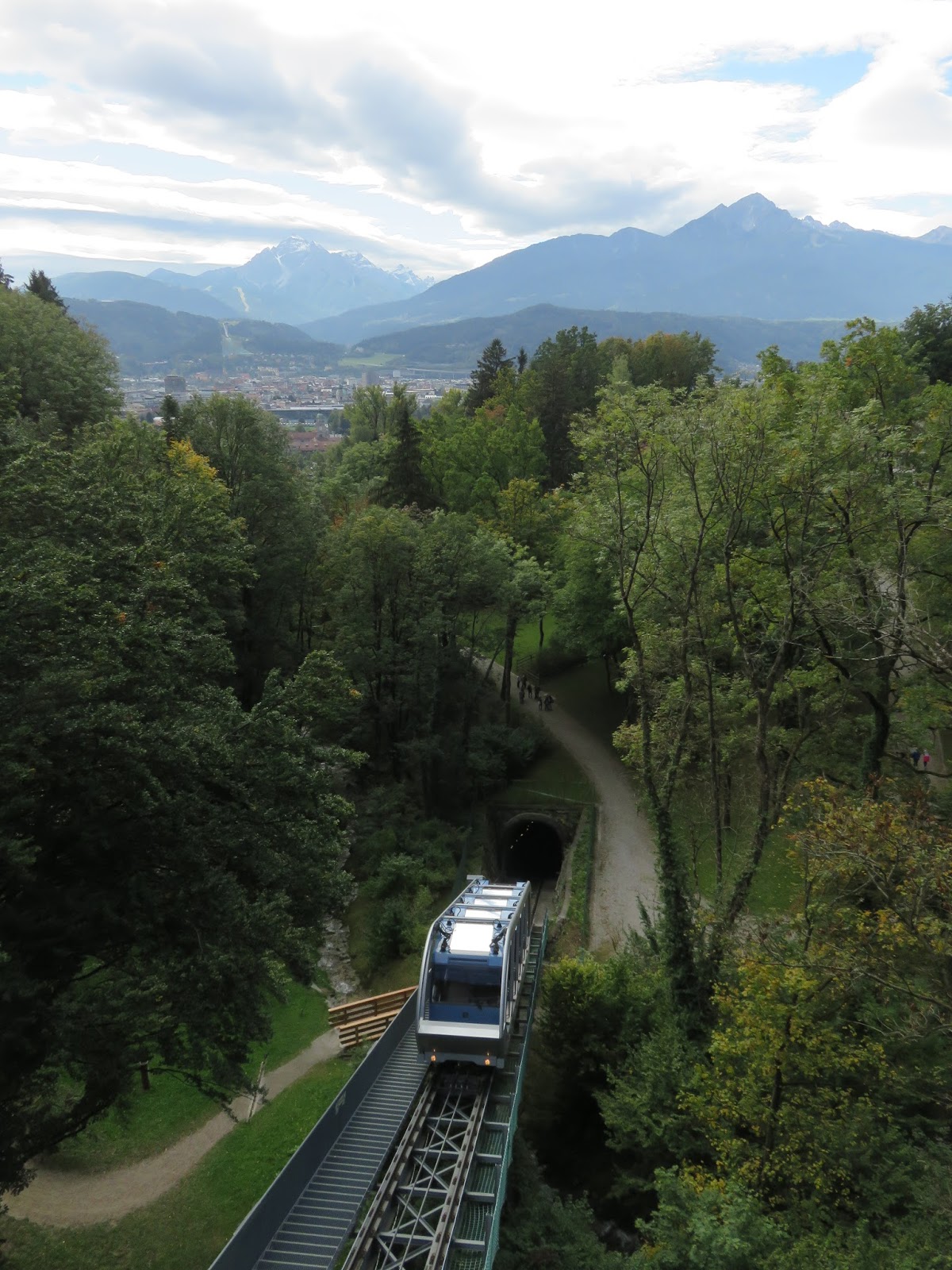
Innsbruck itself is a postcard town. Nestled in the Inn valley and straddling the river of the same name, I am sure that in winter, covered in snow it is also magical. Host to 4 winter Olympics and playing its part in history as a place where rulers could control access through the passes of the Alps, the connection to the mountains is evident through their cable car systems and public transport network. A simple tourist must is taking the STB tram from Innsbruck to Natters (in the south, and our intended campsite). The winding tram gives beautiful views of the mountains to the north, and cuts through the mountains in the south.
We did that ride on our second to last day (a Saturday), and then walked from the township of Natters to the nearby Nattersee campsite & lake.
 |
| St Michael's Church, Natters |
On the way, we encountered a ski jump event for kids. It is not yet winter, and I have to confess I have always wondered how you train for winter sports without any snow. The answer seems to be "you just do the same thing, but without snow!" The kids flew down metal rails on their skis, launching themselves and then landing (we only saw one crash) on a sort of furry fake grass thing that slowed their descent before hitting a bark-laden incline where they stopped. The place was a lively hub of activity with coffee, cakes and baked goods and parents all around clapping and cheering them on; I shouldn't be surprised, it was Saturday after-all, so it was probably just the equivalent of any old cricket or netball event at home!
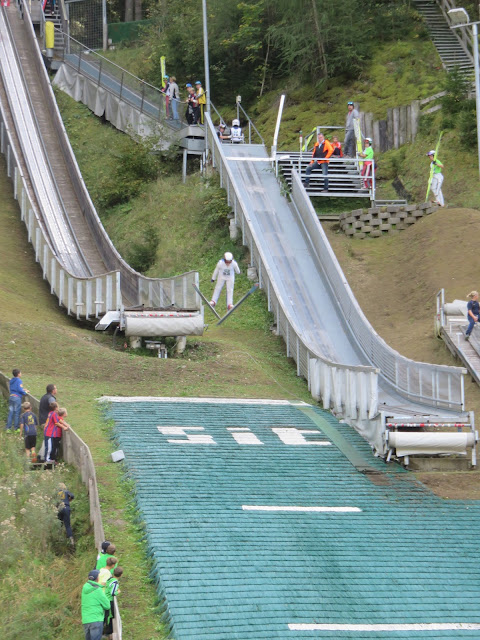 |
| Child launched off the ski jump |
Innsbruck's cathedral is striking, even after the damage cause by the war. From the baroque and intentionally deceptive outer windows to its pretend-domed ceiling the artwork is something to admire (I might have even hurt my neck!). The gleaming alter and its center-piece surrounding the Maria Hilfer were reminiscient (for us) of the Santander cathedral. Little wonder that this is another place pilgrims on the Way of Saint James have and do visit on the long road to the Compostela de Santiago. We visited as part of a walking tour. Our guide was brilliant, although she had to manage two groups at once, a German-speaking and the smaller Australian-speaking group. The other Australians were a friendly couple who were on their own 6-week holiday mainly of the battlefields of the Western Front, they were on the tail-end of their holiday, visiting Innsbruck before returning to Münich and then home to Sydney.
The tour was quite short in distance covered, but not on the detail. It focused a lot on the Roman Emperor Maximillian I, who seemed to manage a lot through his various titles in the late 15th to early 16th century - a period of 60 years. That was a time when country borders looked nothing like today, and where marriages to secure treaties and hold over land were still all the rage. I actually lost track of all the arrangements he made, both for himself, his children and grandchildren - at one point even marrying Anne of Brittany by proxy (PROXY!)
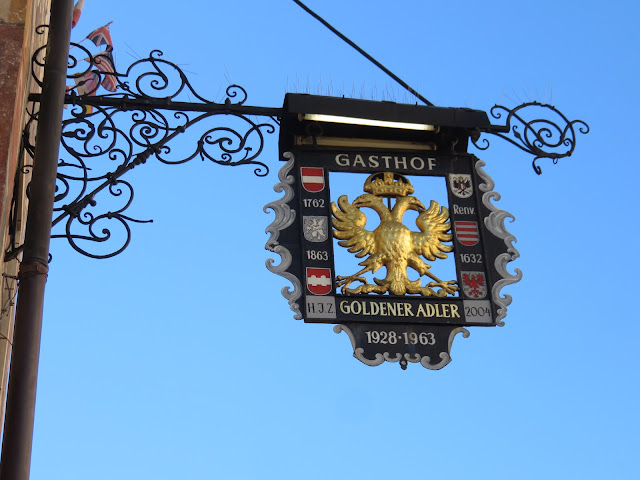 |
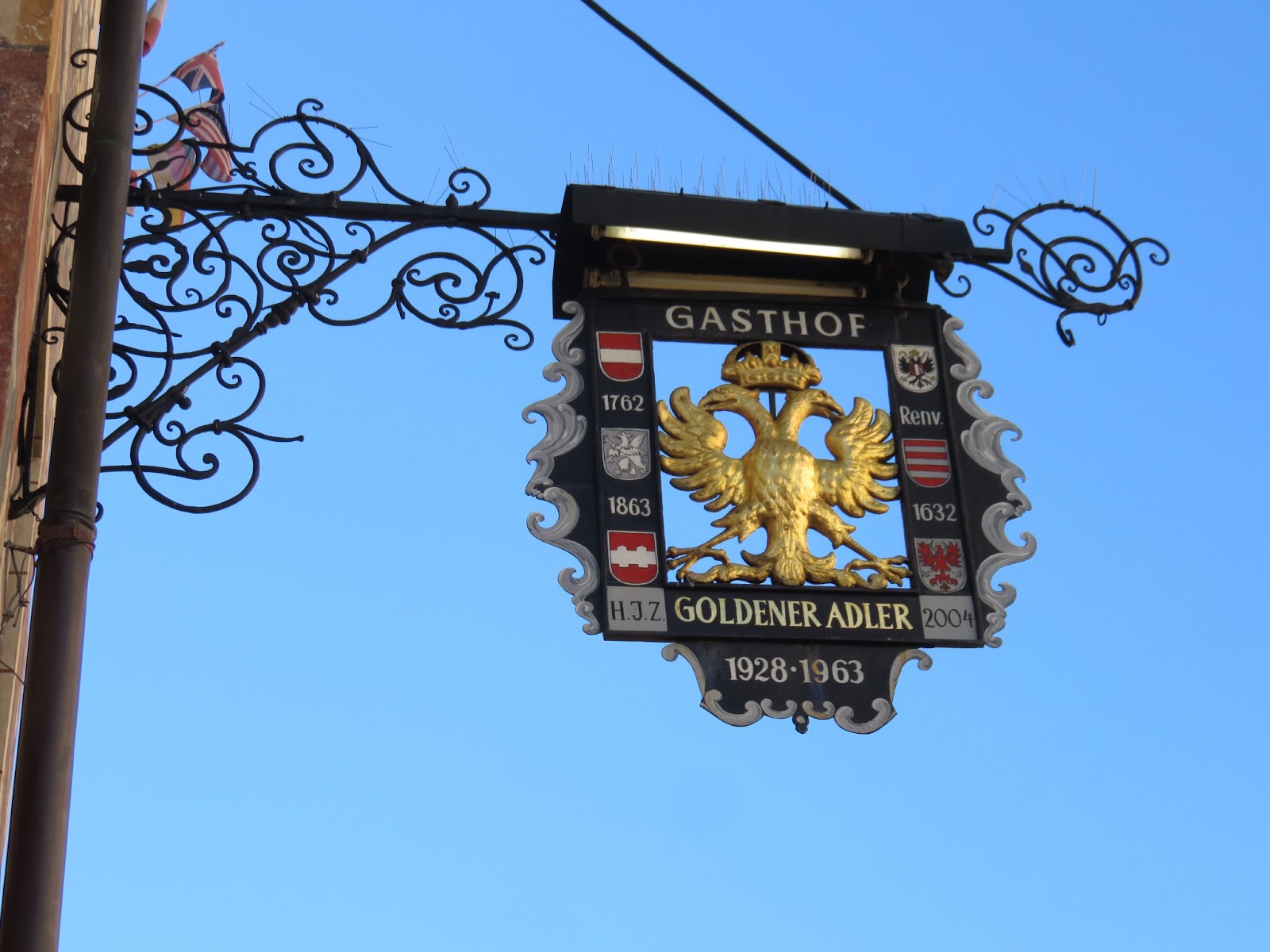
| Regular meeting points, a coat-of-arms is a bit easier when you cannot read! |
Max left a big imprint on Innsbruck and built the Golden Roof, a central landmark overlooking the activity of the market in what is now "Old Town". It sits just by the City Tower, which survived the 22 air raids Innsbruck suffered WWII. We climbed the Stadtturm (City Tower) which is taller than it looks, and enjoyed great views of the nearby cathedral, town and surrounding mountains (but, really you can see them from anywhere in town). From here the city watch was to declare the hours and watch for fires, the last city watchwoman only retired in 1967.
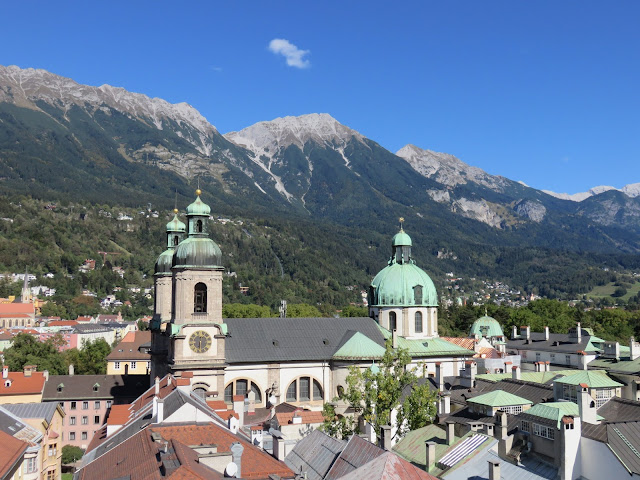 |
The Cathedral from the Stadtturm
 |
| The Golden Pavilion from the Stadtturm |
|
Innsbruck has a population of some 130 000, of whom 30 000 are students. There was certainly a lively feel about the place, and it was so easy to get around by bus. Actually, one day whilst waiting at the bus stop a woman stopped on her way to offer us plums! Typically Kat had been told not to eat fruit until she was better so had to refuse. I solely reaped the benefits of the mountain plums- well, I have assumed the source of the fruit based on the lady's enthusiastic gestures- and after gobbling one, she offered me another. These are the moments we often forget to blog about, but are probably the ones we will always remember.
Our best experience (after the plum lady) was on the cable cars and looking down on Innsbruck from Hafelekar station. Within an hour, you can take a ride on the cable car train from the Congress station past the Alpen zoo to Hungerbergbahn, from there you change cars and ride up to Seegrube and with a final change, ride on up to Hafelekar. Making a 1600m climb in what feels like no time at all.
 |
| A departing cable car/tram/train/rollercoaster |
Once at the top we could see across to Germany, and were free to wander from the Hafelekar station to the peak Hafelekarspitze with a view over Innsbruck but also to walk down to the free ropes course where eager climbers can embark on a 3-5 hours fixed rope climb. We satisfied ourselves with walking, and learning about the rock formations and how they developed.
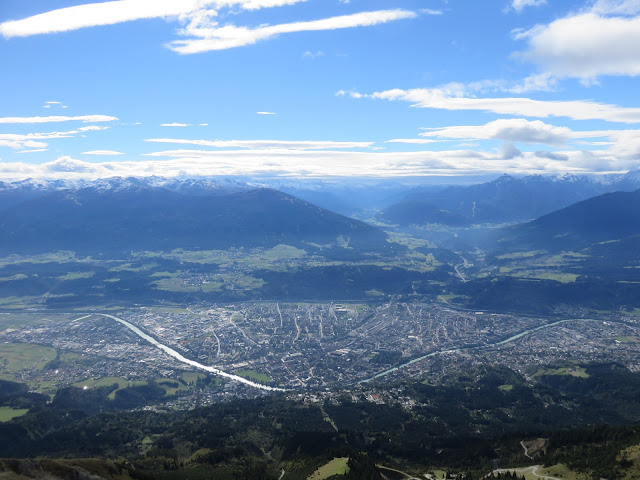 |
View of Innsbruck from Hafelekar
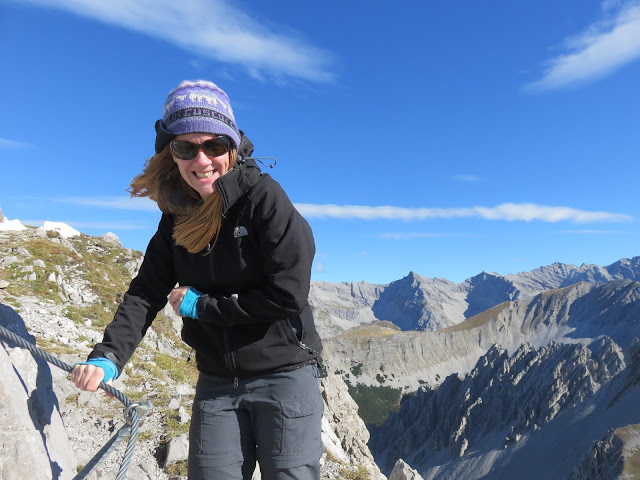 |
We picked a windy day, glad for cable hand-holds!
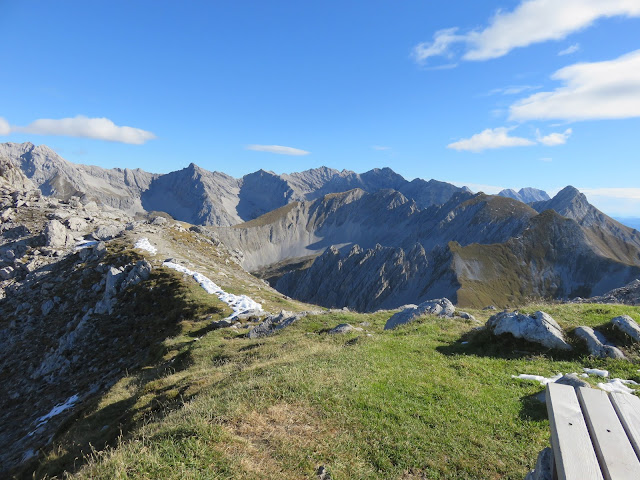 |
| It used to be a coral reef! |
|
|
Maybe one day we'll be back to see the place in winter!