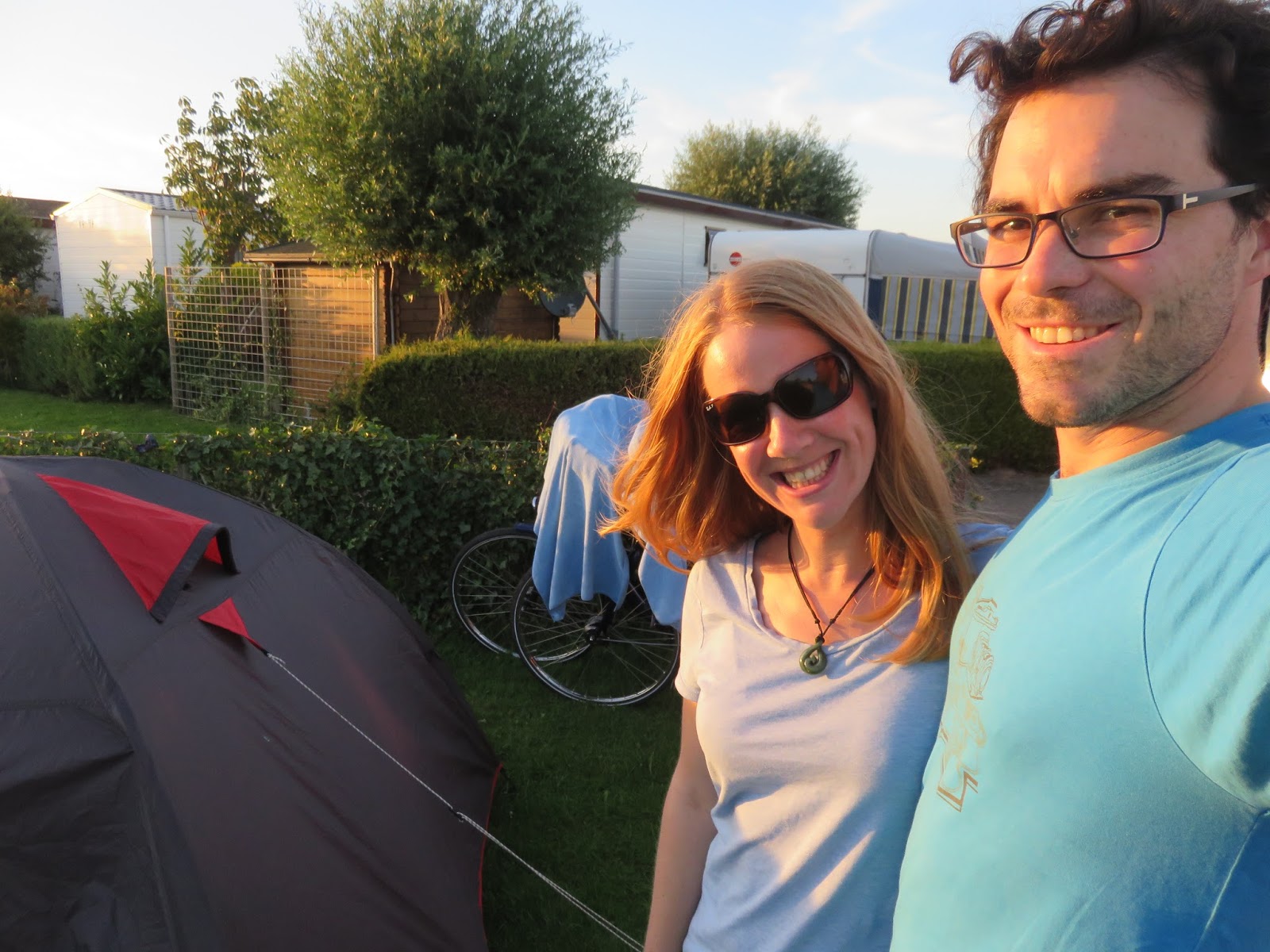
We had some excellent weather in the Netherlands. It was perfect for cycling around the country and that is what we did:
 |
| More or less our 6 day cycling route |
Day 1 - Utrecht to Rotterdam
Setting out kind of late we were again excited to be on bicycles, this time tent and clothes in tow. We had a map and although we would get lost a few times, the signage in the Netherlands is excellent (for pedestrians, cyclists and drivers).
 |
| Blue skies and cycling! |
 |
| Look over there! |
Not only was the weather stunning but just about everything else was ridiculously scenic and lovely. I am not exaggerating when I say most people's gardens look like Australia's wineries*. I don't mean in size but in the care that is taken to manicure a lovely, welcoming setting. I really didn't see many exceptions.
 |
| Traditional Dutch house and baby windmill |
 |
| Thought this statue was great |
 |
| One of many, many lovely canals |
* Not to say Australians don't keep lovely gardens. They do, just not with the same consistency as the Dutch. Who to be fair, have a lot more water and probably better soil!
It was not long before we stopped for lunch. In fact, we were still in Utrecht Province at a town called Oudewater. There appeared to be a lot of witch shops and the like. Later I found out that the town hosts some "Witches' scales." During the 16th century people accused of witchcraft would come to weigh themselves to prove their innocence and avoid being burnt on a stake. The idea behind the scales is that a witch weighs less than a normal person because they have no soul. Anyway, we knew none of this, failed to get our certificates of innocence and may well be witches.
Deciding not to muck about, we hopped straight into some wine and a cheese board. It was delightful. It must be noted though that this was when we first became aware of the slight bee annoyance that would follow us our whole trip. (Where there are flowers there are bees.) Luckily we spotted the local technique of trapping bees in an empty glass or bottle. The trick was to remember to let if free when you left or the waiter would be in for a nasty surprise!
 |
| Enjoying the sunshine in Oudewater |
After lunch we were on our way into South Holland, keen to stop in Gouda to check out the birthplace of the famous cheese. (It is also the home of Stroopwaffles!) It was mostly quiet with noone about except for the main square. Seems like lots of the locals were holidaying on the coast or elsewhere. We poked around a bit, ate some cheese and moved on.
 |
| Mmm cheese sign |
 |
| Gouda's gothic city hall |
Rob was first introduced to the clever processes the Netherlands use to manage their water challenges back in 1994. Having never been myself I was pretty interested to find out more about how the various mechanisms work. We saw the lock shown below on our first day as we headed towards Rotterdam. We watched how they reduced the water level so it would be level with the side they wished to enter. It took a fair while but I suppose traffic lights can too!
 |
| Watching how the lock worked |
Cycling on we made it to our destination Rotterdam. Ready to eat and put up tent (probably in the opposite order), we kept on cycling right to the edge of Rotterdam zoo. Our campsite was pretty standard but the woman that checked us in was extremely friendly and very excited to give us tips for Rotterdam. Desperately thirsty and hungry, after 10 minutes of advice, we had to cut her off! Deciding to eat at the campsite was not what she had in mind but was what we did, vowing to make an early start and explore some of Rotterdam.
Here is a CRUCIAL camping tip for the Netherlands: They usually do not supply toilet paper. They seem to have absolutely everything else: restaurants, convenience stores, game rooms, mini-skate parks, bike hire, just not toilet paper. You can often buy it on-site but its a useful thing to know beforehand. (Sometimes they have a spot for it but just don't provide it.)
Day 2 - Rotterdam to Scheveningen
The next day we searched high and low for a breakfast spot. Many of the cafes were shut until we got right into the centre of Rotterdam's port. We had aimed to go to market square and ended up there for breakfast. Markthal, the "Sistine Chapel of Fresh Produce", is a new, exciting building that hosts 230 flats and a huge food market underneath. The eye-catching ceiling has images of fruit, vegetable, plants and animals; as well as apartment windows peeking through. I thought it was pretty impressive but did wonder how long it would be before it started to date.
 |
Markthal ceiling
 |
| View from the outside |
|
Due to the devastating damage of the Rotterdam Blitz in World War II, the city's building are all, relatively speaking, new and modern. I think it is interesting that the decision was made to demolish the city and start afresh, providing space for innovation and improvement. Across from the Markthal there are yellow cube houses poised on an angle over the main road. The cube houses, Kubusewoningen, designed by architect Piet Blom, were inspired by the idea of living in a treehouse in a forest. Each cube represents a tree-top. The space is now used for small offices, a museum for interested tourists, a youth hostel and social housing. More on Kubusewoningen here.
 |
| Kubusewoningen |
 |
| Underneath Kubusewoningen |
From Rotterdam we cycled a relatively short distance to our campsite for the night, near Scheveningen. The Netherlands has some "wild camping" spots scattered around the place and we'd picked this one due to its close proximity to the Hague. Unfortunately armed with the coordinates and a description of where to find this particular designated area, we absolutely could not find it! AND this was after an initial wrong turn that led to a one hour scenic route. (Luckily not just a figure of speech here: it was absolutely scenic!) We found the general vicinity of where it was meant to be and split up, searching high and low, in and out, round and about. Eventually we found a football golf centre where we asked for help. We got precise directions to "the woods", still had a bit of trouble, and finally ran into a teeny tiny sign showing us we could camp. It was by then late afternoon so we quickly put up the tent and cycled into Scheveningen for dinner. Coming back from dinner we were startled out of our skins when another voice came out from the trees near our tent. Turns out we had evening companions who had managed to find the site and even later than us! What a night we were all in for as a dramatic storm thundered down around us.
 |
| Triple windmill |
 |
| Traditional tent photo: "wild camping" |
Day 3 - The Hague to Zandvoort
We got into the Hague fairly early for a morning coffee and the news. Looking at the pictures in the Dutch newspaper l saw that there had been an horrific accident the day before where two cranes had fallen, flattening houses. A dog died in the accident but amazingly there were no other fatalities or injuries.
Given the adventures of the previous day (i.e. getting lost), we did not spend a great deal of time exploring the third biggest city of the country and is the seat of government in the Netherlands. It was pretty exciting to cycle right into the political centre of the country at Binnenhof. I kept waiting for someone to stop me. Then I remembered I was in the Netherlands. They weren't going to tell me to get off a bicycle!
The buildings of Binnenhof were really something special and we spent a little while admiring them before cycling through other parts of town. Before coming the political centre, the Binnenhof was originally the residence of the counts of Holland. The Ridderzaal is the main building of the Binnenhof and was built in the 13th century. Amongst other things, Ridderzaal is used for the state opening of parliament where the monarch delivers the speech from the throne.
 |
| Outside the Ridderzaal |
 |
| Binnenhof and Hofvijver lake |
TO BE CONTINUED....