Showing posts with label challenging. Show all posts

Saturday, 21 March 2015

Volunteering in Ho Chi Minh

One of my aims for our big trip was to spend some time in the one spot volunteering. I chose Vietnam simply because I enjoyed my short trip there in 2008, knew it would be a good place to be for a month and I thought Rob would enjoy it too. (We were also very lucky to have kind friends living in Ho Chi Minh that put up with us for the month! Thanks again Tim and Steph!)


Prior to organising my volunteering and even leading up to it, I was not sure what I wanted to do exactly. I didn’t set out to work at an orphanage and was not sure what I could offer. Now that I have finished my volunteering, I really hope I provided something of value to the children, teenagers and young adults I worked with.


I organised to volunteer at an orphanage in Ho Chi Minh after corresponding with a Professor at one of the city’s universities. I had gotten in contact with him after discussing volunteering with a Vietnamese attendee of the International Social Work Conference I attended in 2014. The Professor knew the Director of the Orphanage and arranged a meeting with her for a few days after my arrival in HCMC.


After the meeting I was still not sure what I would be helping with but the next day I turned up and was led to the church next door to the orphanage. I was not clear on why I was going there. It turned out that by being led from place to place by one of the teenagers was how I to figure out what the routine of the orphanage would be.


Most mornings I would go straight over to the pavement in front of the church where the children would play. Sometimes they would just stand at the fence and watch the world outside go by. (They do have excursions outside the orphanage but aside from these they spend all their time inside the orphanage’s walls.) After this they would have a drink and some of the teenagers/young adults would head upstairs for school.


The classroom was where I found myself at 8:30am on my first day. Apparently I was going to be teaching English to student’s aged 13-21! Not something I have trained in or felt like I would necessarily be very good at. “That’s okay,” I thought, “I must be here with a teacher who speaks Vietnamese or how else will I communicate?” I was wrong in two ways! A teacher with some English would be there most days (but not my first days) and I did find many ways to communicate. On a few occasions, I was lucky to have the assistance of an older student.


Initially I thought, “They have made a terrible mistake! Do they think I am a teacher?” However, I decided to give it a go for a few days and then I could always ask to assist with something else. A few days passed and I felt I could rise to the challenge and hope that my students would get something out of my classes. At first it was difficult to tell what each student already knew and they varied so much in age, maturity, attention spans and capability. They were a little bit shy at the beginning and mainly just stared at me but I think I grew on them! If nothing else, they enjoyed the games I made for them and loved singing songs. It was a challenge making up educational games with limited resources. (One problem was that the fan would blow away most of what we tried to use. However, if we turned it off it got far too hot.)


Making a shapes game

After the morning class the students had lunch at 10:30. Staff and volunteers had lunch from 11:30-12:30. Then it was time to rest until 2pm! (A wise move due to the heat.) Every day I walked past the cats and kittens that lived at the orphanage. They got the leftovers from lunch.

 
Cats in their usual hangout
At first I accompanied my students to lunch, unsure what I was really meant to be doing. I did this a few times and although they were happy to see me there, I felt I could be more use somewhere else. It was then that I started to visit one of the rooms upstairs that some of the other volunteers were in. It was a room for the babies and young children mostly confined to a cot due to some form of illness, disability or special need. There were a few babies with hydrocephalus (fluid build-up in the brain), some with cerebral palsy, some with epilepsy and other things. I came here for 1-2 hours on most days and played, sung and cuddled the babies and children. I discovered one boy who was completely blind was in desperate need of some sort of audio stimulation and really enjoyed more upbeat songs like Mario Kart, The Simpsons and Postman Pat! A typical day of volunteering involved singing Twinkle twinkle, Insy Winsy Spider, Open shut them, Five little ducks and the Rainbow song multiple times a day with babies aged 6 months to adults 21 years.


In the afternoon I took two teenage boys aged 13 and one 21 year-old woman for reading class. These three, it appears, were chosen because they showed the most aptitude for reading English.


The kids and teens at the orphanage are incredible. It is amazing how they work together to get through their everyday routine. One teen whose legs are amputated at the upper limbs is helped up two flights of stairs in a wheelbarrow type fashion. Once at the classroom, all students are expected to make their way to their individual seats and desk. This is extremely physically challenging for at least half of the teens I taught. They are exhausted before the class starts and yet they are keen to learn and interact. Students that have difficulty with a cup of water are helped by another student. When I cannot communicate something to a particular teen or them to me, another usually came to my aid.

Some of the wondeful students and me

It was rewarding working out what each individual enjoys most. One of the older girls, really a young woman, loves “once I caught a fish alive” and another (I think slightly younger) loves to be twirled around in a dance. One of the younger boys who I was told had psychological problems, was enthusiastic about learning anything new and learnt very quickly. I wondered how much more he could do with the right supports in place. (Unfortunately, that is true of most children there. Although I have found there are a few good programs in place.)


I have also been fortunate to see the commitment by many of the staff members who work long hours with many more tasks they can fit into that time. Although it is clear that some are overworked and in serious need of a break, many still have a smile for a child or arrange something fun to keep them occupied.


Monday mornings were playtime for many kids at the orphanage. Firstly the group would sing songs and dance in a undercover outdoor area. The chicken dance was hugely popular and they also had eating contests (which maybe sounds odd, but it wasn’t). Then it was free-playtime. Every playtime was different; sometimes I would be hanging on the swing with a toddler or playing catch with a teenager or trying to stop a little girl from getting in the way of the plumbers.


One playtime sticks in my mind. I went to visit three children (perhaps aged around 8) who were positioned against the wall in their wheelchairs to watch the everyone else. A carer motioned that I should come closer to one particular girl. When I got there she didn’t react initially but soon we were dancing to the music. Shortly after that the boy behind her put up his leg in the air and waved it up and down, laughing. Nothing like a song to reach through numerous barriers at once.


Many of the children at the orphanage had special needs and of these several were affected by dioxin (see our previous related post). Two of older babies with hydrocephalus had shunts inserted into their heads but many others had not received the crucial medical treatment that could improve their lives. The prognosis for many was grim and this was very sad.  


During my month volunteering I tried to find out what the future possibilities were for those at the orphanage. I heard about a few of the toddlers getting adopted during the time I was there. Some of the other volunteers told me how there is policy change in the pipes that should mean that children with special needs and older children are more likely to get adopted than is currently the case. Some of the staff at the centre grew up themselves at the orphanage and have evidently worked hard to get where they are now. Unfortunately many of the children will not be able to find the support and opportunities they need to gain independence and an increased quality of life. From what I know, many will move to institutions for their adult lives.


There are a few positive social initiatives I heard about during my volunteering time. The best ones, in my opinion, teach skills that increase the opportunities available to someone. “Teach Me to Fish” run by Kids With No Borders is one such project. It provides scholarships to support orphans when they leave an orphanage at age 18. Scholarships support them with continued education, specifical vocational training, health care and other everyday living necessesities. Koto, another program, is based on the idea that learning should be passed on: "Know One, Teach One." It gives disadvantaged youth in Vietnam the chance to train in hospitality.

Colourful dress

Another aspect of my volunteering was meeting some great people. There were quite a few volunteers either living in Ho Chi Minh or those that regularly returned to the orphanage. Some split their time by their country of birth and Vietnam. Near the beginning of my time volunteering we took a lunch time trip to a nearby temple. It was a big celebration with lots of food, colourful dress, music, readings and many offerings. Unfortunately, despite our best efforts, we never found out what the festivities were about! 
Music and ceremony

I enjoyed my time volunteering and learnt a lot from everyone there. It was great to see the student’s progress. The month went by very quickly and I found it very hard to leave. I hope I made some sort of difference by volunteering. In a discussion with one of the other volunteers who had come back for a third year, she said that she thinks of her work there as planting a seed. For her, this involves spending time with a child and joining in a smile with them. I feel like the students gave me so much. Hopefully I too planted some sort of seed.

Friday, 6 February 2015

To Tibet Mustang!

It is significant that we should have recently shared the story of how our blog got its name, because we did not have to wait more than a day from our arrival in Kathmandu that we should see it in action, in all its fist-shaking glory.

Not only were we unable to book a tour to Tibet, within a few days our alternative trek to and within Upper Mustang (a place home to many Tibetans and their descendants) was thwarted by natural causes, not to mention some bad planning and to a certain extent a little bloody mindedness.


Travel Dream! "Be a Buddhist in Tibet"... sort of. 
Rob is not a Buddhist nor in Tibet, but we got close.
Let's take them in turn. I had investigated organising a tour to Tibet some months ago, and came to the conclusion that it may be far simpler to engage a tour company in Kathmandu that could do the running around with visas, passports and the extra special Tibetan Entry Permit cheaper and in many less days than it would take me to do from Australia.  A person of exactness or certainty may not have taken this same approach, but, what can I say, I can be a little odd when it comes to shelling out the greenbacks.


Buddhist prayers flying high in Kagbeni
The first problem arose when it became clear that the Chinese government, had that week announced that they were no longer issuing visas or Tibetan permits for foreigners to enter the "Tibetan Autonomous Region".  This is not uncommon, the problem is just that they usually do it in March (or so I have read and been told), not in late January. As we did some shopping around, it was not immediately obvious that we could definitely NOT go to Tibet, but in the case of each tour company we visited, a single phone call resulted in them resolving to sell us other options.  The reasons given were various ("it is the Chinese New Year, so the area will be full of Chinese tourists and they don't want foreigners there", "because of the weather", and most resignedly "who knows why the Chinese government does these things?") but all amounted to the same thing (not going).


The streets of Kagbeni through Kat's eyes
Luckily, or so we thought, one of the alternative travel dreams, was to take a trip to Upper Mustang - a region I have heard so much about and been jealous of friends' photos.  Friends from my work at Tilganga had been there, other volunteering friends, even my brother (Tim) had been to Lower Mustang and he was only ever in Nepal for about 2 weeks!  Additionally, Upper Mustang itself has traditionally had very close roots to Tibet through religion, trade (the Tibetan-Indian trade route has gone through Mustang for centuries), war, and as the home of refugees, settlers and squatters.  A trek there would not only allow us to see a dramatically different landscape to that of the Annapurna Himalayas, it would take us in to Lo Manthang - a town of many Buddhist monastaries), within kilometres of the Tibetan border.  Upper Mustang also maintains its own figurehead king who judges on disputes and has a certain responsibility for the people in his region (despite the obvious contradiction this presents since the abolition of the Nepali monarchy in 2008 with the rise to power of the Nepali Maoists).


Upper Mustang Permit Required!
Permit required!
Let me be clear, this was not an inexpensive alternative to a Tibetan tour.  The Upper Mustang permit is prohibitively expensive ($US500 per person), but, one hopes, that this has the added benefit of preserving the culture of the region, while still taking in income for preservation and restoration purposes.  Without too much dallying, we set about the process of booking the trek and making arrangements meet  our guide Krishna in Pokhara, on Feb 3 to start out on Feb 4, following on from our Poon Hill & Ghorepani trek.


Rob and Krishna in an awkward backpack embrace


Feb 4 started us out with an amazingly scenic flight from Pokhara to Jomsom, the district headquarters for Mustang.  In that rickety flight where we ascended but never really descended (the plane just landed - think about that) we were treated to a view of all the main stops of our Poon Hill trek over the prior 5 days.  We had breathtaking views of Nil Giri and the Annapurnas right out the window as we wound left and right through the ranges to our destination.  After a few checkpoints the backpacks were on and we were trekking (all by 9am), the day's ultimate destination was Kagbeni, a Hindu/Buddhist town on the intersection of the Kali Gandaki and the Mukti Kola (rivers).

A plane ride that could not be captured on film
Before we got up close with the mountains

Soon after is where we discovered that my bloodymindedness of visiting this region may have been inappropriate for the time of year.  From the outset, Krishna did point out that icy tracks could make the way difficult or impossible, but that his inquiries suggested that we would definitely make it to Chaile - the goal of our second day (Feb 5) and that from there we would need to take advice.


Kat's view of Nil Giri and Kagbeni
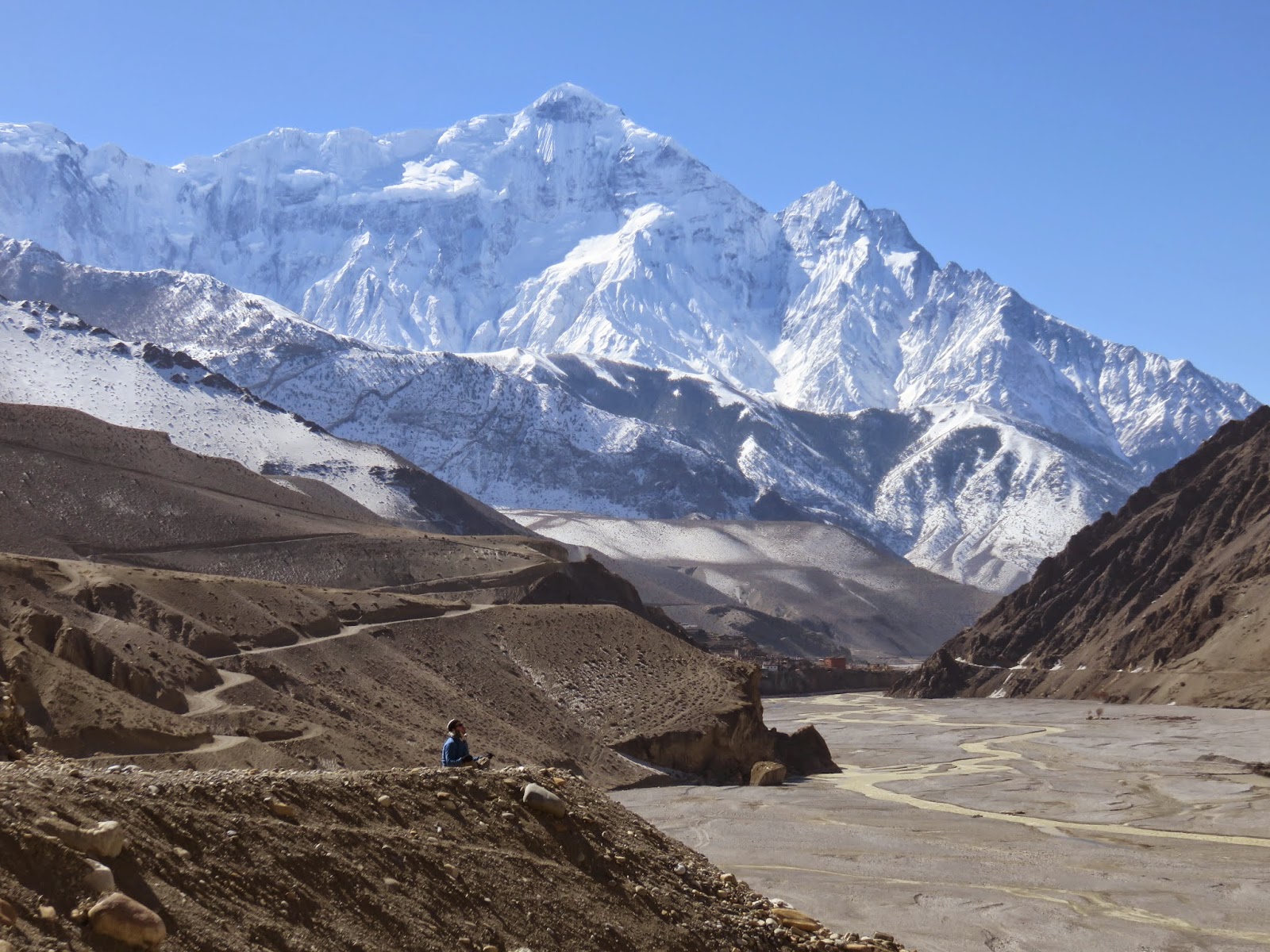
Sadly, this was not to be, and where the second problem developed (or more accurately, where the second problem was discovered).  Having stamped our newly minted and expensive Upper Mustang permits at the border of Kagbeni (for this is the entry point from Lower Mustang to the highly restricted Upper Mustang) and checking on the quality of the road ahead, we discovered that we were the first trekkers to enter the region this year and that "the road ahead is rocky and icy, be careful".  We managed to make it about 2 hours (of fairly consistent uphill) while freezing in the shadow of the hills before being confronted by 3 rockfalls entirely blocking the road that were relatively passable on foot (impossible by jeep) before a fourth that was too dangerous to really mess with.  At this point Krishna and I investigated this avalanche/rockfall and tried to find an alternative (over, under or through). Kat knew that we would not be going further into Upper Mustang and for some time waited patiently for us to reach the same verdict. Well, not so patiently it turned out. In fact, she had decided to test some nearby ice with her foot. Unfortunately instead of hearing one crack she heard two, she had rolled her ankle.

One of the rock falls we were able to pass


Resolving to hide our disappointment (and Kat her pain), and hungry for food, we slowly trudged and limped back to Kagbeni, where we would work out our next steps. Frustrated but also trying to look on the bright side, we were assisted by views of barren landscapes of contrasting brown, white and blue that we had to share with no one.


Brown, Blue and White


Wednesday, 4 February 2015

Poon Hill Trek

Day 1: Pokhara - Nayapul - Tikhedhungga
Sometimes trying to travel like a local is rewarding and exciting, other times it adds even longer to your trip than expected and can become frustrating! On the morning we were to begin our Poon Hill trek it was all these things. We ignored the advice of some to take a taxi to the bus stop and instead found ourselves on a local bus that not only stopped for every person that waived it down (as expected) but stopped for a good 20 minutes to pay a fine or bribe to the police when there were too many people on-board. Since Rob was last in Nepal they have apparently cracked down on overloading buses, especially people hanging off the roof of vehicles. We exasperated things by missing our stop. Luckily a kind Nepali took us by foot to our next bus stop and we, as often happens when you allow yourself to get lost, saw some lovely scenes along the way. 


Found: a soccer field with a view


After roughly 3 hours on the second bus, our first day of hiking began in Nayapul (which means 'New Bridge', but it doesn’t look that new). We began the route through some small villages with three Chinese guys, the only other trekkers we saw until the second day. It was warm, the air was fresh (I remember telling Rob that I would take the smell of donkey poo over city pollution any day!) and following the river was beautiful. We trod along, trusted a less than official sign and ended up stranded on the wrong side of the river. After scrambling up a steep cliff we righted ourselves only to make the same mistake less than an hour later. This was meant to be a short day but we certainly took the scenic route. The constant litter in otherwise beautiful surrounds began to get to me and I collected rubbish on the trail for some time.


Lost in the river

Waterfalls on the way


Whilst in Nepal, and as with past trips to other countries, we have reflected a lot on our privileged education. This has included thinking about how we learnt about how to look after the environment and minimalise pollution (as well as how lucky we are to have regular waste collection). The impact of two of my primary school teachers in particular have constantly come to mind. I distinctly remember the day my grade four teacher drew a river on the blackboard. She added stick figures and explained the problems of one person defecating upstream to someone having a bath, washing their clothes or drinking. I have no idea what context she drew this in but the image certainly stuck with me. What do you do if this is the environment you find yourself in?

My grade five teacher was committed to introducing environmental programs into schools and saw our school begin a chicken pen, a compost and raise money for environmental organisations. We have wondered how many generations it takes before pro-environmental messages begin to take affect. From our time here we know that there are programs where children are now being taught these messages but I imagine that it takes a long time for it to become the norm. It also requires systems to support such behaviour; there is some evidence of these. However, at this stage I suppose things are represented by a site we saw in one town: a road junction with a big sign showing instructions on separating different types of rubbish, surrounded by a large mountain of mixed rubbish.

Goat chaos near Tikedhunga
Back on track (!), we eventually made it past every obstacle (including a herd of goats) to Tikhedhunga. We had planned to go further on our first day and it turned out we were the only guests in a small teahouse for the night. It was quite cold but nothing compared to the freezing temperatures we would later experience in Muktinath. The teahouse was comfortable yet we were very glad to have our warm sleeping bags with us. Rob was excited to be back in a teahouse having milk tea with coconut crunchies and, of course, dahl baht.

Day 2: Tikhedhungga - Ghorepani 
Warmed up and overjoyed at the first proper tea stop
The next morning we had a nice chat with a man who did not give us his first name but asked to be called Mr. Gurung. (This is kind of like introducing yourself as Mr. Smith in Australia!) He had served almost 30 years as a Ghurka in the British Army and been to many counties across Europe, Africa, Asia, Australia and the Americas. It was interesting hearing his thoughts on politics and development in Nepal; the filling of the sandwich between the up-and-coming megapower breads of China and India.

After a Tibetan bread breakfast and a bit of a late start, we headed off. It wasn’t long before we reached a part of the track where the sun reached and our thermals came off. I think I will remember the first part of this trek by its contrast of cold mornings to later shining sun with views of white peaks circled all around. It really was a lot to get used to after the humidity of Malaysia.


Initial down hill morning trekking

On the way to Ghorepani, our resting place for the night, the route was mainly up hill and we started to see some ice on the track. For the last hour or so we walked with Mandy from Hong Kong and her over-friendly guide. Upon reaching Ghorepani we realised he was very keen for us to stay at a particular teahouse where he appeared to get some sort of deal for bringing us as customers. After some friction and Rob pointing out our independence to the owner, it was soon worked out. It turned out to be the best teahouse we stayed at with a fantastic dining and sitting area, a cosy fire the centrepiece of the room. We were also spoilt with a hot water shower that on the balance of things, given how freezing it was trying to get dressed after, was perhaps just worth the effort!

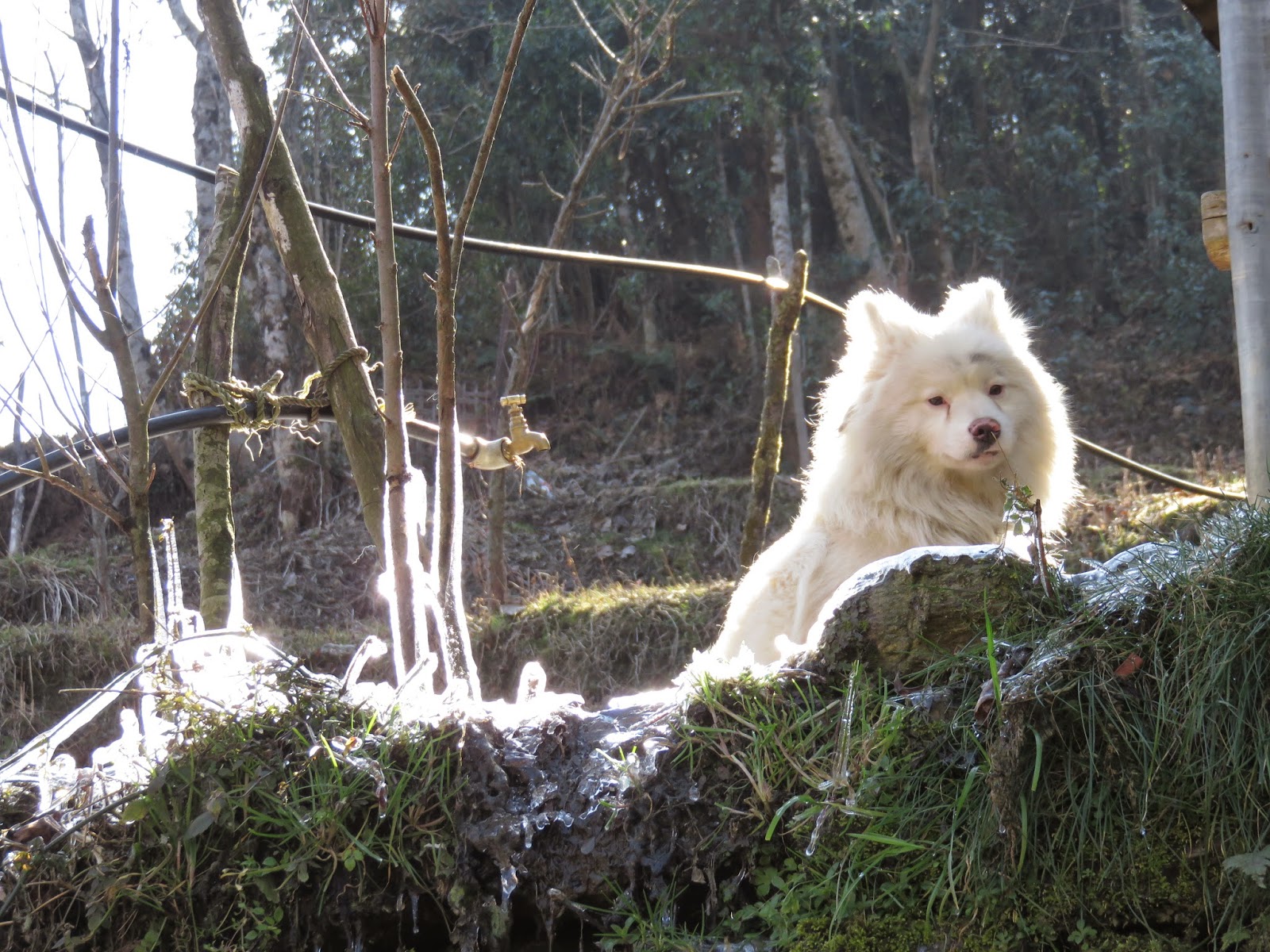
Getting colder: a puppy on ice
That night we enjoyed talking and playing cards with a Nepali guy (Ram) who quickly became known to Rob and I as: ‘Shhh I work in the army’ dude. We had been talking more than half an hour and about to settle down to a game of UNO when it was suddenly vital that he tell us this information in hushed tones before the cards were dealt. Becoming a Ghurka is not just a symbol of national pride but also representative of “making it”, with the opportunity of British citizenship and leaving Nepal if that is your choice.  It was comical how secretive he was about the issue, originally pretending to work in the UK “in IT” then saying he was doing the hike to become a guide, but at the same time it is obvious why he did not want everyone in the teahouse to know his position. He was a friendly guy and we caught up with him the next morning at sunrise.

Day 3: Ghorepani - Tadapani
Chocolate saves the day!
Our third day began nice and early with a 30-minute hike up to Poon Hill. (In Nepal, mountains have to be above 7000 metres before being considered actual mountains, otherwise they are ranges or hills!) We got up the top of the 3219 metre “hill” early enough before sunrise to lose feeling in most of our extremities. A pre-purchased chocolate bar reward and the most expensive tea in Nepal lifted our spirits as we waited for the spectacular view of the Annapurna ranges. It was a truly amazing sight every which way. Not realising that we would continue to be spoilt with beautiful views for the rest of the day, I did not want to leave Poon Hill. It was one of those moments where you knew you were somewhere special but could not quite believe the scene in front of you was real.
Enjoying a tea with the himals
I came out on top
Enjoying the view 
Stunning

Taking it in
As we descended the hill and across the pass towards our next destination, Tadapani, the mountains followed us! 


Treacherous icy paths
This was easily the most scenic day of our short trek. It was also the most challenging. After the pass, the track was pure ice. My method was to crouch and skate down using my shoes as a sled and snow gloves to aid. Rob took a more upright approach. Though both mostly successful, we each spent some time on our bums. 


We tried to help a terrified fellow trekker in converse sand shoes, Fang-La from South Korea, down the worst hill. She carried a hiking pole that was about as useful as a cricket bat and, for some reason, kept offering it to us. Despite our best efforts at aiding her, we soon watched in horror as she slipped and proceeded to slide and tumble, out-of-control down the hill for at least 30 metres. She nearly broke her neck but simply laughed, glad to be down the hill. We were glad (and amazed) when she reached the bottom in one piece.


Mountains following me
The view from our Tadapani teahouse was beautiful but due to the cloud we wouldn’t really see it properly until sunrise. Instead we tried to get warm near the fire. Unfortunately another trekker decided to continually stir up the fire creating an uncomfortably smokey room and smelled up our drying clothes. That night we again played UNO special rules, this time with a fun Spanish couple. They told us of there upcoming plans to visit Australia and we were interested to find out Adelaide was the key focus of their trip. They chose Adelaide as they wanted to swim with a shark or two there.


Day 4: Tadapani - Deurali
Good morning mountains
Huddling near the fire
This was our longest day. My held-up-fairly-well-but-kind-of-angry-knee was not exactly thrilled with the large amount of down hill. Poor Rob had to put up with my snail pace on the descent. However, in Rob’s words I “charged up hills like a mountain goat.” 


Slowly, slowly!
At lunch we were starving and outlandishly ordered some chips in addition to our more local food.  Nearby we saw some children with a multitude of rice terraces as their backyard. Imagine that being the norm! Mountain kids must think flat cities are terribly strange.
Lunch time!

What a backyard!


An Irish couple were the only trekkers we ran into on Day 4. We chatted for a bit and they gave us an Australian Open update (except that the climax was that they turned it off before finding out who won). Our walk continued to be scenic as we walked on to Deurali, arriving there just before dark as clouds settled in. This was our last night at a teahouse in Annapurna and it was spent in a very friendly family atmosphere, clustered around the fire learning from two guides about the new trail they were blazing to a place called Mardi.


Day 5: Deurali - Phedi - Pokhara
We left Deurali ready for a short few hours walk to Kande. Somewhere along the way we took a wrong turn and ended up walking further to Phedi. This should have meant a shorter bus ride however our bus was of the stop-every-10-metres variety. Usually none of this would bother us much but were very eager to get back to Pokhara because our Upper Mustang trek was due to start early the next morning and we originally had tried to plan a rest day so we wouldn’t be walking 20 days straight! It turned out to be a relaxing rest-afternoon in Pokhara instead. That evening we met Krishna, our guide for the Upper Mustang trek, and excitedly packed our bags, ready for another adventure.


Useful information if you want to do the Poon Hill trek:

Trek length: can be done in 4-6 days depending on pace. Don’t under-estimate how many large steps there are around Ghandruk. 6 days is probably best for a comfortable trek with ample time for tea breaks.

Our Poon Hill Trek (Blue line= trekking route, green line= bus route)

Guided tour or independently? May be good to have a guide to learn about different areas but definitely possible independently. We were told that soon guides will become a requirement.

Cost (all for two people):
TIMS permit: 3955 R
Annapurna permit: 4000 R
Transport to Nayapul: 290 R
Accommodation, breakfast & dinner average/day: 1790 R
(accom usually 300 R per night)
Lunch: 671 R
(NB You could easily double your costs if your purchased alcohol on the trek-we bought our own.)

Equipment: cold weather gear (gloves, beanies, scarves, warm clothes), trekking poles if you like them and shoe clamps would be useful but only for a small part of the trek.


How to pick a teahouse: This can be hard as there are so many in some villages. If you value hot water and a fireplace ask first. In my experience the teahouses were all quite comfortable.