Travel dreaming
Our second attempt at fulfilling a travel dream came off without a hitch! Rob had dreamt of visiting Chitwan National Park
since 2008 when he lived in Kathmandu. Chitwan is in the south-central region of
Nepal, near the border with India and covers approximately 900 square kilometres.
The park has more than 700 species of wildlife. Rob had heard great things from friends and was most excited about the possibility of seeing a rhino.
 |
| Where to find the animals |
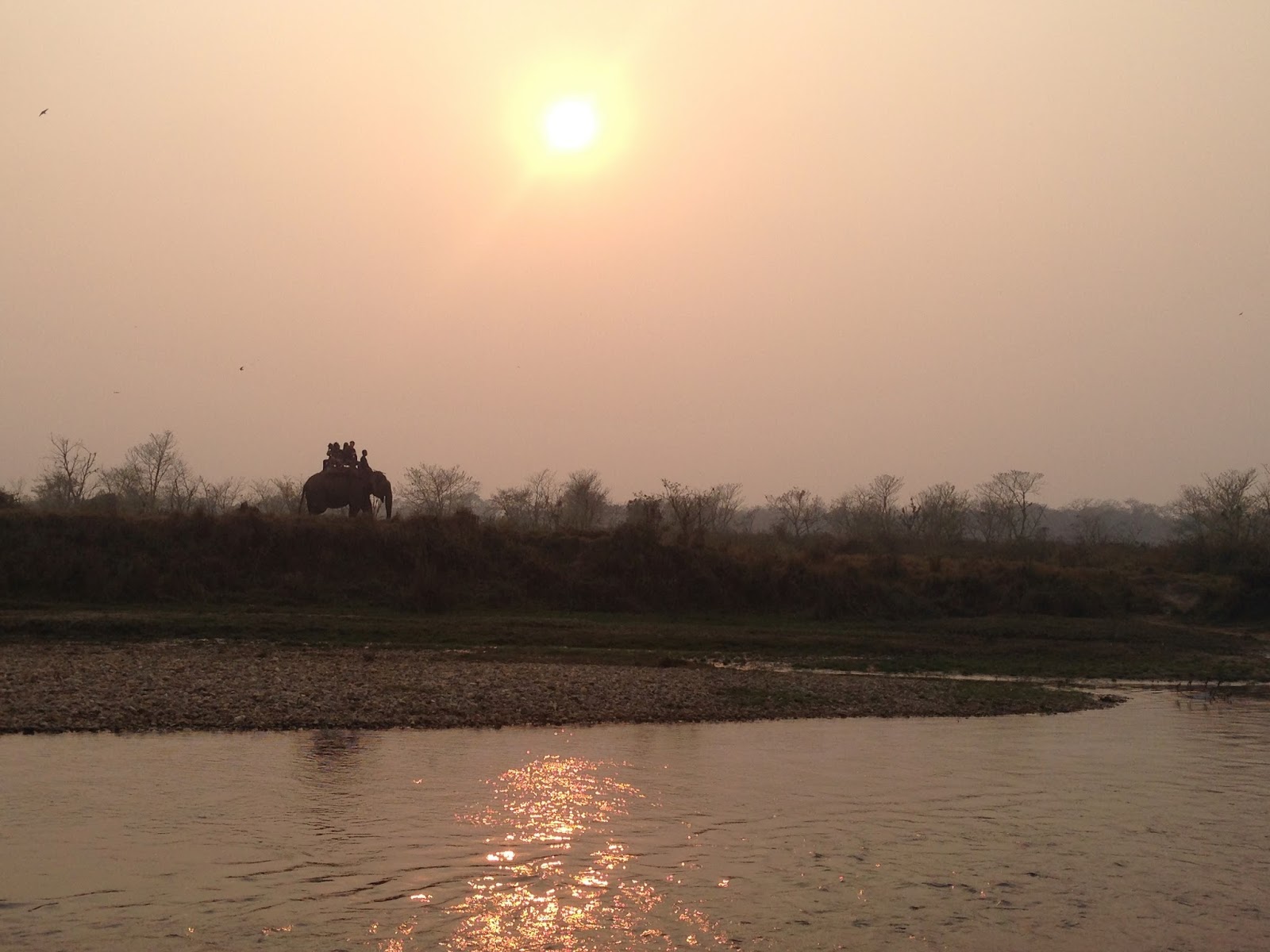 |
| First views of Chitwan National Park |
Pokhara to Chitwan
The bus ride from Pokhara to Chitwan saw me transporting
back and forth between Nepali towns in 2015 and a high school crime scene in Maryland
1999. I had finally taken up my sister, Sarah’s, recommendation to listen to
the Serial podcast (you should too!). Problem was I couldn’t stop listening
and went back-to-back through 4 episodes. Even during our road-side stop I kept listening as we treated ourselves to a Himalayan Beans coffee. (Yes, drive through's have arrived in Nepal.) I found the below sign a bit disturbing.
 |
| Read the bottom line of the sign |
On arrival at Chitwan we were pleased to
be in a more temperate climate again. Our accommodation was luxurious because
we had a discounted package from the Upper Mustang tour company.
The Mystery of the Brown Crack
Once we had lunch and settled in, we met Umesh, our guide
for the evening. He showed us around the village and the town before we walked
along the river. Umesh was an excellent guide, not only because he knew his
stuff and had a hawk’s eye for spotting wildlife, but also because he spoke to
me as well as Rob. (Often I have found that Rob is addressed in conversation.)
Near the river that borders the national park, Umesh spotted some deer with
antlers bigger than their bodies from a miraculous distance. He also pointed
out a “brown crack” to us at one point. Rob searched for it but didn’t see it.
The next day our second guide had indicated another “brown crack”, this time
Rob spotted it and then revealed the day before he had been searching for a
crack in the ground rather than a bird!
 |
| Rob searching for a brown crack! |
After dinner we attended a cultural dance show in a local
hall. There were some brilliant dances and odd audience behaviour. Our
favourite involved a high level of coordination and rhythm sticks. We think it
could have been interesting for Rob’s brother, Tim, who does and teaches stage
combat. After the show we went to a Food Festival that had taken over the town.
It felt a bit like that festival they do in Summer along the Yarra and sell the
same food you can get in the CBD for half the price. However, it was nice to
see how the town celebrated.
This is your breakfast!
On our second day we were set to take part in a boat ride,
jungle walk and jeep safari. Firstly we were greeted by the friendly waiter at
our hotel who was present at every meal and always exceedingly cheerful. That
morning when our food arrived at the table he dramatically declared, “This is
your breakfast!” This amused us since many times whilst travelling in Nepal we
often found ourselves not knowing basic things that were happening, for example
how long a bus would be stopping for lunch (or was it a toilet break?). Anyway,
whenever the waiter presented our meals I found myself saying “Wow” as some
sort of unconscious reflex that attempted to match his cheer. (The food was
fine but we had much better meals trekking in remote regions to be honest.)
Speaking of not knowing basic things, I think the confusion
that sometimes result for the tourist in Nepal was well encapsulated by a
scenario at Jomsom airport. Rob and I were waiting to go into separate male and
female rooms to be searched by security before boarding our flight. Two other tourists were ushered over to the
queues by their guide. Soon they were laughing and I heard one of them say, “I
thought we were being told to line up for the bathroom before our flight, not
security.” (In the end the small airport did not manage to rustle up a woman to
search the female travellers, so once all the men had been searched I was told
to go through the male entry. Noone searched me because I suppose security is
considered second priority in this instance.)
Tiny canoe chairs in the fog
Getting back to Chitwan, we soon found ourselves on tiny
chairs in a narrow canoe (made from the trunk of a silk-cotton tree) that threatened to tip with every head turn. We were
on a boat with three other tourists and three guides that liked to spot the
same birds and make the same jokes! (As a visitor to the national park you must
have a guide.) It was a foggy morning but were able to see a number of birds
before landing for our jungle walk. During the walk we saw more birds, including a few woodpeckers and some deer. I was pretty chuffed when I spotted a sole deer about ten metres off right near our path, before our guide.
 |
| Did we mention it was foggy? |
 |
| Cloaked in fog: our morning trek did not initially look promising |
 |
| Soon the fog cleared up for this explorer |
An elephant's life
A visit to the elephant nursery sanctuary was also a part of
our program but I was not super keen. In fact, I was hesitant about visiting
Chitwan at all because I had read negative reviews about the treatment of
elephants. In the end, we decided to opt for a jeep safari rather than an
elephant safari so that we were at least not supporting these practices
directly.
 |
| Elephant at his post |
 |
| This guy came directly over to me once unchained |
 |
| Daily trip to the forest for the elephants to collect their food |
The visit to the nursery was amazing because I had not been that
close to an elephant before. It was interesting to seem them interact with the
mahout who unchained them and took them to the jungle for feeding whilst we
were there. It was also quite sad seeing these elephants with their front legs
chained together and, more so, once I read about how they were trained. An elephant calf is initially isolated from its mother and food and water is restricted. The calf is chained as not to harm the trainers. The elephant is taught vocal and signal commands and may be injured during training. I have read they
use punishment here rather than the positive reinforcement used to train elephants
in other places.
 |
| Commands taught to elephants |
However, the flip side of the coin is that the trained elephants do some important work. I have since read that in the past few years, Chitwan has reduced the level of rhino
poaching (rhino horns are falsely believed to have medicinal benefits by some and thus
are very valuable and sought after). Elephants are used by the army to patrol
the national park for poachers, rescuing people from flooded areas and counting wild animals. Unfortunately it seems they are also used in polo games. It really made me question how we see the training or domestication of some animals as okay but not others. I suppose I think that training elephants is okay as long they are treated well. I am not enthusiastic when they are trained purely to entertain tourists.
Our jeep safari started off slow as we entered the outskirts
of the park. Though I had deliberately set myself low expectations for wildlife
spotting, I started to wonder if we would see much at all. I remember saying to
Rob that the dried coconut we were munching on was the highlight so far!
Thankfully our luck improved. In 4 hours on the jeep we ended up seeing one
rhino, one python and many crocodiles, deers and birds. We were very close to
the rhino who did not seem to be perturbed by our presence. The poor guy had
lost his horn. Our guide told us this was due to bats which confused us. We had
read that if rhinos are poached for their horns they are usually killed in the
process. We wondered if perhaps the park rangers had removed the horn to
protect the rhino, but we were told they don’t do that at Chitwan. So we are
not sure why the one-horned-rhino was in fact hornless, but we are pretty sure
that bats had little to do with it. It was amazing to see both the rhino, deer
and crocodiles up close.
 |
| We saw a rhino! |
 |
| Oh Dear! Missing our camera and a phone camera did not cut it! |
Crocodile Sanctuary
Mid-way through our jeep safari we stopped at a crocodile sanctuary. Initially I was most excited about a visit to the bathroom. Then I spotted a spider the size of my head next to the loo, and decided I could wait. At the sanctuary we learnt about the Gharial crocodile species that is critically endangered. The sanctuary is doing all it can to boost numbers but it sounds like it has a challenge ahead. The visit confirmed for me that crocodiles are such odd but fascinating creatures. I would pick one to watch and see how long before it moved an eyelid or went to close its open mouth. Most of them looked like statues at a theme park.
 |
| Nothing sinister |
 |
| Open mouth competition number 306 |
 |
| More alarming than the spider? |
 |
| Sunset on our jeep tour |
 |
| Living a dream! (well this was in the carpark but you get the idea.) |
Back to Kathmandu
The bus to Kathmandu was rough. Amazingly it was Rob that felt
motion sickness and not I. Nonetheless I still managed to lose half my lunch
due to the toilet conditions at one of our stops. We were both relieved when we
finally made it to Kathmandu in the middle of the afternoon. Our trekking guide, Krishna had invited us to dinner at his house that night to meet his sister, sister-in-law and baby niece.
Useful information for visiting Chitwan:
Tour or go it alone?: Whilst you need a tour guide once inside the park, you can get to Chitwan independently - we would certainly recommend this. (NB: We didn't due to of our discounted package after the Upper Mustang saga but usually we probably would.) Getting a bus from Kathmandu or Pokhara to Chitwan is easy enough.
Elephant sanctuary: If you go, make sure you visit the museum here to learn about the life of the elephant. It was good to get this insight though it left me with many questions. Most people missed it and our guide did not mention it until I enquired about it. (This time I had done some pre-reading.)
Jeep safari: A lot of places may advise the elephant safari over the jeep tour because the engine will scare away the wildlife. However, I feel like we saw a number of animals for a safari and though I have no experience from atop a Chitwan elephant, I would recommend the jeep option.
Elephant sanctuary: If you go, make sure you visit the museum here to learn about the life of the elephant. It was good to get this insight though it left me with many questions. Most people missed it and our guide did not mention it until I enquired about it. (This time I had done some pre-reading.)
Jeep safari: A lot of places may advise the elephant safari over the jeep tour because the engine will scare away the wildlife. However, I feel like we saw a number of animals for a safari and though I have no experience from atop a Chitwan elephant, I would recommend the jeep option.
Camera and binoculars: A good zoom comes in handy (i.e. make sure your camera doesn't break just prior to your trip to Chitwan like some people we know! (DOLPHIN SANDS ROAD! *Shakes fist!*). Our guides lent us their binoculars lots but, if practical, having your own might be nice too.
When to go: Apparently it was a good time to go because they do burning off of the elephant grass around this time of year and you can see more wildlife with the grass cleared.
 |
| Recently burnt-off elephant grass |