Showing posts with label jeep. Show all posts

Saturday, 30 May 2015

Part II - The Execution - Entering Mongolia


The Execution
Of course, there are plans, and then there is what happened.  Here's how we did the trip the "fun" way.

In the end, while the experience was challenging, we did it our own way.  We made it with a sense of achievement, great memories, and having met good people (one of whom I almost poisoned with some disgusting Chinese rice wine) and for a significantly lower cost than buying direct train tickets through CITS. 


The Bus Station - Muxiyuan
Starting by getting lost lost on the way to Muxiyuan Long Distance Bus Station in Beijing, we engaged help of a lady out shopping and a street cleaner who entered into a 5-10 minute debate on which way is the fastest way to the bus terminal.


The Bus
Due to the fact you cannot book the bus and they don't formally sell tickets for this trip from the actual ticket windows at Muxiyuan, we wandered about the back bus park trying to find a red bus and match up the characters on the business card we picked up from 365 Inn.  

Upon finding the bus a dramatic scene ensued where for about 5 minutes, I was trying to speak basic levels of incomprehensible Mandarin to the driver until I realised that he was a Mongolian at which point in time I switched to Mongolian which was so bad he got a passenger to start talking to me in Mon-glish.  With many hand gestures, shouts and good natured laughs we discovered that the bus was full.

With hands up in an "I surrender" gesture, the driver told us to wait; what for we had no idea, but wait we did.  Within 10 minutes, a new Mongolian man arrived and escorted us to strange new bus park hidden behind a warehouse, as we wondered the whole time, "should we be doing this?", we desperately tried to track our location using the GPS in Kat's iPhone.

Despite the new Mongolian man assuring us that the bus would go to Zamin-Uud, we learned from the new driver that the bus was not going to Zamin-Uud but to Erlian.  Upon receiving multiple assurances via hand gesture that we would truly be able to get to Zamin-Uud one way or another, we bought tickets to Erlian (for a little cheaper than we had expected for Zamin-Uud).

Told that the bus was leaving at 4.30pm, we grabbed lunch and patiently waited.  At about 5pm, it became apparent that the passengers were not the most important cargo but instead the black plastic bags with duct tape were; and boy is duct tape a hot commodity.  Not only can it be used for taping things up, but for security, patching holes and for making handles!


Comfy bus cots (assuming you are no taller than 5 feet)

Settling in for a long night on the bus

At 6pm, the packing continued, and in such a way as to make any holiday maker cringe.  We never got to the bottom of why it took them so long but it seemed to have something to do with the guy doing the packing waiting for instructions, and the guy giving the instructions not knowing that was his role.  By 6.30pm we were definitely on our way (to a traffic jam). A plus was driving right past different sections of the Great Wall as the sun went down. It isn't every day that you get a surprise Great Wall at sunset moment!

Never far from a misunderstanding, our dinner consisted of a hot chocolate (and not the expected instant noodles!) and some sugary buns.

When noodles become hot chocolate!

At 3.30am, I woke up to discover that the bus is parked on the side of the highway and the driver was asleep in one of the cots!  With no one else surprised or seemingly disturbed, I rolled over and went back to sleep.  Kat later confirmed that the bus had been parked since around 1am. At 6.30 we pushed on for arrival at Erlian by 7am. Determined not to be influenced by touts, and yet quickly realising that's the only choice we had to get anywhere, we accepted the services of a man who would take us to Zamin-Uud.  At 7.10am we arrived at his hotel where we would "rest" until 10am when the jeep would come to take us over the border.  Haha, for a small 10 yuan, we didn't complain as it presented the opportunity to have a shower and a coffee.


The Jeep
On the jeep journey to Zamin-Uud, we again realised that we were not the most important cargo, with the team taking at least an hour to pack more black plastic bags secured with duct tape into the ancient Russian jeep.  "Stacking" four passengers into a space for one brought its own laughs, and we came to know some new travel companions, Ocka and her brother Perov, Mongolians who had been holidaying in China.

Passing through some Chinese armed guard checkpoints, we were instructed to get out and walk through Chinese border control.  The driver kept our bags and promised (I suppose) to meet us on the other side.  Luckily we had Ocka to help as she spoke English pretty well.

Now was time for the old switcheroo.  In order to avoid paying for an additional visa, I was leaving China on my Australian passport but entering Mongolia on my British one (there's a HUGE list of nationalities from which Mongolia does not require a visa until 1 Jan 2016, Australian is not one of them).  I had been quite nervous about the switch, but there was no reason to be, there's a big space between China and Mongolia, and the Mongolian border official took no time at all and didn't even blink at the fact my British passport had zero stamps in it.

BIG TIP!  If you are doing this trip, the driver takes much longer at Mongolian border control than China, there's a cafe/lounge area upstairs where you can buy lunch, snacks and drinks and go to the toilet - you would never know because it is not signposted.  We spent a half an hour here sharing some food and a coffee with Ocka and Perov, and learned a little more about them.

With a bit more shoving and pushing amongst the black plastic bags, we were dropped nearby the Zamin-Uud train station.  This wikiTravel post gives good instructions on where to go to buy train tickets.  We bought ourselves tickets in the same berth/cabin/koupe as Ocka and Perov and relaxed for the rest of the afternoon doing some grocery shopping and picking up a SIM card, until train departure time. 


The Train

All aboard!

Inside the train - hard sleeper car


Our hard sleeper berth was tight but not uncomfortable and you could securely store bags underneath the bottom bunk (someone would have to lift you off it to get at them!) with space above for less valuable things.  Ocka was fairly quickly asleep, but we took the opportunity to take in the VERY late sunset while Perov played cards with the boys in the berth adjacent.


Settling in for a(nother) long journey

Our stewardesses, in two minds about being photographed

Wood powered boiling water

Perov, Ocka and Kat in our shared "hard sleeper"

Just after I had rocked off to sleep amidst the clackity-clack, I was woken to insistent tapping on my hip.  All I could think was "it's finally happened!  I'm being mugged!", I turned to see Perov's smiling face.  With a tray in one hand and a bottle of vodka in the other he said "HORSE!" and rubbed his belly.  He had bought some horse-meat with potato and 3 slices of carrot at the last stop and wanted to share it with me. Perov and I shared in a midnight indulgence of horse-meat washed down with vodka ("makes inside good," Perov says).

HORSE!
Rob and Perov enjoying a moment

The views we enjoyed in the morning were amazing, and I don't think we could have enjoyed the trip any more had we taken the train all the way from Beijing.  It was a really enjoyable (although slightly hair-raising) way of making the journey! This was our very own brand of Trans-Mongolian! 

Our first Bactrian camel

Sunset from the train

Travel dream uniquely realised!


Part I - The Planning - Entering Mongolia (Travel Dream!)


The key is flexibility!


I've heard too many horror stories, and experienced a few too, so we really wanted to make the Chinese to Mongolia border crossing an enjoyable but painless one.  If I were to rate the desired experience on a scale, I'd put it "somewhere on the scale of nothing like Thailand to Vietnam" and "more adventurous than Vietnam to Cambodia" (which it seems we never wrote about).

Originally, we were to traverse the great Eurasian continent by train, from Beijing to Ulaanbataar to Irkutsk to Moscow and Saint Petersburg.  Timetables and our own deadlines dictated that we would have only spent 5 days in Ulaanbataaar, something with which we were always a little uncomfortable.  In a strange set of circumstances, what with the Russian visa development, [maybe] meeting Oliver in Helsinki, Christine in Dublin and having already purchased tickets to connect the two; AND the Great Chinese Firewall standing between us and a functioning PayPal account* (needed to buy Beijing-UB train tickets from CITS), we made the decision to spend the period of time between our Chinese visas expiring (late May) and our flight from Helsinki to Dublin (early July), in Mongolia.  The Russians [sort of] didn't want us, so this plan really was the only semi-logical one that had the bonus of allowing as much longer in Mongolia than originally planned.

While making our plans to get to Ulaanbataar, we realised that the "Trans-Mongolian" itself was a rather loose term that we could redefine to meet our own needs.  As it was a travel dream, we decided that as long as we actually saw some of Mongolia by train, we could still say we did the Trans-Mongolian, even if not from Beijing and even if not literally to cross the China/Mongolia border. 

Thanks to the amazing help of this wikitravel article and TripAdvisor contributors, we managed to get ourselves to Ulaanbataar from Beijing through a combination of public bus, metro, long-distance sleeper bus, dodgy hotel, jeep, train and a right-hand drive car (Mongolians have both left and right-hand drive, depending on whether they are Japanese or Russian cars!).

As far as booking trains through China, Mongolia and Russia goes, there is a lot of fear and a lot of misinformation (some of it intentional and some of it not).  The process is so different and so confusing that Lonely Planet even have a book dedicated to the Trans-Siberian Railway and how you navigate the fear and confusion.  We wanted to avoid some of the high prices charged by the likes of Real Russia and Vodka Train - although I am sure they do a great job of making it easier for you.  Besides the high prices, we never had a fixed address to have anything mailed to, which seemed a pre-requisite for these services. PLUS who doesn't love trying it the "independent" way?

Trains from Beijing to Ulaanbataar only leave once a week, on a Wednesday.  However, from Zamin-Uud, a tiny border town in Mongolia, they leave for Ulaanbataar daily, all we needed to do was get to the Mongolian border via long-distance bus. For inexplicable reasons, I don't think you can book the bus online or over the phone but with the help of TripAdvisor and the ever helpful "King Kong" and "Sharon" from 365 Inn (our Beijing hostel) we hatched a plan.  

The Plan
1. 27 May - Muxiyuan Long Distance Bus Station, Beijing, China
2. 27 May - overnight bus to Zamin-Uud, "Outer Mongolia" as the Chinese refer to the Mongolian People's Republic.  We were very desperate to ensure that we took a bus to Zamin-Uud and not to Erlian, the Chinese border town; our understanding was that border processing would be a lot easier if we could just stay on the bus (you cannot cross the Chinese/Mongolian border on foot).
3. 28 May - overnight train to Ulaanbataar train station.
4. 29 May - pickup from Sunpath Mongolia (one of THE GREATEST organisations we have come across on this trip).

For "The Execution" you will need to read Part II of this entry!  Stay tuned!


*In a horror story that is still not resolved, PayPal suspended access to both of our accounts due to "unusual activity", a situation we were not able to resolve even with 2 weeks in Japan (outside the Great Firewall) and meant that we were unable to pay for our train tickets from Beijing to Ulaanbataar online.  I highly recommend anyone planning to go on a trip like this, that you setup multiple PayPal accounts, just in case they arbitrarily decide to freeze your account.  Here is a link to a discussion about where this has had nasty consequences.

Tuesday, 17 March 2015

Phan Thiet and Mui Ne

This little guy thought we were very interesting
We took our first train journey of our round the world adventure aboard the Phan Thiet Express as dawn broke across Ho Chi Minh City on Friday morning.  The experience of getting tickets was not as simple as one might have thought.

Most advice we received about booking train tickets in Vietnam was not to try and do it ourselves.  Too regularly, this seems to be the advice dished out to all tourists, for fear that we will be ripped off, overcharged, or that the tickets themselves would not even exist.  In retrospect, for buying tickets from the train station, it probably could have been one of the easier things we have had to do on our own.  However, I say this in retrospect.

We picked one of an apparent two choices.  Ms Anh, one of Mum's former Ho Chi Minh City/USQ graduates, who comes from Phan Thiet, offered to buy us the tickets, and there was an agency that could print the tickets in Hanoi, send them to Ho Chi Minh City, and then have them delivered to us in District 2.  Given the ridiculous logistics, Ms Anh won - but only came out about 10c cheaper per ticket.  

In the end, while we were at the station, there was plenty of English signage, and I am sure that we would not have had too many problems buying the tickets for ourselves, when armed with the actual price.
Comfortable seats on the Phan Thiet Express
 (with power outlets)


Number 9 bus leaves from the Phan Thiet Station 
and stops regularly along the beachfront all the way to Mui Ne


Of course, buying the tickets was just the start of the weekend.  Phan Thiet is a popular destination because of its proximity to a giant (and comparatively newly constructed) reclining Buddha, beautiful White and Red sand dunes, the Fairy Spring/Canyon, its seafood options and markets and its beachside location, perfect for kite surfing on the south-east coast.

We were picked up at 4.30am on Saturday morning by a revitalised US jeep and a group of other tourists.  


Sunrise at the White Dunes
With little communication from our driver, our jeep was off, flying northwards towards the smaller town of Mui Ne, with the beach somewhere off to our right, invisible in the darkness.  We screamed past other jeeps packed up with tourists, our driver was apparently keen to be there first.  It probably took us a little under an hour to get to the White Sand Dunes where we had to pay the entrance fee (despite paying for the tour), luckily, we had fair warning on this from a guidebook - it's certainly worth other travellers trying to confirm these sorts of details at the time of booking, so that there's no nastiness.


Meandering through the White Dunes

With few instructions, we had no idea where it would be best to see the sunrise, so we had to make it up for ourselves.  Opting to move away from the noisy 4x4's many used to explore the dunes, we found ourselves a nice place, all to ourselves, with others less keen to walk far from the dropoff point. The white dunes were definitely worth a visit, even if you have visited sane dunes elsewhere.


Kat awaiting the sunrise

Our second visit was to the Red Dunes.  Much closer to town and more popular with tourists and locals alike for that reason.  


Many more locals (and touts) at the Red Sand Dunes

Apparently the sands' colour change with the seasons, which I think is pretty incredible.  For the record, I think they're red at the moment, Kat yellow. You can sandboard at the Red Dunes if it takes your fancy. As the ride down is rather short we left it for others to enjoy, although it was interesting to see an elderly lady doing it herself, to convince us how much fun it could be.  Although the dunes appeared tame, Kat's 2011 temporary blinding-after-a-sand-board-stacking-experience in Peru is still fresh in her mind. If you had to choose between the dunes, Kat would opt for the White Sand Dunes.


Anything and everything a fisherman can unload

Our jeep also took us to a fishing village where the catch is shelled, gutted, traded or all three right there on the beach, before being thrown on the back of a motorbike and driven off to it final destination - even if the motorbike needs to drive up the cement embankment overlooking the beach.
Fishing village (with escaping motorbike, 
racing up the concrete embankment)

We were taken by the Fairy Spring, our next stop on this journey of the coast.  This is an innocuous little stream that is only 1 or 2 cm deep and you can walk up it.  While at first it just seems like a little tourist trap, after you turn a few corners, you are faced with an amazing scene of red sand combined with exposed limestone stretching away in front. It was certainly worth the minuscule entry fee. There is also a cafe that looked quite nice and you could easily spend some restful time here.


The Fairy Spring

Unfortunately Kat became sick following the tour (which finished about 11am) and spent a rather miserable 6 hours lying down in our hotel room. We had been sharing food so we had to put it down to a smoothie she had consumed the evening before. Luckily our hotel (Hai Yen Family Hotel, booked through Agoda) was very comfortable and before long Kat felt ready to jump in the sea and then spend some time in the pool. 


View from our room


There we met a large Vietnamese family that were very keen to take photos of us (some surreptitiously, and others more conspicuously) - they had rented a van to bring the whole lot of them to Phan Thiet for the weekend.


HCMC family on a weekend in Phan Thiet

Costs for things that matter:
  • $US32.80 (656 000VND) for 2 return tickets HCMC-Phan Thiet
  • $US5 for a xe om driver to take me to meet Ms Anh and home again
  • $US21 per night - Hai Yen Family Hotel
The rest of the weekend we spent beached, eating or reading. As it turns out, I'm better at these things than I am at buying train tickets!

The Red Dunes of Mui Ne

Wednesday, 18 February 2015

Chitwan National Park (Travel Dream!)

Travel dreaming
Our second attempt at fulfilling a travel dream came off without a hitch! Rob had dreamt of visiting Chitwan National Park since 2008 when he lived in Kathmandu. Chitwan is in the south-central region of Nepal, near the border with India and covers approximately 900 square kilometres. The park has more than 700 species of wildlife. Rob had heard great things from friends and was most excited about the possibility of seeing a rhino.


Where to find the animals
First views of Chitwan National Park

Pokhara to Chitwan
The bus ride from Pokhara to Chitwan saw me transporting back and forth between Nepali towns in 2015 and a high school crime scene in Maryland 1999. I had finally taken up my sister, Sarah’s, recommendation to listen to the Serial podcast (you should too!). Problem was I couldn’t stop listening and went back-to-back through 4 episodes. Even during our road-side stop I kept listening as we treated ourselves to a Himalayan Beans coffee. (Yes, drive through's have arrived in Nepal.) I found the below sign a bit disturbing. 

Read the bottom line of the sign
On arrival at Chitwan we were pleased to be in a more temperate climate again. Our accommodation was luxurious because we had a discounted package from the Upper Mustang tour company.


The Mystery of the Brown Crack
Once we had lunch and settled in, we met Umesh, our guide for the evening. He showed us around the village and the town before we walked along the river. Umesh was an excellent guide, not only because he knew his stuff and had a hawk’s eye for spotting wildlife, but also because he spoke to me as well as Rob. (Often I have found that Rob is addressed in conversation.) Near the river that borders the national park, Umesh spotted some deer with antlers bigger than their bodies from a miraculous distance. He also pointed out a “brown crack” to us at one point. Rob searched for it but didn’t see it. The next day our second guide had indicated another “brown crack”, this time Rob spotted it and then revealed the day before he had been searching for a crack in the ground rather than a bird!

Rob searching for a brown crack!
After dinner we attended a cultural dance show in a local hall. There were some brilliant dances and odd audience behaviour. Our favourite involved a high level of coordination and rhythm sticks. We think it could have been interesting for Rob’s brother, Tim, who does and teaches stage combat. After the show we went to a Food Festival that had taken over the town. It felt a bit like that festival they do in Summer along the Yarra and sell the same food you can get in the CBD for half the price. However, it was nice to see how the town celebrated.

This is your breakfast! 
On our second day we were set to take part in a boat ride, jungle walk and jeep safari. Firstly we were greeted by the friendly waiter at our hotel who was present at every meal and always exceedingly cheerful. That morning when our food arrived at the table he dramatically declared, “This is your breakfast!” This amused us since many times whilst travelling in Nepal we often found ourselves not knowing basic things that were happening, for example how long a bus would be stopping for lunch (or was it a toilet break?). Anyway, whenever the waiter presented our meals I found myself saying “Wow” as some sort of unconscious reflex that attempted to match his cheer. (The food was fine but we had much better meals trekking in remote regions to be honest.)

Speaking of not knowing basic things, I think the confusion that sometimes result for the tourist in Nepal was well encapsulated by a scenario at Jomsom airport. Rob and I were waiting to go into separate male and female rooms to be searched by security before boarding our flight.  Two other tourists were ushered over to the queues by their guide. Soon they were laughing and I heard one of them say, “I thought we were being told to line up for the bathroom before our flight, not security.” (In the end the small airport did not manage to rustle up a woman to search the female travellers, so once all the men had been searched I was told to go through the male entry. Noone searched me because I suppose security is considered second priority in this instance.)

Tiny canoe chairs in the fog
Getting back to Chitwan, we soon found ourselves on tiny chairs in a narrow canoe (made from the trunk of a silk-cotton tree) that threatened to tip with every head turn. We were on a boat with three other tourists and three guides that liked to spot the same birds and make the same jokes! (As a visitor to the national park you must have a guide.) It was a foggy morning but were able to see a number of birds before landing for our jungle walk. During the walk we saw more birds, including a few woodpeckers and some deer. I was pretty chuffed when I spotted a sole deer about ten metres off right near our path, before our guide.

Did we mention it was foggy?

Cloaked in fog: our morning trek did not initially look promising
Soon the fog cleared up for this explorer

An elephant's life
A visit to the elephant nursery sanctuary was also a part of our program but I was not super keen. In fact, I was hesitant about visiting Chitwan at all because I had read negative reviews about the treatment of elephants. In the end, we decided to opt for a jeep safari rather than an elephant safari so that we were at least not supporting these practices directly. 

Elephant at his post 
This guy came directly over to me once unchained
Daily trip to the forest for the elephants to collect their food
The visit to the nursery was amazing because I had not been that close to an elephant before. It was interesting to seem them interact with the mahout who unchained them and took them to the jungle for feeding whilst we were there. It was also quite sad seeing these elephants with their front legs chained together and, more so, once I read about how they were trained. An elephant calf is initially isolated from its mother and food and water is restricted. The calf is chained as not to harm the trainers. The elephant is taught vocal and signal commands and may be injured during training. I have read they use punishment here rather than the positive reinforcement used to train elephants in other places. 

Commands taught to elephants

However, the flip side of the coin is that the trained elephants do some important work. I have since read that in the past few years, Chitwan has reduced the level of rhino poaching (rhino horns are falsely believed to have medicinal benefits by some and thus are very valuable and sought after). Elephants are used by the army to patrol the national park for poachers, rescuing people from flooded areas and counting wild animals. Unfortunately it seems they are also used in polo games. It really made me question how we see the training or domestication of some animals as okay but not others. I suppose I think that training elephants is okay as long they are treated well. I am not enthusiastic when they are trained purely to entertain tourists.

Jeep safari 
Our jeep safari started off slow as we entered the outskirts of the park. Though I had deliberately set myself low expectations for wildlife spotting, I started to wonder if we would see much at all. I remember saying to Rob that the dried coconut we were munching on was the highlight so far! Thankfully our luck improved. In 4 hours on the jeep we ended up seeing one rhino, one python and many crocodiles, deers and birds. We were very close to the rhino who did not seem to be perturbed by our presence. The poor guy had lost his horn. Our guide told us this was due to bats which confused us. We had read that if rhinos are poached for their horns they are usually killed in the process. We wondered if perhaps the park rangers had removed the horn to protect the rhino, but we were told they don’t do that at Chitwan. So we are not sure why the one-horned-rhino was in fact hornless, but we are pretty sure that bats had little to do with it. It was amazing to see both the rhino, deer and crocodiles up close.

We saw a rhino!
Oh Dear! Missing our camera and a phone camera did not cut it!

Crocodile Sanctuary
Mid-way through our jeep safari we stopped at a crocodile sanctuary. Initially I was most excited about a visit to the bathroom. Then I spotted a spider the size of my head next to the loo, and decided I could wait. At the sanctuary we learnt about the Gharial crocodile species that is critically endangered. The sanctuary is doing all it can to boost numbers but it sounds like it has a challenge ahead. The visit confirmed for me that crocodiles are such odd but fascinating creatures. I would pick one to watch and see how long before it moved an eyelid or went to close its open mouth. Most of them looked like statues at a theme park. 

Nothing sinister


Open mouth competition number 306

More alarming than the spider?

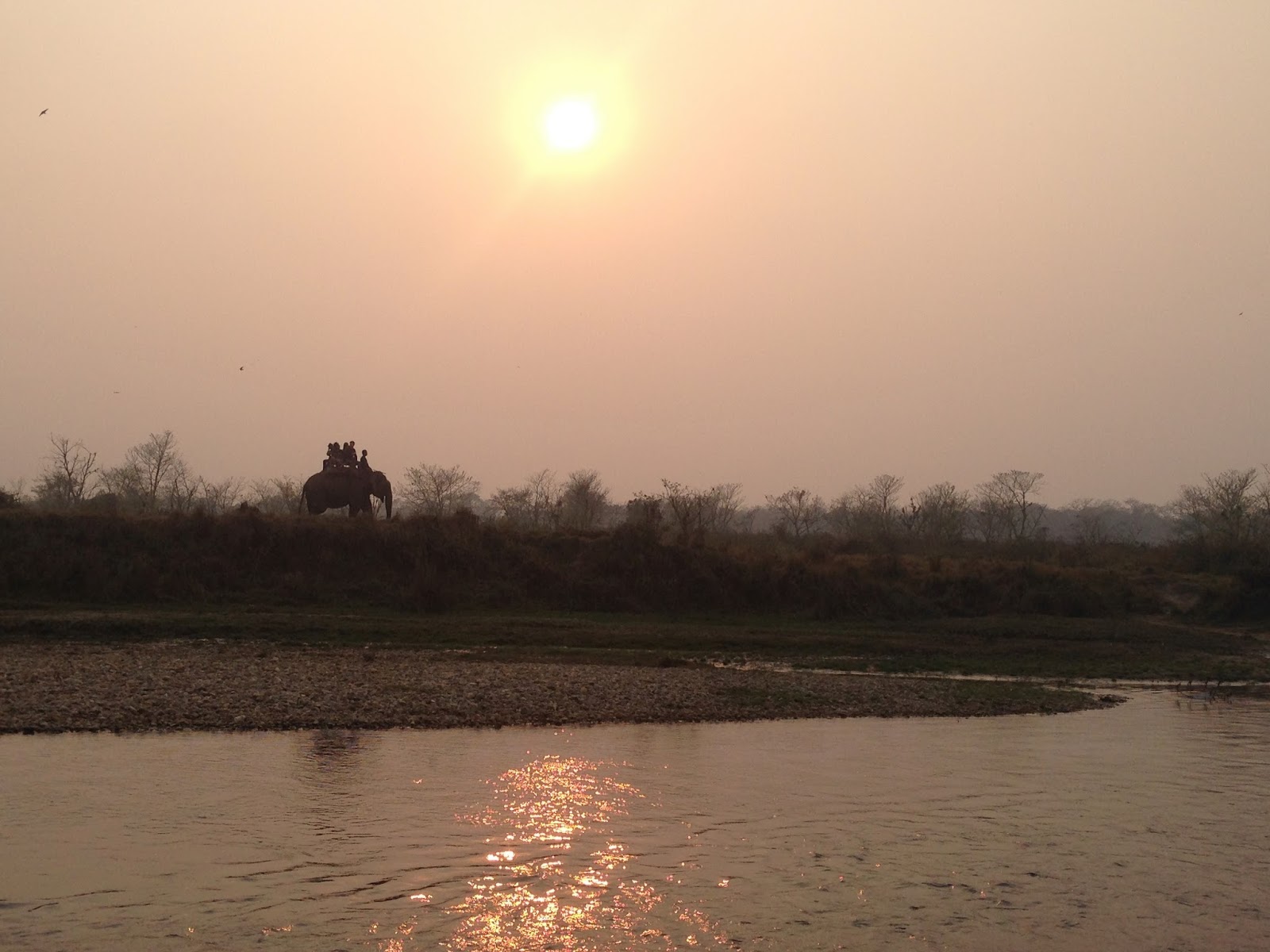
Sunset on our jeep tour
Living a dream! (well this was in the carpark but you get the idea.)

Back to Kathmandu
The bus to Kathmandu was rough. Amazingly it was Rob that felt motion sickness and not I. Nonetheless I still managed to lose half my lunch due to the toilet conditions at one of our stops. We were both relieved when we finally made it to Kathmandu in the middle of the afternoon. Our trekking guide, Krishna had invited us to dinner at his house that night to meet his sister, sister-in-law and baby niece.


Useful information for visiting Chitwan:

Tour or go it alone?: Whilst you need a tour guide once inside the park, you can get to Chitwan independently - we would certainly recommend this. (NB: We didn't due to of our discounted package after the Upper Mustang saga but usually we probably would.) Getting a bus from Kathmandu or Pokhara to Chitwan is easy enough.

Elephant sanctuary: If you go, make sure you visit the museum here to learn about the life of the elephant. It was good to get this insight though it left me with many questions. Most people missed it and our guide did not mention it until I enquired about it. (This time I had done some pre-reading.)

Jeep safari: A lot of places may advise the elephant safari over the jeep tour because the engine will scare away the wildlife. However, I feel like we saw a number of animals for a safari and though I have no experience from atop a Chitwan elephant, I would recommend the jeep option.

Camera and binoculars: A good zoom comes in handy (i.e. make sure your camera doesn't break just prior to your trip to Chitwan like some people we know! (DOLPHIN SANDS ROAD! *Shakes fist!*). Our guides lent us their binoculars lots but, if practical, having your own might be nice too.

When to go: Apparently it was a good time to go because they do burning off  of the elephant grass around this time of year and you can see more wildlife with the grass cleared.

Recently burnt-off elephant grass