Saturday, 21 March 2015

Volunteering in Ho Chi Minh

One of my aims for our big trip was to spend some time in the one spot volunteering. I chose Vietnam simply because I enjoyed my short trip there in 2008, knew it would be a good place to be for a month and I thought Rob would enjoy it too. (We were also very lucky to have kind friends living in Ho Chi Minh that put up with us for the month! Thanks again Tim and Steph!)


Prior to organising my volunteering and even leading up to it, I was not sure what I wanted to do exactly. I didn’t set out to work at an orphanage and was not sure what I could offer. Now that I have finished my volunteering, I really hope I provided something of value to the children, teenagers and young adults I worked with.


I organised to volunteer at an orphanage in Ho Chi Minh after corresponding with a Professor at one of the city’s universities. I had gotten in contact with him after discussing volunteering with a Vietnamese attendee of the International Social Work Conference I attended in 2014. The Professor knew the Director of the Orphanage and arranged a meeting with her for a few days after my arrival in HCMC.


After the meeting I was still not sure what I would be helping with but the next day I turned up and was led to the church next door to the orphanage. I was not clear on why I was going there. It turned out that by being led from place to place by one of the teenagers was how I to figure out what the routine of the orphanage would be.


Most mornings I would go straight over to the pavement in front of the church where the children would play. Sometimes they would just stand at the fence and watch the world outside go by. (They do have excursions outside the orphanage but aside from these they spend all their time inside the orphanage’s walls.) After this they would have a drink and some of the teenagers/young adults would head upstairs for school.


The classroom was where I found myself at 8:30am on my first day. Apparently I was going to be teaching English to student’s aged 13-21! Not something I have trained in or felt like I would necessarily be very good at. “That’s okay,” I thought, “I must be here with a teacher who speaks Vietnamese or how else will I communicate?” I was wrong in two ways! A teacher with some English would be there most days (but not my first days) and I did find many ways to communicate. On a few occasions, I was lucky to have the assistance of an older student.


Initially I thought, “They have made a terrible mistake! Do they think I am a teacher?” However, I decided to give it a go for a few days and then I could always ask to assist with something else. A few days passed and I felt I could rise to the challenge and hope that my students would get something out of my classes. At first it was difficult to tell what each student already knew and they varied so much in age, maturity, attention spans and capability. They were a little bit shy at the beginning and mainly just stared at me but I think I grew on them! If nothing else, they enjoyed the games I made for them and loved singing songs. It was a challenge making up educational games with limited resources. (One problem was that the fan would blow away most of what we tried to use. However, if we turned it off it got far too hot.)


Making a shapes game

After the morning class the students had lunch at 10:30. Staff and volunteers had lunch from 11:30-12:30. Then it was time to rest until 2pm! (A wise move due to the heat.) Every day I walked past the cats and kittens that lived at the orphanage. They got the leftovers from lunch.

 
Cats in their usual hangout
At first I accompanied my students to lunch, unsure what I was really meant to be doing. I did this a few times and although they were happy to see me there, I felt I could be more use somewhere else. It was then that I started to visit one of the rooms upstairs that some of the other volunteers were in. It was a room for the babies and young children mostly confined to a cot due to some form of illness, disability or special need. There were a few babies with hydrocephalus (fluid build-up in the brain), some with cerebral palsy, some with epilepsy and other things. I came here for 1-2 hours on most days and played, sung and cuddled the babies and children. I discovered one boy who was completely blind was in desperate need of some sort of audio stimulation and really enjoyed more upbeat songs like Mario Kart, The Simpsons and Postman Pat! A typical day of volunteering involved singing Twinkle twinkle, Insy Winsy Spider, Open shut them, Five little ducks and the Rainbow song multiple times a day with babies aged 6 months to adults 21 years.


In the afternoon I took two teenage boys aged 13 and one 21 year-old woman for reading class. These three, it appears, were chosen because they showed the most aptitude for reading English.


The kids and teens at the orphanage are incredible. It is amazing how they work together to get through their everyday routine. One teen whose legs are amputated at the upper limbs is helped up two flights of stairs in a wheelbarrow type fashion. Once at the classroom, all students are expected to make their way to their individual seats and desk. This is extremely physically challenging for at least half of the teens I taught. They are exhausted before the class starts and yet they are keen to learn and interact. Students that have difficulty with a cup of water are helped by another student. When I cannot communicate something to a particular teen or them to me, another usually came to my aid.

Some of the wondeful students and me

It was rewarding working out what each individual enjoys most. One of the older girls, really a young woman, loves “once I caught a fish alive” and another (I think slightly younger) loves to be twirled around in a dance. One of the younger boys who I was told had psychological problems, was enthusiastic about learning anything new and learnt very quickly. I wondered how much more he could do with the right supports in place. (Unfortunately, that is true of most children there. Although I have found there are a few good programs in place.)


I have also been fortunate to see the commitment by many of the staff members who work long hours with many more tasks they can fit into that time. Although it is clear that some are overworked and in serious need of a break, many still have a smile for a child or arrange something fun to keep them occupied.


Monday mornings were playtime for many kids at the orphanage. Firstly the group would sing songs and dance in a undercover outdoor area. The chicken dance was hugely popular and they also had eating contests (which maybe sounds odd, but it wasn’t). Then it was free-playtime. Every playtime was different; sometimes I would be hanging on the swing with a toddler or playing catch with a teenager or trying to stop a little girl from getting in the way of the plumbers.


One playtime sticks in my mind. I went to visit three children (perhaps aged around 8) who were positioned against the wall in their wheelchairs to watch the everyone else. A carer motioned that I should come closer to one particular girl. When I got there she didn’t react initially but soon we were dancing to the music. Shortly after that the boy behind her put up his leg in the air and waved it up and down, laughing. Nothing like a song to reach through numerous barriers at once.


Many of the children at the orphanage had special needs and of these several were affected by dioxin (see our previous related post). Two of older babies with hydrocephalus had shunts inserted into their heads but many others had not received the crucial medical treatment that could improve their lives. The prognosis for many was grim and this was very sad.  


During my month volunteering I tried to find out what the future possibilities were for those at the orphanage. I heard about a few of the toddlers getting adopted during the time I was there. Some of the other volunteers told me how there is policy change in the pipes that should mean that children with special needs and older children are more likely to get adopted than is currently the case. Some of the staff at the centre grew up themselves at the orphanage and have evidently worked hard to get where they are now. Unfortunately many of the children will not be able to find the support and opportunities they need to gain independence and an increased quality of life. From what I know, many will move to institutions for their adult lives.


There are a few positive social initiatives I heard about during my volunteering time. The best ones, in my opinion, teach skills that increase the opportunities available to someone. “Teach Me to Fish” run by Kids With No Borders is one such project. It provides scholarships to support orphans when they leave an orphanage at age 18. Scholarships support them with continued education, specifical vocational training, health care and other everyday living necessesities. Koto, another program, is based on the idea that learning should be passed on: "Know One, Teach One." It gives disadvantaged youth in Vietnam the chance to train in hospitality.

Colourful dress

Another aspect of my volunteering was meeting some great people. There were quite a few volunteers either living in Ho Chi Minh or those that regularly returned to the orphanage. Some split their time by their country of birth and Vietnam. Near the beginning of my time volunteering we took a lunch time trip to a nearby temple. It was a big celebration with lots of food, colourful dress, music, readings and many offerings. Unfortunately, despite our best efforts, we never found out what the festivities were about! 
Music and ceremony

I enjoyed my time volunteering and learnt a lot from everyone there. It was great to see the student’s progress. The month went by very quickly and I found it very hard to leave. I hope I made some sort of difference by volunteering. In a discussion with one of the other volunteers who had come back for a third year, she said that she thinks of her work there as planting a seed. For her, this involves spending time with a child and joining in a smile with them. I feel like the students gave me so much. Hopefully I too planted some sort of seed.

Tuesday, 17 March 2015

Phan Thiet and Mui Ne

This little guy thought we were very interesting
We took our first train journey of our round the world adventure aboard the Phan Thiet Express as dawn broke across Ho Chi Minh City on Friday morning.  The experience of getting tickets was not as simple as one might have thought.

Most advice we received about booking train tickets in Vietnam was not to try and do it ourselves.  Too regularly, this seems to be the advice dished out to all tourists, for fear that we will be ripped off, overcharged, or that the tickets themselves would not even exist.  In retrospect, for buying tickets from the train station, it probably could have been one of the easier things we have had to do on our own.  However, I say this in retrospect.

We picked one of an apparent two choices.  Ms Anh, one of Mum's former Ho Chi Minh City/USQ graduates, who comes from Phan Thiet, offered to buy us the tickets, and there was an agency that could print the tickets in Hanoi, send them to Ho Chi Minh City, and then have them delivered to us in District 2.  Given the ridiculous logistics, Ms Anh won - but only came out about 10c cheaper per ticket.  

In the end, while we were at the station, there was plenty of English signage, and I am sure that we would not have had too many problems buying the tickets for ourselves, when armed with the actual price.
Comfortable seats on the Phan Thiet Express
 (with power outlets)


Number 9 bus leaves from the Phan Thiet Station 
and stops regularly along the beachfront all the way to Mui Ne


Of course, buying the tickets was just the start of the weekend.  Phan Thiet is a popular destination because of its proximity to a giant (and comparatively newly constructed) reclining Buddha, beautiful White and Red sand dunes, the Fairy Spring/Canyon, its seafood options and markets and its beachside location, perfect for kite surfing on the south-east coast.

We were picked up at 4.30am on Saturday morning by a revitalised US jeep and a group of other tourists.  


Sunrise at the White Dunes
With little communication from our driver, our jeep was off, flying northwards towards the smaller town of Mui Ne, with the beach somewhere off to our right, invisible in the darkness.  We screamed past other jeeps packed up with tourists, our driver was apparently keen to be there first.  It probably took us a little under an hour to get to the White Sand Dunes where we had to pay the entrance fee (despite paying for the tour), luckily, we had fair warning on this from a guidebook - it's certainly worth other travellers trying to confirm these sorts of details at the time of booking, so that there's no nastiness.


Meandering through the White Dunes

With few instructions, we had no idea where it would be best to see the sunrise, so we had to make it up for ourselves.  Opting to move away from the noisy 4x4's many used to explore the dunes, we found ourselves a nice place, all to ourselves, with others less keen to walk far from the dropoff point. The white dunes were definitely worth a visit, even if you have visited sane dunes elsewhere.


Kat awaiting the sunrise

Our second visit was to the Red Dunes.  Much closer to town and more popular with tourists and locals alike for that reason.  


Many more locals (and touts) at the Red Sand Dunes

Apparently the sands' colour change with the seasons, which I think is pretty incredible.  For the record, I think they're red at the moment, Kat yellow. You can sandboard at the Red Dunes if it takes your fancy. As the ride down is rather short we left it for others to enjoy, although it was interesting to see an elderly lady doing it herself, to convince us how much fun it could be.  Although the dunes appeared tame, Kat's 2011 temporary blinding-after-a-sand-board-stacking-experience in Peru is still fresh in her mind. If you had to choose between the dunes, Kat would opt for the White Sand Dunes.


Anything and everything a fisherman can unload

Our jeep also took us to a fishing village where the catch is shelled, gutted, traded or all three right there on the beach, before being thrown on the back of a motorbike and driven off to it final destination - even if the motorbike needs to drive up the cement embankment overlooking the beach.
Fishing village (with escaping motorbike, 
racing up the concrete embankment)

We were taken by the Fairy Spring, our next stop on this journey of the coast.  This is an innocuous little stream that is only 1 or 2 cm deep and you can walk up it.  While at first it just seems like a little tourist trap, after you turn a few corners, you are faced with an amazing scene of red sand combined with exposed limestone stretching away in front. It was certainly worth the minuscule entry fee. There is also a cafe that looked quite nice and you could easily spend some restful time here.


The Fairy Spring

Unfortunately Kat became sick following the tour (which finished about 11am) and spent a rather miserable 6 hours lying down in our hotel room. We had been sharing food so we had to put it down to a smoothie she had consumed the evening before. Luckily our hotel (Hai Yen Family Hotel, booked through Agoda) was very comfortable and before long Kat felt ready to jump in the sea and then spend some time in the pool. 


View from our room


There we met a large Vietnamese family that were very keen to take photos of us (some surreptitiously, and others more conspicuously) - they had rented a van to bring the whole lot of them to Phan Thiet for the weekend.


HCMC family on a weekend in Phan Thiet

Costs for things that matter:
  • $US32.80 (656 000VND) for 2 return tickets HCMC-Phan Thiet
  • $US5 for a xe om driver to take me to meet Ms Anh and home again
  • $US21 per night - Hai Yen Family Hotel
The rest of the weekend we spent beached, eating or reading. As it turns out, I'm better at these things than I am at buying train tickets!

The Red Dunes of Mui Ne

Sunday, 15 March 2015

2 Months On: Packing Review

We thought it was about time to review our packing decisions. For a breakdown of what we initially brought see our post: "Packing hand sanitiser for a year?" Here are our thoughts, two months and three countries on:

Verdicts on the items of contention:
Sleeping bags (used many times)

Bottle opener (not yet used!)

Yoga mats (Used more times than I can count on my fingers)

Hair dryer (Brilliant in Malaysia and Nepal, less used in Vietnam)

Things we could NOT have lived without:
Sleeping bags/thermals (probably saved us from hypothermia at least a few nights)
Beanies (ditto above)
UNO (only a slight exaggeration, was great whilst hiking)

Muktinath: At around -15 degrees Celsius sleeping bags, thermals and beanies were essential

Not yet used!
Expandable bowls, utensils & bottle opener haven't yet seen the light of day. 

Thing we are glad we did not bring:
Tent
Rob's tigers
Leggings (still not pants)

Thing we could have done with:
Tiny stove (we probably wouldn't have used it yet but we are likely to ask a fairy to bring it to either Beijing or Dublin for us!)

Thing we could have done without:
Less underwear (Rob)

All in all, I think we packed okay. Though we have added a few things on the way, and lost a few things too:

New things
Day/hiking pack 
T-shirt for Rob and shirt for Kat (time to swap out some clothes)
Thongs x2 (Rob’s broke. Kat needed some)
Warm gear for Nepal (Proper jackets)
Gifts we have received (a certain 'China fairy' may help us here)


New t-shirt!


Wearing my new scarf and jacket outside 'Yac donald's' in Kagbeni

Lost things
Rob’s hat (left on a flight)
Our backpack rain cover (wanted to stay near the Himalayas, who could blame it?)
Rob’s mobile (Worst. Left in a dodgy taxi)


Tuesday, 3 March 2015

Say Ohm!

Having been burnt from an experience with a nasty dodgy taxi driver, I was more than content to spend a few days hanging out in the relative safety of Tim and Steph's District 2.  Hiding from the heat of the day in coffee shops, catching up on world news and some less than important things (like the ongoing Australian government leadership controversy).

But eventually there would come a time when this little traveller would actually need to see more of Ho Chi Minh City than the cool sanctuary of air-conditioned western coffee shops and smell aromas other than Italian coffee beans.

Traffic in Vietnam probably has more than its fair share of dedicated blog posts, so I'll leave it at the fact that there are 90 million people in Vietnam, and most of them get about my motorbike.  The streets are full, loud and dangerous for riders and pedestrians alike.  Of course, as most people get about by motorbike, it stands to reason that it is also one of the most cost-effective ways to get about.

Kat, having previously experienced both enjoyable and heart-stopping rides on the back of motorcycles in Vietnam on her 2008 trip, usually opted for the relatively safe taxi option for the half-hour journey to volunteering each day.  Safe, as long as you never opened your eyes or looked at where the taxi drivers' eyes were focused (usually on a mobile phone) - on this day, I rode with her, to see the orphanage, and explore the area.  For the first time since arrival, I finally put together my cheat sheet of Vietnamese words (1-10, please, thankyou, sorry) and was determined that to get home, this day would be the one in which I would take a xe om (pronounced "say ohm") and to be honest, a Buddhist mantra is probably desirable if not required for this activity.

Finding xe om drivers is usually not an issue of how, but more an issue of saying "yes".  Probably thousands of men spends their days dozing atop their parked motorbikes on street corners, always with a second helmet, waiting for a customer to approach.  Thousands more hound you at every turn, "motorbike?", "taxi?", "where you going?".  However, in the heat of the day (between 10 & 2) most people are already where they are going, so I caught my prospective driver napping.

Still nervous from the dodgy taxi incident, but determined to bring some local language into play, I made a cautious approach.  My prospect was one of two men in their late forties hanging out of the corner.  The first excitement lay in determining the actual destination.  Having prepared for this moment like a university exam, I was persistently trying to tell them that I wanted to go to "Dinh Độc Lập", but without the capability of forming complex Vietnamese sounds correctly, it came out as "din dock lap", which I think is probably wrong.  Mainly wrong, because we could only get universal agreement when I said "Reunification Palace".

With that issue sorted, next came the price.  As anything worthwhile, some healthy negotiation is both expected and necessary (don't hop on without agreement first).  This also hit a snag.  Capable only of counting to 6 from the top of my head (after all, it was only university exam-like preparation), negotiating amounts in the range of 50-70 000 dong became all to much for me to handle.  To the great mirth of my two prospects, many hand gestures and waves and we concluded on a price of 60 000VND.  They managed to work out which of them would drive me through some non-verbal queue I never witnessed, and as they helped me on with a helmet, they asked "American?, New Zealand?, Australia?"  Receiving a solid nod and a thumbs up at confirming my nationality and therefore passing some obscure test, we were off, as I tentatively pondered the clause on the insurance policy stating "under no circumstances are you covered in the event of a motorcycle accident".

From what I had read, your local xe om driver is a key to unlocking the city.  They know the back roads you would never go down yourself and that taxis can't fit in.  They know every street and alleyway in the city, and even if they don't, have the local language skills to work it out.  My driver "Nam" was an utter professional, living up to this standard, but at the same time, I was completely comfortable at all times.  Never did he pull in front of a truck or bus or weave in and out of traffic, and always accelerated at a reasonable speed.  The only issue was that because he was so short, each time we slowed down, I almost broke my nose.


Nam says "OK thankyou", as he drives away

And so my first time on a xe om took me to a fairly interesting visit at the Reunification Palace. (Though I would have to say I enjoyed my time with Nam more, and I can't say that for most of the xe oms I have taken since!) I learnt about the significance of another more important entrance through the same gates, done by a number of North Vietnamese tanks on April 30, 1975.  Back then, it was known as the Presidential Palace.

Incredible video footage of this historic moment was taken by an Australian Neil Davis (1975), who reportedly stayed in Saigon because he hadn't yet picked up a safari suit he was having made.

If internet comments are anything to go by, this moment continues to be a source of national pride and disappointment, a happy/sad moment, all depending on your political and historical point of view.  For an insight into some near-sighted American AND Vietnamese patriotism, read the comment sections (some as recent as 3 months ago) on youtube of any of the Neil Davis footage of this moment.


Tank 843's significant arrival


Please keep off the grass

Phu Quoc Island


After less than a week in Ho Chi Minh City we took our first mini-trip to Phu Quoc Island. Still adapting to Vietnam's heat, post-Nepali freeze, we thought it was smart to take to the water. Phu Quoc is a southern Vietnamese island that sits just below Cambodia. It is a short one hour flight from Ho Chi Minh. One of those flights were you aren't cruising for long.

As we flew into Phu Quoc, I debated whether to wake Rob up from his nap. The sea around the island looked beautiful as was lit up by many boats. I let him sleep and wake up as we hit the tarmac. (This is not as mean as it sounds. We have established the same rule goes for buses and planes, Rob would prefer the sudden jolt of landing or stiffness in his neck to being woken.) 

We chose to stay at a guesthouse listed on airbnb called The Venue. It was a good location as long as you don't mind a 400 metre walk to the beach. There were lots of food options at the end of the street and on the beach nearby. 

For a fair chunk of the weekend we beached ourselves. The island has some nice beaches,
though as always, it depends on your point of comparison. The beach closest to us did not have much of a coast but we were away from the main strip and it was peaceful. The lack of sand didn't really matter as it was too hot for us to lie in the full sun for a lot of the day and we preferred to be near the smoothies, fruit platters, spring rolls, cocktails and other delights. Reading, swimming and eating was the order of the day! That evening we enjoyed a sunset and saw my Mum's youngest brother's doppleganger. (Hi Peter if you happen to read this!)
Enjoying the beach near our guesthouse

Yoga at sunset
On our second full day at Phu Quoc we rented a motorbike from a restaurant. We were advised by their owner that under no circumstances were we to speak English, French or Vietnamese if pulled over by the police. "Pretend you don't understand anything", we were told. There have been tourist accidents in recent years on the island and the police have been cracking down on foreigners riding bikes. (Later, upon reading and thinking more on the subject we decided we probably wouldn't rent a motorbike again whilst in the country. After all, we don't ride motorbikes back home and aren't really on top of the Vietnamese road rules.) 

Anyway, on this particular day we set off with the idea that we would encounter small amounts of island traffic and if we drove safely would be okay. This turned out to be the case and we didn't spot the police anywhere. We stopped off at a cafe for a morning coffee before heading to the north-east part of the island. It took longer than we thought to get there and navigating the island wasn't quite as straight forward as we thought. Eventually we had lunch on a quiet fishing beach.


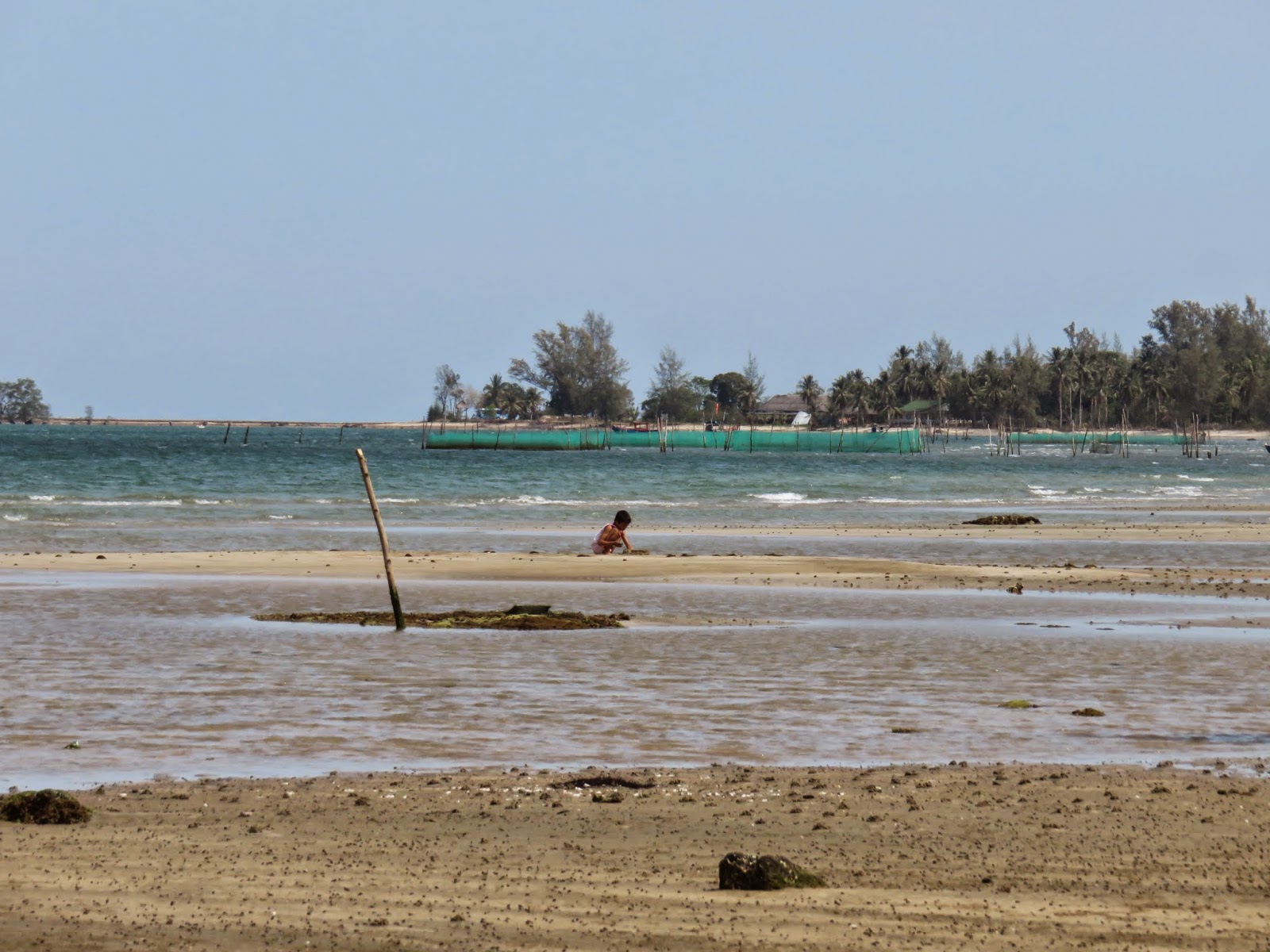
Child playing in the sand on a Northern beach
After lunch we found a bumpy dirt track that took us to a beach on the north-west side of the island. I made the ride more fun/dangerous by driving us slightly too fast at one point. Riding wasn't too comfortable but it was nice to be able to travel independently for awhile. Some of the island's resorts were on the north-west coast, perhaps positioned here more for the peace than the beach itself. We went for a nice afternoon dip before jumping back on our bike and heading south for the wet market. Though the market was interesting to see, Rob had a challenging time navigating us through the sea of motorbikes and stalls whilst suffering an overpowering stench of fish. After further wanderings we found the night market just in time for dinner. 


Something fishy in a market full of motorbikes
On our last day we journeyed to the southern beaches to spend more time reading on the beach. The beach was nice but very busy with large groups and lots of beach chairs covering the sand. (Yes, I know we are spoilt in Australia with quiet, often "untouched" beaches so this will always shade my thoughts on beaches overseas!) Towards the end of the afternoon people cleared off and it began to look like paradise! 


Reading on the beach

South-facing beach
All of a sudden everyone left!
We would recommend Phu Quoc as a great choice for a relaxing beach weekend trip from Ho Chi Minh.


Phu Quoc Costs and Tips 

Flight: AUD$346 return for two people

Accommodation: AUD$30/night for a double room at the Venue

Motorbike hire: ~70,000 dong (~AUD$4.40) for a day

Sun lounge hire: ~100,000 dong for a day (Or just got a few metres back on the sand and order a drink or some food and use their lounges. We were never made to feel like we should leave or continue to eat!)

Choosing a beach: There is something to like about most of the beaches but if you don't feel like exploring what each has to offer, we would recommend the east facing beach. If you walk a little south of the main bar and restaurant area it is both peaceful and beautiful.

General tip for Vietnam: Don't forget your passport! Everywhere in Vietnam requires your passport to register it locally and many keep it during your stay. Try not to be like us and leave it at the hotel!