Showing posts with label Phnom_Penh. Show all posts

Wednesday, 1 April 2015

S-21 Prison, Phnom Penh

Cambodians, like the Vietnamese, have been through horrific experiences in recent decades through US/allied bombing, the disturbing rule of the Khmer Rouge, ongoing civil war, Vietnamese invasion and the nasty vestiges of war.  The eastern part of the country was heavily mined to restrict the movements of the Vietcong and the process of mining continued throughtout multiple regimes, as a way to maim but not always kill enemy combatants. The 'logic' behind this is that injuring a soldier takes two  enemy combatants out of action but killing only takes one.

Somehow while growing up, I either never learned or somehow blocked my mind to these tragedies.  When I did hear of Pol Pot, I imagined some far off dictator, some regime in South America, something that happened long ago.  But the truth is so much closer in time and geography.  Some of these heinous crimes occurred before I was born, but much of it so close that people on the street, little older than me must have suffered through the experience in one way or another, and many of those much older could have been directly involved with them, as perpetrator or victim.

S-21 Prison is actually a school that was used as a prison and torture facility after the Khmer Rouge came to power (1975) and drove most people from the cities to the fields.  Their brand of communism (like many others I suppose) was the belief that labouring in the fields was a glorious pursuit and that intellectuals and artists were a threat to the regime.  People would be brought here for "re-education" or "re-training" if they were not of use in their prior role, if they were somehow a threat to someone in power, or if they were suspected of being a CIA spy (or perhaps that last one was just used as a way to getting rid of people the Khmer Rouge didn't want around).  People were whipped, drowned, electrocuted, starved and executed within the walls of this school.  If they did survive the prison, many were taken out to the killing fields to be executed.

In one remarkable room, there was a section dedicated to a visit, in the late 70's, of a Swedish journalist who came as one of Pol Pot's guests to Cambodia, and left writing about what a glorious place Cambodia was.  He wrote about a classless agricultural communist state could thrive. He now writes about how horribly wrong he was, how ridiculous it seems that the wool had been pulled over his eyes, with he a willing participant. None of the others in his party have similarly stated these revelations. Kat found this display especially fascinating as it was a new addition to since her visit in 2008. It certainly raised questions as to whether we are turning a blind eye to the various conflicts or dictatorships around the world at the moment.

During our visit, we saw a documentary, where two of the only seven known survivors of the camp told of their experience, along with a "prison guard" who told of his role at the prison, and at being forced to murder someone at the killing fields to prove that he was an "absolute" follower.

Now setup as a quasi-museum to expose these crimes for what they were, a visit here is a sad, soul-crushing experience, leaving you to (again) wonder how humans can be capable of such atrocities.  Even after being driven out by the Vietnamese invasion in the late 70's, the Khmer Rouge continued a guerilla war to 1991. Disturbingly, the court cases against men like Pol Pot and his cadres have only recently commenced, with the man himself dying in 1998, before justice was done.

Stories we have read and seen are reflective of tragedies elsewhere where people under a dictatorship have been forced to do horrendous things to save loved ones or themselves. It is impossible to know what lengths one would go to in these circumstances. Although evidence perhaps points to the contrary, one would hope we as humans can learn from the devastation of war or turning a blind eye to our neighbouring countries and avoid any sort of repetition of these events. Cambodia is showing tremendous strength in rebuilding their communities with such fresh memories and resulting (and ongoing) pain of a truly horrifying time.

Tuesday, 31 March 2015

Hello! Sue sdei! Where do you go? I don’t know!


Hashing in Phnom Penh
Rob has been talking about the Himalayan Hash House Harriers since the day I met him. Hash House Harriers is an international group of non-competitive social running clubs. Hashing involves following a path laid out by a Hare through all sorts of obstacles. Traditionally it is paired with the drinking of beer, which I less eagerly anticipated! 
 During Rob’s year in Nepal he was a regular Hasher. We had hoped to do a hash in Kathmandu whilst we were there but the stars did not align and we were not there on a Sunday (hash day). We vowed to look out for future opportunities and Phnom Penh turned out to be the city to host us!

We invited Tim (who we had been staying with in Ho Chi Minh and whose travel dates coincided with our stay in Phnom Penh) to join us. It was his first Hash too which meant we initially followed-the-leader rather than the white spray-paint that indicated the path. It also meant we were required to stand in the middle of the circle during the drinking songs and the end of the hash.


The hash got off to a very slow start. Meeting at the deserted train-station of Phnom Penh we were to wait a good hour before hopping on a cattle truck that took us to the ferry. Our hash was to be out in the country-side and after reboarding the cattle truck on the other side of the river, a few wrong turns, several tree branches in people’s faces, numerous bumps in the road and many looks of disbelief from locals, we arrived at our starting point: a primary school.


Tim and I on the way to our first hash
Our group was diverse, consisting of expats (or immigrants), locals and tourists aged from 25-60 with a wide range of backgrounds. Some were walkers (one of them showed up in dress shoes but everyone was relieved he had sneakers in his bag) and others ran. Our route involved rice paddies, temples, someone’s backyard, a boat crossing, roads and alleyways. Farmers stared at us; probably wondering why we weren’t in our hammocks at this time of day. I used my miniscule amount of Khmer to greet a farmer and it turned into a little rhyme:


Sue sdei!

Hello!

Where do you go?

I don’t know!


It must be very odd to find foreigners running in your fields looking like they are on a mission but realising they actually do not have the faintest idea where they are headed! 

The first crossing of the hash
Serenity

What are you people doing?

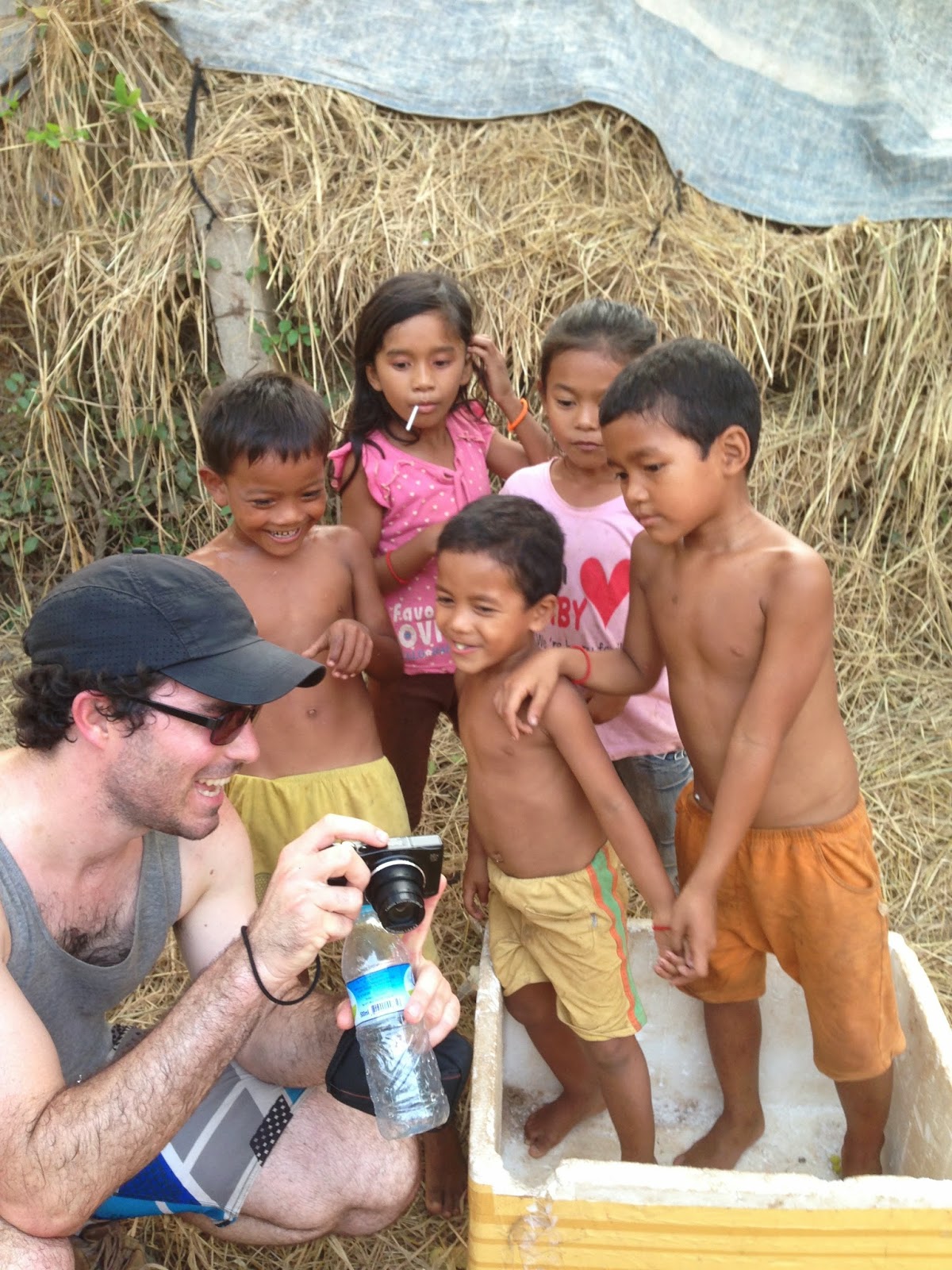
We passed through villages with many friendly waves and giggles from children. Towards the end it felt like we were finishing a marathon with the reception we got. Children waved tree branches and cheered and I felt like I should be more exhausted than I was! Don’t get me wrong, though it wasn’t a marathon; it was certainly a challenge. It was a very hot day and it has been awhile since I ran at all, let alone on uneven trails in scorching sun!

Marathon crowd :P

Smiley kids

Take my photo!

Taking a look at the previous photo

Once we reached our final destination the drinks were handed around and we formed a ceremonious circle. I opted for an electrolyte drink, until I was pulled in the circle and given a cup of beer. It felt rude not to take part. If someone from around the circle sat down on the ground they would be forced to sit on a huge ice cube in the centre. Rob had mouthed off early so also found himself in the middle of the circle with a pipe around his arm. His drink was a bit harder to swallow.


Rob's challenge, Tim and my beer that tasted like...beer

Circle time went on a bit too long for me with far more drinking songs than you can poke a stick at. We had told poor Steph (Tim’s wife) that we would be back before dinner but it was going to be much later by the time we took the journey back to Phnom Penh. Nevertheless, I enjoyed being surround by the local kids playing as the sun went down. 

Kids, probably wondering what one earth we were doing


We hope to do more hashing in other places this year and would recommend it to other travellers. It is a great experience, incorporates some exercise and the costs are minimal (US$5 in Phnom Penh). Visit the PP site here!

Ready to hash another day!

Chinese Visas for Australians (Phnom Penh)

I officially hate visa applications.  If you have read my blogs from the past, you might already be familiar with my frustrations at this process (see "Ma American Hoina"), but I'm now making it official.

Getting visas sucks, big time.

When living in Nepal, I remember for the first time meeting people who were doing a "visa run".  Baffled, I asked for more detail. "Well, you know, there's no reason for me to be in Kathmandu, except that I need a visa for X & Y..." (Then again, perhaps it is not a good idea to get travel advice from people that think there is no reason for them to be in Kathmandu).

The process is the bane of a backpacker, because while you probably care little for weekends, it seems that many embassies and consulate's do.  Even more so, they have incredibly strict opening hours, dodgy looking websites, out-of-date addresses, long processing times and unpublished rules that all factor in to whether you will find yourself making multiple trips.  Also, while it is generally pretty easy to get passport photos, filling in forms is a dull and sometimes complex task, made all the more complicated when you need to print the form first, and try to keep it in a somewhat neat condition.  Let alone actually having an itinerary to present alongside your application.

Before Kat & I left Australia in January, the Vietnamese visa was the only shiny new one in our passports.  We tried applying for Russian, Mongolian and Vietnamese visas before we left.  Russia would not provide one more than 3 months in advance of our arrival, even with a very polite letter that this Lonely Planet Forum post suggested would work. Mongolia would not provide a transit visa without us first procuring a Russian visa.  Luckily (haha or so we thought), Vietnam obliged.

Our first crack at Chinese visas in Ho Chi Minh City was thwarted by the lengthy process it took to get a new Vietnamese visa (more on that later).  We only had one specific day where we would have to drop our application and passports at the Chinese consulate in HCMC, allowing for 4-5 business days of processing before we needed passports again.  Unfortunately, after waiting in a security line for 30 minutes (where I was waved through upon reaching the end) and a further 30 minute wait in a very confusing waiting room, China would not accept Kat's application unless she dropped it off in person (despite there being a section of the form that suggested otherwise).  With Kat working at the orphanage every day, this proved an impossibility and we made hasty plans to re-apply in Phnom Penh, once we had made it to Cambodia.

In the end, this proved to be far more convenient, and I would suggest to other travelers faced with similar problems, that they should apply in Cambodia. When we applied in March, there were no lines, the process was more or less straight forward and it was easy.  Let me stress that.  Easy, if still frustrating .  After all the schmozzle of Russia, Mongolia, Vietnamese extensions and new ones and reprinting forms for a Phnom Penh application instead of an HCMC one and the genuine fear of being in a place without your passport, this was easy.  You really do not need your hotel to do the process for you (SLA Hostel - where we stayed) offered the service for $US88/pp, we did it in person for $US45/pp +2x$US8 round trip tuk-tuk, one of which we combined with a visit to the S-21 Khmer Rouge prison/museum (former school).
  • Make sure you have:
    • a fully completed application form
    • glued on your passport photo ahead of time
    • have an itinerary attached (including names, addresses and phone numbers of accommodation providers)
    • have evidence of any planes or trains attached (they would not accept our application for a double-entry visa unless we had plane tickets in, out and into China again). I did manage to explain that it was too early for us to book our onward train tickets.
  • Tips:
    • AirBNB is unlikely to be viewed positively on the application - I suggest picking a hostel, at the very least for your first night (although we did receive our visa, our AirBNB host that was booked ahead of the visa application, spontanesously canceled a few days before our arrival in Guangzhou citing that "local police don't accept me having foreigners" - we suppose perhaps our application with his phone number on it had something to do with the cancellation.
    • Pay when you pick up (cash in Phnom Penh), not when you drop off.
    • We wrote a cover letter which they ignored and gave back to us before processing.
    • Plan your Phnom Penh visit around drop off and pickup at the Chinese Embassy.
    • I've read that looking smart (shave, collared shirt etc) helps.
    • Know a few words in Mandarin - politeness helps!
    • The visa processing section is at an unsigned side door down a road to the right of the main entrance (our tuk-tuk drivers both took us to the main entrance), the security guard outside is the only indication you are in the right place.
    • Address: No.156, Blvd Mao Tsetung, Phnom Penh, Cambodia (P. O. Box 26)
      Duty-Phone: +855-12-810928
      Website: http://kh.china-embassy.org
      Open Hours of Consular Office: 08:30-11:30 Monday-Friday