Showing posts with label museums. Show all posts

Wednesday, 8 July 2015

Dublin - Ireland Roadtrip Part 1

After a relatively short flight from Helsinki we arrived in Dublin late afternoon for a reunion with my Mum! We stayed next to the Old Jameson Distillery at a nice Airbnb apartment. Mum, who had only come all the way from Australia had prepared dinner for us! It was great to be able to sit around undisturbed and catch up with Mum.

Dublin welcomed us with the most beautiful weather. In fact, in a way, it was a bit of a shame because it set the bar FAR TOO HIGH for the rest of our time in Ireland! No, it was lovely and possibly even nice for Mum who had come over to seek respite from a very cold winter - during 2015 Melbourne recored the coldest winter morning for 18 years! It was great we had such good weather on our first full day as we had opted for a Sandeman's New Europe Walking Tour. Rob and I had only ever had good experiences with "free" (tip-based) walking tours, usually finding them a great introduction to a city. We weren't disappointed: this was not only engaging but memorable with our guide Liz starting by teaching us some gaelic and proceeding to recite a verse here and there. 

My favourite part of the tour was learning about Dublin Castle, originally built for defence, once the seat of the UK's administration of Ireland and now an important Irish Government complex. It was a key site during the Easter Rebellion and leading up to the Anglo Irish Treaty in 1921.


Dublin castle 
Hanging out in Dublin's Brick Alley


Having heard about the Irish "YES" vote to marriage equality only about
a month earlier (and wishing Australia would get on with it already) it
was great to see this on the streets of Dublin. 

My goodness...

Picnic time
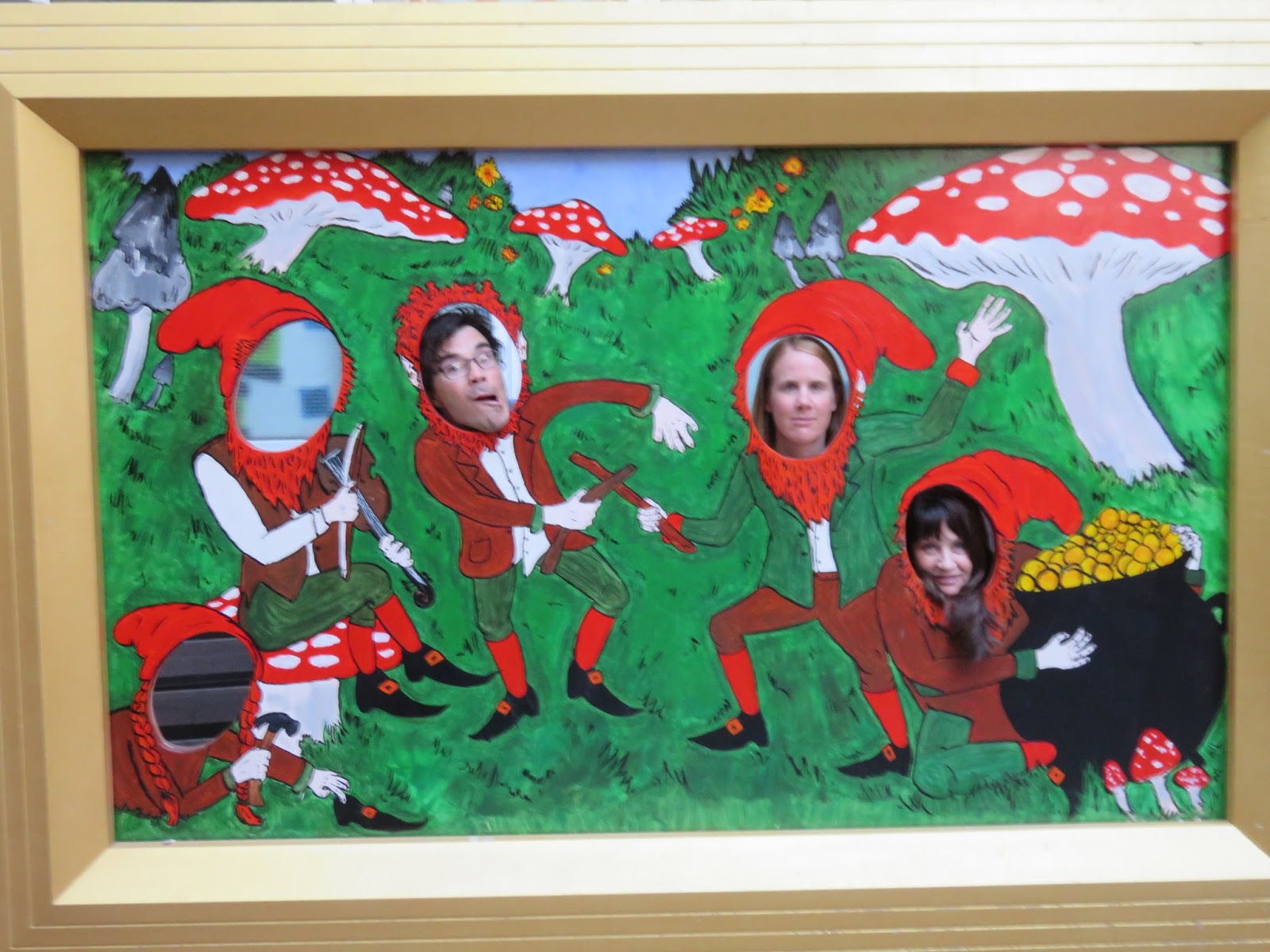
Dublin also provided us with the worst museum experience I can remember. Maybe it was the recency effect, but the National Leprechaun Museum was truly terrible. The premise of the museum is that a tour guide takes you into different rooms where they narrate Irish folk stories. I thought that sounded great and the reviews on trip advisor looked quite good. My problem here was that the day show reviews (good ratings) vastly outnumbered the night show reviews (bad ratings) but they were all mixed together...and we chose the night show. Granted this sort of concept relies heavily on the skill of the story teller. Well, we truly lucked out (FYI for the USA readers, that's a BAD thing). Later (when others complained after the show) we found out it was the guide's first night. It was also expensive and though I enjoyed climbing up a super big chair, the entry fee was not worth feeling tall for a few minutes.* DOLPHIN SANDS ROAD!


Look how optimistic I was at the beginning of the tour!
Probably the highlight. The fellow customer taking the photo must have also felt outraged about the show he just paid for as he didn't bother to focus the camera!

Luckily, the Leprechaun Museum wasn't the only museum we attended. The Little Museum of Dublin was certainly small but well worth the effort. It had exhibitions on 20th century life in Dublin with a 45 minute tour. Though the museum was good, we all agreed that the associated optional outside tour of St Stephen's Green was a highlight of our time in Dublin. Apparently Donal Fallon's Green Mile tour only takes place on certain days so we were lucky to catch it. Donal was very passionate about his job and provided an excellent historical tour of the Greens. The Greens was the site of the Easter Rising of 1916. It was not a great choice of location as the British Army took up position in a nearby hotel allowing them to fire directly into the Greens. Donal told us about how during the Rising, fire was ceased temporarily to allow the groundsman to safely feed the local ducks!


Another highlight of our time was a simple thing, but as we know the simple things in life matter! We all really enjoyed our walk into the centre of Dublin. It was a good 20-30 minute walk to most places we found ourselves wanting to go and it was nice way to start and end the day. The lovely River Liffey, the green post boxes, the company and of the course the "No dog fouling" signs are probably what made it!


On our daily walk across the River Liffey
From Dublin we hired a car to do a daytrip to the Wicklow Mountains and Glendalough, followed by a much larger trip that would eventually end in Belfast. Stay tuned!

* Clearly I have not gotten over this yet!

Sunday, 5 July 2015

Magical Tallinn and the people that gave us Skype

Oliver, Rob and I took a ferry from Helsinki to Tallinn for the weekend. Apart from feeling a bit sea sick on the ferry, it was a fine trip.

We spent a lot of our time in Tallinn simply wandering around. Although it feels like the walls of the old town are there to trap tourists inside it, we did not complain! The streets and buildings were beautiful and it was very interesting to learn about some of the history of the town. 
Town Market
How will our budget last through Europe?!

Walking in the steps of history


We know that man!


On the Saturday we visited the Estonian History Museum which is one of the best museums we have been to on our trip. Different mediums were well integrated to provide the history of the country. (As opposed to other museums that only use digital methods of presentation for the sake of it.) It was incredible how they fit so much history into such a small space and yet presented it in a concise and interesting manner. There was a temporary exhibition on "Children and War". They used curtains to create little booths were you could listen to individual stories and recollections of Estonians caught in conflict.

In the afternoon Oliver found a nice spot at a cafe for lunch. Rob and I, so absorbed in the museum, almost missed the town walking tour we had planned to attend. We made it in time for the tour guide's introductions but had to content our empty stomachs with delicious roasted almonds from a street stall en route. 

Our tour guide really knew her stuff and we learnt a lot from her. I found it especially interesting to find out about Estonia's struggles for independence. Unsurprisingly due to the geographical position of the country, Estonia has been under Danish, Swedish, German and Russian control. During the tour we learnt a little bit about the oppressive forces of the Nazis and the Soviets and the terrible consequences of war for Estonians. The methods the Estonians used to retain their language and what culture they could during these times were a fascination, as was hearing about the Singing Revolution

The Russian orthodox cathedral was a city symbol so disliked by that Estonia actually planned to demolish it, except that they didn't have enough money to do so! 

On quite another note, we found out Estonians invented Skype (but had to get the project financed elsewhere) and they lay claim to putting up the first Christmas tree. (However this is a battle of the Baltics with Latvia also purporting to have been the first).


The Russian church (it's a touchy subject)
By the Viru gates


Old Fat Margaret
Kiek in de Kok - Peek in the
Kitchen tower
The "quiet" backstreets


Walking outside the moat and city walls
Tall Hermann by the now parliament -  where the raising and lowering of the country flag is very ceremonial 

St Olaf's Church at dusk

St Olaf's from another angle

Friday, 3 April 2015

Siem Reap, Cambodia

I really didn't know what to expect when heading to Siem Reap.  I knew it was coming and Kat had been before so I was kind of hoping to ride on her coat tails a bit.  What I really did not understand is just how big the temples are, how far away they are and how free you can be to explore them at your own pace.

We broke up our temple exploring over 3 days more or less geographically.  

Day one we spent visiting the temples and sights to the far north - so far away that we would not come back in the heat of the day.  We started the day with a very long tuk-tuk drive (with a hotel-based tuk-tuk driver, Mr Rhet) at Bantey Srei.  Bantey Srei was hard to really get a handle on as we only purchased a guide book after passing through, but there were enough other tourists to crowd the space and make me want to move on rather quickly.  I did spend enough time to be truly impressed how much detail Hindu people can fit into their temples and stone carvings, much like in Nepal, except that most of the wood carvings have been looted or rotted away.

A linga is a phallic-like rock, and at Nbal Spean ("The River of a Thousand Lingas"), thousands of them have been carved into the rock that forms the base of the river.  In the rainy season, the lingas along with other carvings of Shiva, Vishnu and Brahma are totally covered by running water. While I missed seeing this (oh how good it would have been for some rain) I really enjoyed the experience - both for the nice long walk to get there, but also because it was unlike anything I have seen before. Kat also really liked the pleasant hike and she had not visited Nbal Spean on her previous trip here.

The afternoon was eye-opening in a new way.  Cambodians, like the Vietnamese, have been through horrific experiences in recent decades through US/allied bombing, the disturbing rule of the Khmer Rouge, ongoing civil war and Vietnamese invasion.  Near to Bantey Srei is a Landmine Museum, opened by a man now known as Aki Ra, with a horrifying exposure to it all.  After experiences as a child soldier for the Khmer Rouge, and adult soldier for the Vietnamese army, and a man who never knew the name his parents gave him, he came to know land mines very well.  While both countries were trying to rebuild, he found his best way to participate was by disarming land mines, and the museum is a testament to his effort.  Everything in there (disarmed explosives in the tens of thousands) have been personally disarmed by him.  He has also started an orphanage and school there, specifically helping the victims of landmines and their families.  To support their efforts, please visit http://www.cambodianselfhelpdemining.org/ and give generously (they are a legitimate Cambodian-run NGO).  There are still millions of live explosives spread through the countryside of Cambodia on people's farms and in village's backyards.

Another remarkable thing we learned there was the world wide treaty on Land Mine use, to which China, Russia and the US are not signatories (they also happen to be the biggest producers).  Interestingly, according to the museum, the US' reasons for not signing is that there is no "North Korea exclusion-clause".  Apparently, the use of land mines in the "demilitarised zone" between North and South Korea is a key element in the US & South Korea's defence strategy, as the most effective means for preventing a North Korean invasion.  I've actually discovered that the US has agreed to the terms of the treaty with the exception of the Korean peninsula (South Korea is not a signatory for the reasons stated above, see wikipedia).

Taking it all in

Our second half of the day adventures were greatly improved by studying our new guide to the temples.  It certainly prevented us from "templing out" as you might be wont to do if you are just seeing without learning.

We finished off day one at Bantey Samrei, which was practically deserted.  I found the detail of the carvings remarkable, but the most memorable the image of the god Rama riding (Hanuman) while surrounded by the monkey army.  I think it was so memorable because of throwbacks to my childhood and the stories of the Journey to the West or better known as "Monkey Magic" - a great Japanese TV drama of the late 70's! (Sadly, I cannot find a youtube link).

With the heat in March being oppressive our plan was to explore temples in the morning and afternoon, while resting and swimming in our hotel's pool during the day.  This was such an important part of the plan that our hotel choice was based on it. However, we were to discover that our hotel didn't work like that and dis-satisfied with their strange method of calculating tuk-tuk fees, on day two we said goodbye to Mr Rhet. Kat also found it rather disappointing after the excellent driver she and her friends had in 2008...well apart from the tuk-tuk accident. On Day 2 we were to say hello to Mr Widget (or that's what we think his name was) whose services we acquired without the help of the hotel.  

Sunrise through the gate at Banteay Kdei
above Srah Srang
Our prior-to-sunrise departure took us to Srah Srang, a beautiful spot that was probably once a lovely balcony to an impressive temple overlooking a dam.  The sun's reflection on the water would have been impressive, could we see it through the haze. Whilst waiting for sunrise, Kat told me about plans to build a cafe amongst the ruins. Totally in support of such an idea, she let me go a little way with it before letting me know it was April 1st. 

Before long we thought it much more appealing to explore the nearby Buddhist temple Bantey Kdei while there were fewer other tourists about.  This was a far less grandiose, almost intentionally understated place that many tourists seem to overlook for the nearby and more famous Angkor Thom and Angkor Wat.  To top things off, as we left to the east at about 7am, we had a remarkable view of the now risen sun, above Srah Srang.

Following this, a visit to a place with probably the most shared photos of the region I have seen - Ta Prohm.  At this temple, silk-cotton trees (the husks of which we was used to float down the river in Chitwan) have taken over the walls and temples, such that it now looks like they are holding it together.  I can't help but wonder if this was a natural development, or whether someone intentionally did this.

One of Kat's favourite temples

Mr Widget seemed enthusiastic about our midday break, because it meant that he could collect his wife and go an get a scan done (she's pregnant) before picking us up again in the afternoon.  

The afternoon we used to explore Angkor Thom, the grand Elephant Terrace, and the well-famous Bayon "face-temple".  Although these ancient Khmer temples were built over a period of about 4 centuries (from 9th to 13th) - while the Christians in the west were off crusading - they were all made within a rather small area.  Each king trying to outdo the efforts of another even if those efforts were actually borne by their poor subjects.  

Hard-working elephants eternally uprooting lotus plants
On the last day, we were headed to where everyone heads at some point.  Sunrise at the famous Angkor Wat.  Except, that Mr Widget didn't show up.  We truly hope that he and his wife are OK, but we had no way to get in touch.  Instead, we had to do a last minute shuffle (at 5.30am) and find a new driver, enter Mr Widget 2 - he actually had the same name, we didn't just call him "number 2"! 

As Kat had told me, sunrise and sunsets at the temples are often hazy - early mornings are more about missing the heat of the day than seeing a sunrise. sometimes, its just best to get a photo of a beautiful woman instead.  

Kat at the famous Angkor Wat

Churning for eternal life
Our particular day at Ankor Wat was far too hazy and there were too many people eager to step into our carefully selected shot, so we focused more on exploration.  The bas-reliefs on the south side of Angkor Wat really were amazing, but further improved by our trusty guidebook.  Without that, or a guide to explain them to you, you could be forgiven for thinking of them as repetitive images of Vishnu.  I think the great highlight was the "Stirring of the Ocean of Milk", a great story that I think ties nicely in with that of the Rainbow Serpent.

A second, perhaps grander (although not as well preserved), version of the
Stirring of the Ocean of Milk
Mr Widget 2 was only too happy to give us a ride out to the airport for a few extra dollars, where a storm was brewing before our flight to Bangkok.  It was certainly a packed three days, but we really enjoyed it, I'm glad Kat was willing to come a second time.

Tips for the temples:
  • Don't be a fool, climbing around the temples in the middle of the day is not fun - especially in March.
  • We stayed at the Lotus Lodge Villa - I recommend you don't.  There's not one thing that leads me to say this, but the combination of a thousand tiny things (to which they have not seen fit to respond to).  I've received better service for $4/night at a guest house.
  • Get a guide book dedicated to the temples - it's worth the investment.
  • Don't try to do too much - take your time.

A happy face at Bayon

Wednesday, 1 April 2015

S-21 Prison, Phnom Penh

Cambodians, like the Vietnamese, have been through horrific experiences in recent decades through US/allied bombing, the disturbing rule of the Khmer Rouge, ongoing civil war, Vietnamese invasion and the nasty vestiges of war.  The eastern part of the country was heavily mined to restrict the movements of the Vietcong and the process of mining continued throughtout multiple regimes, as a way to maim but not always kill enemy combatants. The 'logic' behind this is that injuring a soldier takes two  enemy combatants out of action but killing only takes one.

Somehow while growing up, I either never learned or somehow blocked my mind to these tragedies.  When I did hear of Pol Pot, I imagined some far off dictator, some regime in South America, something that happened long ago.  But the truth is so much closer in time and geography.  Some of these heinous crimes occurred before I was born, but much of it so close that people on the street, little older than me must have suffered through the experience in one way or another, and many of those much older could have been directly involved with them, as perpetrator or victim.

S-21 Prison is actually a school that was used as a prison and torture facility after the Khmer Rouge came to power (1975) and drove most people from the cities to the fields.  Their brand of communism (like many others I suppose) was the belief that labouring in the fields was a glorious pursuit and that intellectuals and artists were a threat to the regime.  People would be brought here for "re-education" or "re-training" if they were not of use in their prior role, if they were somehow a threat to someone in power, or if they were suspected of being a CIA spy (or perhaps that last one was just used as a way to getting rid of people the Khmer Rouge didn't want around).  People were whipped, drowned, electrocuted, starved and executed within the walls of this school.  If they did survive the prison, many were taken out to the killing fields to be executed.

In one remarkable room, there was a section dedicated to a visit, in the late 70's, of a Swedish journalist who came as one of Pol Pot's guests to Cambodia, and left writing about what a glorious place Cambodia was.  He wrote about a classless agricultural communist state could thrive. He now writes about how horribly wrong he was, how ridiculous it seems that the wool had been pulled over his eyes, with he a willing participant. None of the others in his party have similarly stated these revelations. Kat found this display especially fascinating as it was a new addition to since her visit in 2008. It certainly raised questions as to whether we are turning a blind eye to the various conflicts or dictatorships around the world at the moment.

During our visit, we saw a documentary, where two of the only seven known survivors of the camp told of their experience, along with a "prison guard" who told of his role at the prison, and at being forced to murder someone at the killing fields to prove that he was an "absolute" follower.

Now setup as a quasi-museum to expose these crimes for what they were, a visit here is a sad, soul-crushing experience, leaving you to (again) wonder how humans can be capable of such atrocities.  Even after being driven out by the Vietnamese invasion in the late 70's, the Khmer Rouge continued a guerilla war to 1991. Disturbingly, the court cases against men like Pol Pot and his cadres have only recently commenced, with the man himself dying in 1998, before justice was done.

Stories we have read and seen are reflective of tragedies elsewhere where people under a dictatorship have been forced to do horrendous things to save loved ones or themselves. It is impossible to know what lengths one would go to in these circumstances. Although evidence perhaps points to the contrary, one would hope we as humans can learn from the devastation of war or turning a blind eye to our neighbouring countries and avoid any sort of repetition of these events. Cambodia is showing tremendous strength in rebuilding their communities with such fresh memories and resulting (and ongoing) pain of a truly horrifying time.

Wednesday, 25 February 2015

The War Remnants Museum, Ho Chi Minh City


Can't imagine what it would have been like to see these Hueys coming at you 

The War Remnants Museum exhibits the horrors of war in Vietnam's recent past with a message to never to forget the long lasting and devastating impact of war. The Vietnam War (as we refer to it) is known more locally as the American War, and really was a continuation of hostilities of the First Indochina War that the Northern Vietnamese saw as a colonial war, originally resisting French occupation and trying to reunify Vietnam as a communist state.


Kat spent a short amount of time in Ho Chi Minh in 2008 and the War Remnants Museum was the standout experience of her time. It is a powerful museum that exhibits some of the horror of the war and the continuing impacts it has on those involved. Most people know that as technology had improved, the horrors of this conflict was better documented than prior to this time. However, for us, nothing really compared to the photographs and stories shared in this museum. Two particular things stood out.  

From French photographer Huet


Requiem exhibit
On the top floor there was an exhibit called "Requiem" (Tim Page and Horst Faas brought it together and have a book of the same name, and we should credit the book itself here). This description from the exhibition itself puts it better than we could summarise:  

"....Between the height of the French Indochina War in the fifties and the fall of Phnom Penh and Saigon in 1975, 135 photographers from all sides of the conflict were recorded as missing or dead. This exhibition is a memorial to those men and women, and in many cases it includes the last photographs they took...."


Not just the last photographs they took, but ones they took moments before their own death, the words "last roll of film" give an extra definition to the full stop at the end of the caption.  


Capa stepped on a landmine after this "last frame"
This was truly a moving exhibit because it focused less on "we this..." and "we that..." but really just allowed you to see people and their experiences with a journalistic and artistic eye.


It's hard to pick a favourite (even the term doesn't fit), but some punched harder than others.  This image from Eddie Adams is of a South Vietnamese colonel threatening a Vietcong prisoner.  He would have only had seconds to take this photo, and didn't know until after it was developed what significance it had.  If you actually want to know what happened next, the photographer talks about it in this Youtube video.  


Eddie Adams' photograph of South Vietnamese colonel and a Vietcong prisoner
It has been a little harder to find online copies of North Vietnamese photographers.


Shadows of war (Dinh)


We don't want to diminish the other parts of the museum, for they too have a very significant and important message, and leave one feeling quite worn out, horrified, sick and generally disgusted that we as humans continue to do this to each other. An interesting element of the exhibitions was the use of language to show perspectives of history. In several places "American War" was used or "Vietnam War" (with apostrophes) to intimate how many view the atrocities that occurred here. It actually used to be called the "Museum of American War Crimes" among other names, which gives you an idea of the tone of the place.


Self-immolation as protest
The long-lasting impacts of Agent Orange

The other major element of the museum that stood out was the section dedicated to the horrific "Agent Orange".  Rob knew very little about the use of dioxin during the war or its devastating impact on land, crops and people generations later. Kat's knowledge was based on her last visit however the depth of information actually makes a second visit worthwhile. Dioxin can cause debilitating disability for millions of children and families, even now.  The vestiges of this insidious weapon are still felt in the Vietnamese (and to a smaller extent American) communities today, and there are still sites that have not been cleaned or treated since the anti-communist presence in the 70's. Particularly striking was the below letter to President Obama written in 2009 which shows how the devastating impact continues in second generation victims. This letter was exhibited after hundreds of photos of adults, children and babies affected by dioxin and asks if the President could spare some time trying to address this “forgotten problem”.


Letter from a second generation victim of Agent Orange to President Obama


Questions of accountability for actions of war and responsibility for the consequences loomed large during our visit. This article provides information on how 40 years post-war the U.S. has begun decontamination of the worst affected areas in Vietnam. This marks the countries first direct involvement in decontamination and is expected to take four years.

Parts of the exhibition showed the incredible skill that people with disabilities due to exposure to war chemicals have developed. For example, one story told of a man who could write with his feet. Seeing such stories and photos, especially those that involved children, Kat considered what impacts of war would she see when she began volunteering at an orphanage in the next few days.

The displays also made us think about what supports are there for victims of dioxin and how these differ between countries. For example, the article mentioned earlier compares the compensation which American veterans exposed to Agent Orange receive ($1,500 a month) to Vietnamese families with disabled children (just over $5 a month). Court cases and pleas to both the US government and chemical companies from Vietnamese victims have not been successful, whereas U.S. veterans' cases have. 


The direct and indirect effects of dioxin will continue to be felt by many Vietnamese now and in the future. It is obvious that a huge undertaking is needed to improve the lives of those with disability in Vietnam by providing better supports. Whilst the decontamination project is significant, if long overdue, it is only really part of the picture.