Showing posts with label temples. Show all posts

Wednesday, 27 May 2015

Westeros...I mean Beijing

Beijing was great, especially as Sarah the China Fairy met us there for a wonderful week of travel. It wasn't long into our trip that we realised that perhaps we had wandered into Westeros instead of Beijing.* 

If you haven't seen or read the Song of Ice and Fire (AKA Game of Thrones), this post will make no sense to you.  In which case, you probably have better things to do.  One strong recommendation would be to immediately stop what you are doing (ie. reading this) and go and read the books NOW...there's only 5 of them, get to it.


We spent our week exploring...


The Summer Palace (King's Landing)
Where we learned about the Empress Cixi and her nasty, manipulative and probably murderous rise to power.  Empress Cixi (which we imagine sounds a lot like Cersei) ruled as "regent" over a large period of the Qing dynasty.  She forced her son to marry against his will, declared war in the early 1900's on everyone around (including some pretty significant world powers at the time: the UK, France, Germany, Japan, Russia and the US).  She was probably involved in the deaths of many political opponents, was resistant to reforms and lived an indulgent life in the Summer Palace and, towards the end of her rule lived in a time of mass unrest that ultimately ended in the collapse of the Qing dynasty, not long after her death.  Probably a significant warning at the current time for a certain Cersei Lanniser of King's Landing.


The view from the Summer Palace/Red Keep

Summer Palace
How the rich live in both kingdoms
Hutongs (Fleas Bottom)
Exploring the Hutongs of Beijing was not dissimilar to Arya's early exploration of the alleyways of Flea Bottom in King's Landing, where she chased cats to work on her reflexes.  The weaving streets, the touting shopkeepers and the constant throng of people here and about, it was easy to draw the comparison.

Sarah to the Hutong Cat Cafe as Arya to the alleyways of Flea Bottom


The Great Wall of China (The Wall)

The Great Wall...well this is an easy one isn't it?  I mean, there's a huge wall in the north of Westeros.  There's a huge wall in the north of China.  Both were built to keep out a terrifying enemy.  Frozen zombies in one case, marauding Mongolians in the other.  And further, remember that Daenarys is told of a prophecy, involving a three-headed dragon.

THE WALL
The three-headed dragon!
Castle Black after the battle with the Wildlings!
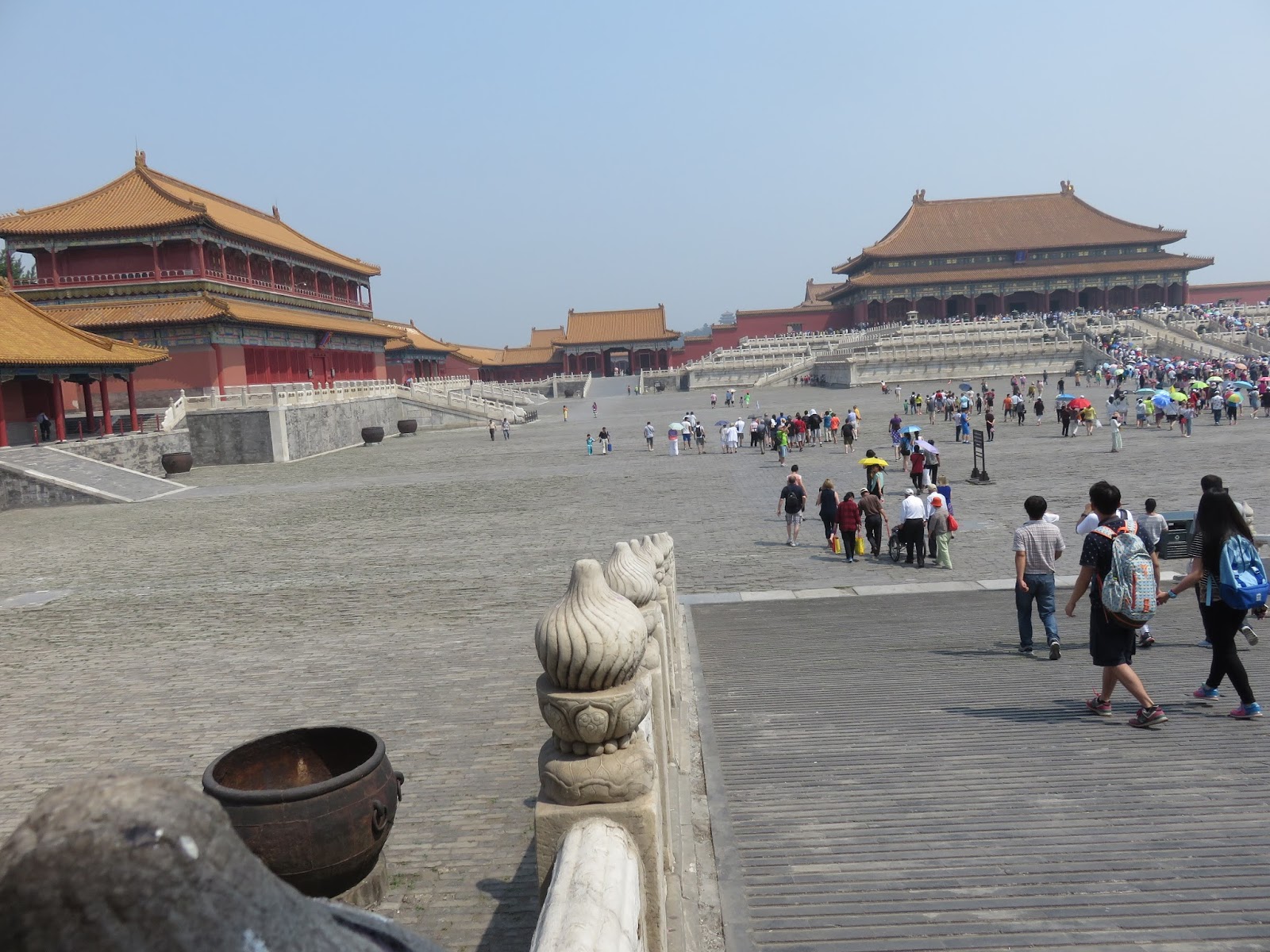
The Forbidden City (Meereen)
The Forbidden City's sister would be Meereen, a stretch we'll admit...but its intimidating structures and lack of any kind of colour will have to do.

Formidable
A hot climate paired with lots of concrete!


The journey
On our voyage we were constantly met by intimidating protectors in the form of dragons, lions, stags (and probably wolves, although to be perfectly honest, we couldn't find a single one to back this theory up).  These animals all represent the strongest families of Westeros, and and there are plenty of other animal sentinels used in China that could relate to other smaller houses.

Targaryans standing guard


Baratheon on the watch

Lannisters all dressed up

Then we ventured over the border into some grassy lands.

Meeting the Mongolians (Dothraki)

Mongolians is where the next surprising association is, although you have to use a bit of your imagination.  Remember the Dothraki?  The people who live and die by their horses, a nomadic people, constantly moving to new pastures and do not trust the sea (modern Mongolians don't even have access to one).  They survive on horse meat and fermented mare's milk.  This is textbook Mongolia!  Except for the fact that the Dothraki are no where near the Wall in Westeros, the relationship between Dothraki and Mongolians is pretty strong.

A nomad with his horse

Westeros, er...I mean Beijing, was impressive and not just for the huge scale of everything in it. It is an incredible place to find yourself for a week.

*Later we found out we were certainly not the first to draw such comparisons between Westeros and Beijing

P.S. Interesting also to read about speculation as to why Game of Thrones is censored in China

Monday, 18 May 2015

Kyoto - Wash dashi-dashi masu*

Kyoto does not suffer from a lack of activities and things to see.  The beautiful streets you could walk up and down for hours, tucked away restaurants and alleyways in the geisha district were just lovely. 


A rainy night in the geisha district

Kyoto was a place we could relax a little, with a longer stay and a hostel with a common space that allowed us to spread out.  We had a number of gastronomic adventures, a cultural parade, some additional sake tasting, further onsen relaxation, haircuts, a cycle along the river and many visits to what I think Kyoto is best known for...it's shrines and temples.

I have to confess ignorance here. I don't know whether it is because I am missing the very detailed and fine points of Japanese culture, I had no one to explain to me the intricacies of Shintoism, whether I was "templed out" or if it was something else.  But I found the visits to many of the shrines around Kyoto a rather non-spiritual experience.  Often the focus was stolen from the architecture and enshrined deities to be placed on trinkets that will bear their superstitious buyers some form of luck, good business or fortune.  Notably at the Fushimi-Inari Taisha, for those after good business, it seems apparent that wishes only come true if you buy or sponsor noticable arches near the entrance, where everyone walks and will see it, rather than buying one at the top of the hill that most visitors will never make the effort to climb to.  


Fushimi-Inari entrance

Sometimes the temples felt like a fete or fair, but perhaps its good that they have an element of fun, just maybe the trinkets are not for us.

Putting the cynic in me to one side, the actual arches at the Fushimi Inari Taisha, its bamboo forest walk and the views from the top were amazing.  On our return, a father and daughter were practicing sword work in an amazing display.


Bamboo forest at Fushimi-Inari


Samurai battle
Coming down from Kuramadera, we enjoyed time in the nearby onsen - oh so relaxing. But for crying out loud, two things you do NOT do when at an onsen:

1. TAKE PHOTOGRAPHS - Kat was the star model in one lady's sneaky photo (which wasn't so sneaky).


2. BATHE WITH SHORTS - when it explicitly says that you are to bathe naked, THAT'S WHAT YOU DO!  One man hopped in wearing his board shorts, despite many signs instructing to the contrary, causing quite the kerfuffle. If you are feeling a bit prudish or shy, just don't go to an onsen.


The walk in the far more isolated Kuramadera Temple is invigorating, and where they provide you with a whacking/karate/walking stick (free of charge!).  Beautiful scenery and another grand view from the top.


Hiking at Kuramadera
Some of the many stairs at Kuramadera


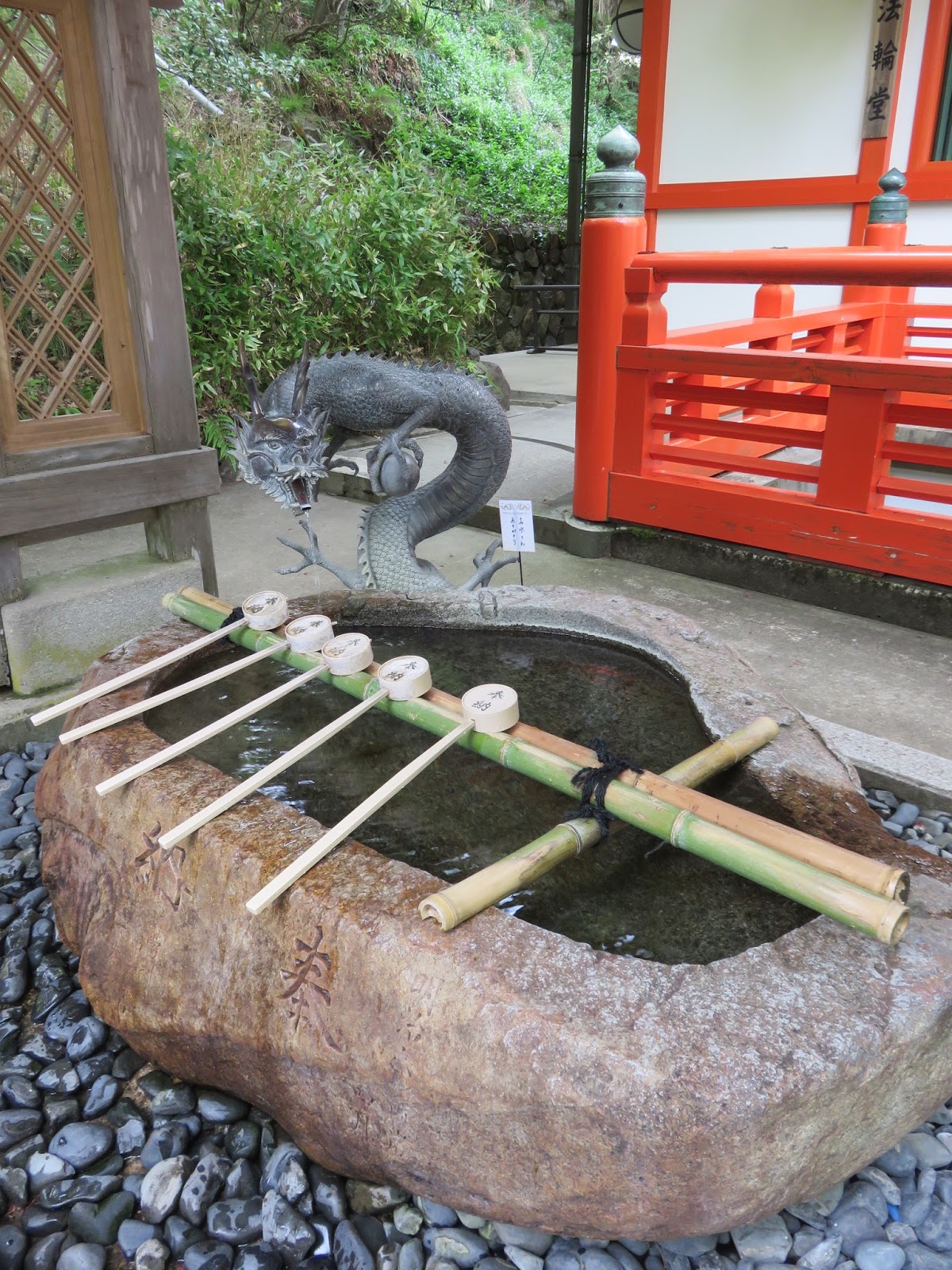
A dragon font at Kuramadera

A man and his stick


Another visual and and certainly more spiritual experience was visiting the buddhist zen garden at Ryoan-ji.  And despite the fact that I am nearly quoting a guidebook word for word, it was wonderful to have the cacophony of  school children racing about drowned out by the silent emptiness and simplicity of the rock garden.  


Zen garden at Ryoan-ji


Tea Ceremony at Camellia
Similarly, witnessing a majestic Japanese tea ceremony was also a more relatable part of our time in Kyoto. 


We also took the opportunity to meet up with David, a colleague of my Mum's from a long time back, who took us out for a lovely dinner with his two sons where we discussed mutual acquaintances, politics and our future plans.

With so much to occupy our time, it went by in a flash, however from here the adventure continues, to Beijing and beyond!


*The title of this post is dedicated to the elevator at Ayado Gion hostel, which greeted us on each door opening with what we think was "Wash dashi-dashi masu"

Wednesday, 13 May 2015

Kanazawa? Can he ever!

The colours of a lovely garden
Kanazawa for us was a land of sneaky ninja temples, re-invented castles, beautiful gardens, the freedom of a bicycle and the height of space-efficiency. Whilst here Kat also did some research work.


A great highlight of Kanazawa was visiting the "ninja temple".  It earns double-quotes because it has nothing specific to do with ninjas, rather than it has a number of very smart in-built defense systems, its true name is Myoryuji.  To visit, you must book ahead and go on a tour, and the tour is only available in Japanese, but that should absolutely not deter non-Japanese speakers.  Being "forced" into a tour seems a little over the top at first, but I assure you, it makes the experience more enjoyable, for you could not really learn all of the elements simply from a guide book.  Our guide gave us an English picture book, for want of a better word, that contains photos and a rough English translation of what she was saying in  Japanese in each room we visited.  The most important part of being on a tour was that they could control the number of people in any room, meaning we could definitely get to see each of the tricks employed throughout the building, up close.  
No photos in the ninja temple - but we got this
Plum Flower family crest outside


The simplest tricks were probably trapdoors that couldn't be seen by a person coming from a bright room to a dark one.  Others employed were paper coverings over the vertical parts of the stairs.  Defenders could lie in wait while the attacker walked up the stairs, and the defender could spear the attackers' ankles and feet based on the silhouettes on the paper. 


The buildings of the time period were only allowed to be three storeys, so the Maeda lords incorporated a deceptive architecture that made it look outside like there were only 3, but there were really 7 levels on the inside - something they achieved through hidden stairways and other lighting tricks.  There were escape tunnels that were sealed by the action of the attacker opening the door over the very trapdoor the defender had escaped through.  It is said that the well conceals a tunnel that runs all the way through to the castle, so that the lords could be warned of any attack.  Basically, if you saw it in The Last Samurai (which is 12 years old!), we saw it here.  A highly recommended visit!


While in Kanazawa, we visited the much feted samurai district where you can see inside some reconstructed/maintained samurai foot-soldier homes which were remarkable.  The use of space and light and the arrangements of the gardens were beautiful, and the whole area was very peaceful with free or low entry prices to the various homes along the creek.


A "backyard" garden in the samurai district


The giant ice-cream sandwich
Geisha-spotting appears to be a common spectator sport amongst people visiting Japan, and the geisha district of Kanazawa is full of people hoping to get lucky, their cameras ever at the ready.  It is also an area of fine restaurants, arts, crafts and beautiful buildings (and ginormous ice-cream sandwiches!).  We actually visited at a few different times of day to see it from different perspectives.  Teeming with shoppers and visitors throughout the day, it appears abandoned at night, although you can hear the laughter and clinking of glasses through the doors and paper-thin walls.  Another great place to visit.  


Geisha district by night

In between our Geisha district visits, we found a cute little sushi bar where we were treated to a performance in the preparation of our meal.  We also provided a source of conversation and entertainment for the other customers bored with the sumo wrestling on the TV.  The sushi-chef and his wife visited Melbourne on their honeymoon 20 years ago!
Kenrokuen Gardens

The Kanazawa castle and nearby Kenrokuen Gardens provided lovely walks, and the castle was playing host to a kind of marathon event.  It was on for young and old, the competitors had great costumes and kids would run alongside their parents cheering them on.  


The castle looks re-invigorated and re-energised compared with many I have seen in the past (granted, I was 10 years old for most of them and they were European), but it seems that the people of Kanazawa have gone to some effort to continually keep the castle and its grounds relevant in a changing world.  The gardens were a busy place that you have to share with others, I would just loved to have been there without other tourists and visitors to truly absorb it.  It was splendid in springtime, but it would be great to see in winter with snow sitting on the tops of the branches, adding decoration to an already well-coordinated retreat.


Kenrokuen Gardens


If I had a castle, I'd make it look like this

We got around using the Machi-nori - Kanazawa's bike share system.  So simple and accessible, it gave us a freedom from bus timetables and routes but did not stop us from getting lost!
Kat takes over the streets in the geisha at dusk

Our stay at Ochakare Guest House was alright, we marvelled (because we weren't staying in them) at the closets off the common room that had somehow been turned into additional bunk beds.  Dorms can be annoying at the best of times with people coming in at any hour, sometimes considerate, sometimes not.  However when someone is sleeping on the other side of a sliding door while you are trying to eat breakfast, work or figuring out what's happening the next day, it can be a bit limiting.  That's Japan though, the best possible use of the space is being made and you can't begrudge anyone that.


Geisha district by night

Saturday, 18 April 2015

Sunset and Sunrise Mission 2015! (Part 1)

I thought it would be nice to have a Sunset and Sunrise Mission for the year. (Okay, if I am honest, it was initially just a Sunset Mission but I thought I'd make it more enjoyable/easier.) The aim is to see a sunrise or sunset in every country we visit. Here is our progress so far:

Malaysia

We have already blogged on our failed attempt at finding a sunset spot in Kuala Lumpur, and we really did not have many other tried at it. Luckily, on our trip to Pulau Selingan we caught the below sunset before we were ushered off the beach in case the turtles arrived to hatch. It was not spectacular but at least we have one to show. (And we will always remember Rob hacking at a coconut for half an hour while I did laps on the sand!)


Pulau Selingan

Nepal 
Nepal likes to turn on the fog or up the pollution in time for sunset. From Kathmandu you cannot see much at all and Pokhara sunset was rather disappointing. We enjoyed a beautiful sunrise at Poon hill but I really like this shot from Chitwan National Park. (Taken around the time Rob was looking for a brown crack.) 


Elephant in a Chitwan sunset

Vietnam
Phu Quoc purportedly provides the best sunsets in Vietnam. Whilst we did enjoy saying goodbye to the sun from the beach with cocktails there, we think our Mekong sunset took the cake for Vietnam:


Phu Quoc March sunset

Mekong fishing village
Cambodia
As it was severely hot in Siem Reap, we got up before dawn and rested during the middle part of the day. On our second morning at the temples we visited Banteay Kdei and Srah Srang and I captured this couple a bit after sunrise. 

Sunrise from Banteay Kdei looking towards Srah Srang
On our third day at the temples we spent some time trying to capture the beauty of Angkor Wat. 


Angkor Wat
Hopefully there are more sunsets and sunrises in our future- stay tuned!

Friday, 3 April 2015

Siem Reap, Cambodia

I really didn't know what to expect when heading to Siem Reap.  I knew it was coming and Kat had been before so I was kind of hoping to ride on her coat tails a bit.  What I really did not understand is just how big the temples are, how far away they are and how free you can be to explore them at your own pace.

We broke up our temple exploring over 3 days more or less geographically.  

Day one we spent visiting the temples and sights to the far north - so far away that we would not come back in the heat of the day.  We started the day with a very long tuk-tuk drive (with a hotel-based tuk-tuk driver, Mr Rhet) at Bantey Srei.  Bantey Srei was hard to really get a handle on as we only purchased a guide book after passing through, but there were enough other tourists to crowd the space and make me want to move on rather quickly.  I did spend enough time to be truly impressed how much detail Hindu people can fit into their temples and stone carvings, much like in Nepal, except that most of the wood carvings have been looted or rotted away.

A linga is a phallic-like rock, and at Nbal Spean ("The River of a Thousand Lingas"), thousands of them have been carved into the rock that forms the base of the river.  In the rainy season, the lingas along with other carvings of Shiva, Vishnu and Brahma are totally covered by running water. While I missed seeing this (oh how good it would have been for some rain) I really enjoyed the experience - both for the nice long walk to get there, but also because it was unlike anything I have seen before. Kat also really liked the pleasant hike and she had not visited Nbal Spean on her previous trip here.

The afternoon was eye-opening in a new way.  Cambodians, like the Vietnamese, have been through horrific experiences in recent decades through US/allied bombing, the disturbing rule of the Khmer Rouge, ongoing civil war and Vietnamese invasion.  Near to Bantey Srei is a Landmine Museum, opened by a man now known as Aki Ra, with a horrifying exposure to it all.  After experiences as a child soldier for the Khmer Rouge, and adult soldier for the Vietnamese army, and a man who never knew the name his parents gave him, he came to know land mines very well.  While both countries were trying to rebuild, he found his best way to participate was by disarming land mines, and the museum is a testament to his effort.  Everything in there (disarmed explosives in the tens of thousands) have been personally disarmed by him.  He has also started an orphanage and school there, specifically helping the victims of landmines and their families.  To support their efforts, please visit http://www.cambodianselfhelpdemining.org/ and give generously (they are a legitimate Cambodian-run NGO).  There are still millions of live explosives spread through the countryside of Cambodia on people's farms and in village's backyards.

Another remarkable thing we learned there was the world wide treaty on Land Mine use, to which China, Russia and the US are not signatories (they also happen to be the biggest producers).  Interestingly, according to the museum, the US' reasons for not signing is that there is no "North Korea exclusion-clause".  Apparently, the use of land mines in the "demilitarised zone" between North and South Korea is a key element in the US & South Korea's defence strategy, as the most effective means for preventing a North Korean invasion.  I've actually discovered that the US has agreed to the terms of the treaty with the exception of the Korean peninsula (South Korea is not a signatory for the reasons stated above, see wikipedia).

Taking it all in

Our second half of the day adventures were greatly improved by studying our new guide to the temples.  It certainly prevented us from "templing out" as you might be wont to do if you are just seeing without learning.

We finished off day one at Bantey Samrei, which was practically deserted.  I found the detail of the carvings remarkable, but the most memorable the image of the god Rama riding (Hanuman) while surrounded by the monkey army.  I think it was so memorable because of throwbacks to my childhood and the stories of the Journey to the West or better known as "Monkey Magic" - a great Japanese TV drama of the late 70's! (Sadly, I cannot find a youtube link).

With the heat in March being oppressive our plan was to explore temples in the morning and afternoon, while resting and swimming in our hotel's pool during the day.  This was such an important part of the plan that our hotel choice was based on it. However, we were to discover that our hotel didn't work like that and dis-satisfied with their strange method of calculating tuk-tuk fees, on day two we said goodbye to Mr Rhet. Kat also found it rather disappointing after the excellent driver she and her friends had in 2008...well apart from the tuk-tuk accident. On Day 2 we were to say hello to Mr Widget (or that's what we think his name was) whose services we acquired without the help of the hotel.  

Sunrise through the gate at Banteay Kdei
above Srah Srang
Our prior-to-sunrise departure took us to Srah Srang, a beautiful spot that was probably once a lovely balcony to an impressive temple overlooking a dam.  The sun's reflection on the water would have been impressive, could we see it through the haze. Whilst waiting for sunrise, Kat told me about plans to build a cafe amongst the ruins. Totally in support of such an idea, she let me go a little way with it before letting me know it was April 1st. 

Before long we thought it much more appealing to explore the nearby Buddhist temple Bantey Kdei while there were fewer other tourists about.  This was a far less grandiose, almost intentionally understated place that many tourists seem to overlook for the nearby and more famous Angkor Thom and Angkor Wat.  To top things off, as we left to the east at about 7am, we had a remarkable view of the now risen sun, above Srah Srang.

Following this, a visit to a place with probably the most shared photos of the region I have seen - Ta Prohm.  At this temple, silk-cotton trees (the husks of which we was used to float down the river in Chitwan) have taken over the walls and temples, such that it now looks like they are holding it together.  I can't help but wonder if this was a natural development, or whether someone intentionally did this.

One of Kat's favourite temples

Mr Widget seemed enthusiastic about our midday break, because it meant that he could collect his wife and go an get a scan done (she's pregnant) before picking us up again in the afternoon.  

The afternoon we used to explore Angkor Thom, the grand Elephant Terrace, and the well-famous Bayon "face-temple".  Although these ancient Khmer temples were built over a period of about 4 centuries (from 9th to 13th) - while the Christians in the west were off crusading - they were all made within a rather small area.  Each king trying to outdo the efforts of another even if those efforts were actually borne by their poor subjects.  

Hard-working elephants eternally uprooting lotus plants
On the last day, we were headed to where everyone heads at some point.  Sunrise at the famous Angkor Wat.  Except, that Mr Widget didn't show up.  We truly hope that he and his wife are OK, but we had no way to get in touch.  Instead, we had to do a last minute shuffle (at 5.30am) and find a new driver, enter Mr Widget 2 - he actually had the same name, we didn't just call him "number 2"! 

As Kat had told me, sunrise and sunsets at the temples are often hazy - early mornings are more about missing the heat of the day than seeing a sunrise. sometimes, its just best to get a photo of a beautiful woman instead.  

Kat at the famous Angkor Wat

Churning for eternal life
Our particular day at Ankor Wat was far too hazy and there were too many people eager to step into our carefully selected shot, so we focused more on exploration.  The bas-reliefs on the south side of Angkor Wat really were amazing, but further improved by our trusty guidebook.  Without that, or a guide to explain them to you, you could be forgiven for thinking of them as repetitive images of Vishnu.  I think the great highlight was the "Stirring of the Ocean of Milk", a great story that I think ties nicely in with that of the Rainbow Serpent.

A second, perhaps grander (although not as well preserved), version of the
Stirring of the Ocean of Milk
Mr Widget 2 was only too happy to give us a ride out to the airport for a few extra dollars, where a storm was brewing before our flight to Bangkok.  It was certainly a packed three days, but we really enjoyed it, I'm glad Kat was willing to come a second time.

Tips for the temples:
  • Don't be a fool, climbing around the temples in the middle of the day is not fun - especially in March.
  • We stayed at the Lotus Lodge Villa - I recommend you don't.  There's not one thing that leads me to say this, but the combination of a thousand tiny things (to which they have not seen fit to respond to).  I've received better service for $4/night at a guest house.
  • Get a guide book dedicated to the temples - it's worth the investment.
  • Don't try to do too much - take your time.

A happy face at Bayon