Showing posts with label photography. Show all posts

Friday, 19 June 2015

Mongolian Tour: Horses and Reindeer (Travel Dream!)

While I can recognise a Shetland pony, I don't really know the difference between a horse and a pony.  Some people seem to refer to them interchangeably, so I am forever confused.  Such as it was, when writing out my travel dreams, one of them was to ride a Mongolian pony in the desert.

Before arriving in Mongolia, and for a long time after, I knew very little about the place (which is absurd, because I applied for an AYAD volunteer position based in Ulaanbataar in 2008, but I instead went to Nepal). What I did know is that they were horse people.  Love horses, just love them.  Horse carvings, horses painted on the sides of trains, horse souvenirs, horses where you find bicycles in every other country - hell, the national drink appears to be fermented mare's milk!  Horses were something we saw just about everywhere we traveled in the country, and why we wanted to make it a part of our tour.

After leaving the yak herders and beautiful Terkhiin Tsagaan, we moved again into more barren terrain, to the home of a collection of gers all devoted to strengthening, breeding and training beautiful horses.  Mongolian horses have somewhat of a wild streak to them (much like the people) and probably all horses do, but there's something in their eyes here that makes you realise you are not dealing with a household pet.  We were to spend 3 days with these beautiful creatures, as we climbed to the mountains in search of not only reindeer, but a family of the Tsaatan people who herd and breed them.  I'm actually not exaggerating about "searching" for them, because we literally did not know where they would be.

We learned earlier on the trip that Mongolians do not name their horses;  we found this out because we asked what Bataar called his car, and the answer from Bimba was "he doesn't call it anything, just like Mongolians, we don't name our horses".

"Not even your favourite?" someone ventured.

"No".

"What about one you receive as a gift?"

"No.. and those are even more special, we don't even ride them...that's the crazy", she says.  More on "that's the crazy" later.

Day 1 - Meeting the people
The afternoon of our first day here was remarkable.  While Bimba prepared an evening meal for us, we were treated to a veritable show.  The whole neighborhood (at least from gers within riding distance) had gathered outside Nara's family's home (Nara was our horse guide).  Partly they had come because tourists had arrived and they wanted to get a good look at us, and partly because they were here to see the breaking in of a horse.

Matcha (our apprentice horse guide) had the unenviable job of saddling the unhappy star attraction while the old sages looked on.  Young and old, women and men, toddlers and teenagers, all squatted within a safe distance, only occasionally mumbling a joke or piece of advice.  


Lesson time
The show only really began once the saddle was on, because another man climbed aboard and the horse fairly lost his temper and he raced off bucking and kicking to the horizon and we never saw the rider again.  


And we never saw him again
Strangely enough though, the horse was back the next day - Matcha had the job of riding it along with escorting the horse carrying all our gear!  Man, it gave him a rough time.

Following the show, the group broke up and went their separate ways, the highlight was a 3 or 4 year old, standing on the back of Dad's bike!


Show's over, heading home with Dad
Day 2 - Riding
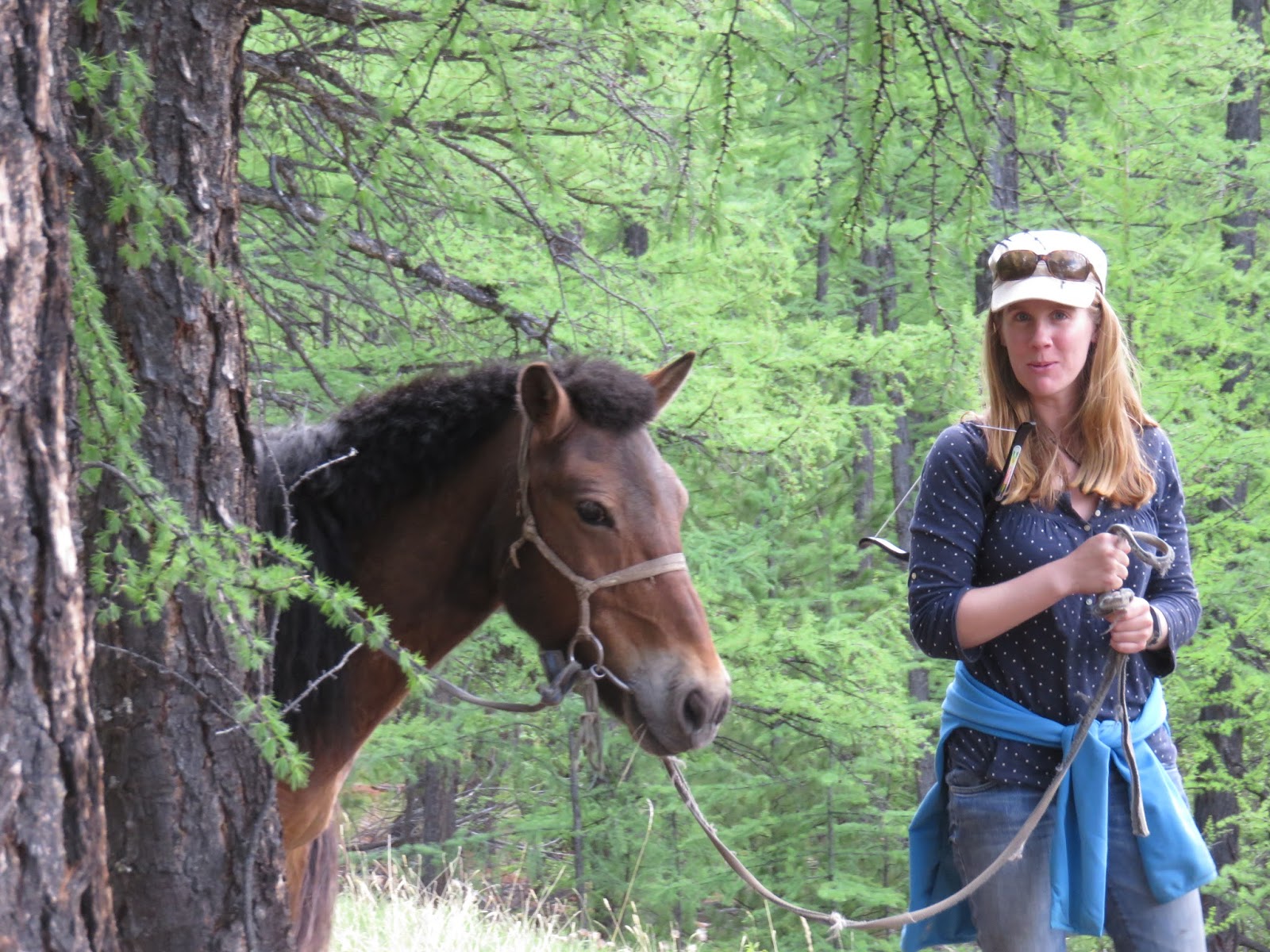
My nameless dun-coloured horse, poor fella, as I am sure I was much too big for him, measured up to my expectations of an almost wild animal.  He was not interested in pats, "good boy" comments or sugar cubes, or stopping when told to.  He really wanted to go where we were going and then get back home.  


Rob's horse had a chunk bitten from his hindquarters

Kat had a chestnut horse which almost earned a nickname (until we remembered that we shouldn't) of "Bitey" due to his tendency to try to eat the other horse's butts. Strangely Kat's camel from the sand dune expedition shared this same tendency! Kat's horse was otherwise fairly cooperative, usually stopping on request and pretty happy to be alive. He did require a firm grip and Kat certainly found him more fun to ride than any other horse she has even met!  


Kat striking a Mongolian marauder pose

Our first day was spent walking steadily upwards towards a glacier near the Russian border (I was never able to find out the name), the vicinity of which we expected to find the Tsaatan family - for they were somewhere non-specific, in-between their winter and summer camps.  Through open plains, windy hills, boggy marshes, lush green forests and pine-clad ridges we meandered, getting to know our horses (but not our guides who were almost basically silent).  Bimba was (what appeared to me) an expert on the back of a horse and I think she loves it any time one of her groups goes on a riding expedition.  


Kat & Bimba, the horse-whisperer
Two dogs followed us all the way, and it took me almost the entire day to realise that they belonged to our guide Nara and weren't strays from a nearby ger-camp. They had a marvelous time finding their own way through the streams we crossed, digging out mouse and prairie dog holes and at one point terrifying my horse so much that it bolted (which is the part that terrified me).  Before long we were back under control and I was still in the saddle, but my heart rate was certainly right up!


Kat taking a sneaky break with Bitey

In the evening, we found the family, camped out in a clearing of a pine tree wood, not far from a thrashing stream.  After the initial introductions they rather kept to themselves, except for helping us set up our own yhurt, complete with semi-permanent (as permanent as anything is in a nomadic society) stove/fireplace and introduced us to their magnificent herd of reindeer.
How to build a yhurt 101
The big buck, recognisable from his ridiculously humongous antlers fed alongside the 30-strong herd of varying ages.  


Big man reindeer
You could easily touch and feel their fur (not the antlers!) as they were very docile.  Before we knew it, the reindeer were herded in for the night. I couldn't tell whether the baby human* or the reindeer were more adorable!  


*Child might be cuter than a reindeer (look at those cheeks)
They were all tied overnight, so they did not wander too far from where the family were staying.  I think this was mainly because in-between camps they had no pen in which to house them, and they needed the mothers close by for milking in the morning.


Mama reindeer settling in for the night
Day 3 - More riding and the glacier
A much slower and easier day, where we started to understand our horses a little better; we spent a few hours climbing the hill above our camp guided by the dogs to have a glorious view of the glacier.


Off to the glacier
Matcha, Sarah, Kat, Tasha & puppy-dog winding up the hill
We had a snow fight and just sat quietly, as far from anywhere as we have been on our entire world journey, soaking up the sound of the wind and the impermanence of our existence.


Even dogs like contemplating their existence

Day 4 - Homeward Bound


Our horses seemed to know the route pretty well.  So they knew that this day was time to go home.  With most of the route downhill, it was all I could do to keep my horse from galloping all the way!  Back through the same marshes and slopes, any time there was an open space he tried to go for it.  Eventually we all had confidence enough that we let them go and BOY what a feeling!  When the ger was in sight, I just needed to slacken the reins one little bit and he would go.  I probably looked like a lame little Lost Boy, but I felt like the Man From Snowy River.


Our crew: Tasha with Nara, his wife and son, Batar, Sarah, Kat and Rob
The best way to get the smile off a Mongolian's face is to pull out your camera!

Wednesday, 10 June 2015

Mongolian Tour: Gobi and Sub-Gobi Desert PART 1

Warning: Mongolia is stunning and the photos will not reflect this. (Except perhaps the quantity of photos!)

Reading Rock Maps
On the first day of our big Mongolian trip began we met Bimba, our guide, and Batar, our driver then hopping into our Russian van, we set off. We had already met Sarah, fellow Australian, online and in Beijing. Again leaving UB, we were surprised at how quickly the city shifted from buildings to gers and were content to stare out the windows, podcasts reserved for future days. 

Our van, Rob stretching and Bimba
Aside from some stunning cliff sides, almost being crushed by a rock and sleeping with fox skins and wolf hides hanging over my head in our first ger experience, our favourite moment was when Bimba and Batar left us in the van to check out the “map” we imagined was on the rocks they examined. You see, in Mongolia you aren’t driving on a road most of the time. There is no signage, no obvious landmarks (well, to us) and at this point we were already wondering how on earth Batar was navigating. It is still a bit of a mystery really, however we can confirm that they were checking for rock paintings, not roadside directions!

Our first day amongst the beauty of the Gobi

Top of the world

This hapenned

Roadside directions (or rock paintings)

Dreaming of foxes and wolves for some reason

Camel dung to fuel our fire
Looking for open spaces? Come here!
The White Stupa
On the second day of our tour we met Tasha, a lovely Canadian, who after teaching in South Korea was joining our Monoglian trip before heading back home. We were also lucky enough to meet some beautiful camels before visiting a spectacular cliffside that was named the white stupa due to its shape. We arrived relatively early to meet the family we were staying with on our second day. This allowed us time to have a desert tea party and enjoy the beautiful blue skies and the superior Mongolian clouds (they are surely the best in the world!). It was also here that we first appreciated the fun that can be had with the country kids and the miraculous views of oncoming weather that the Mongolian landscapes afford you.


Woolly wise camel
Camel and his teeth!

The White Stupa 
The White Stupa from the top

Tea-party (toilet in background)

Cheeky child we stayed with
Fun and games
Sunset...as midnight approaches
Rob with a fair bit of walking ahead of him!
Animal sunset
TO BE CONTINUED...

Wednesday, 25 February 2015

The War Remnants Museum, Ho Chi Minh City


Can't imagine what it would have been like to see these Hueys coming at you 

The War Remnants Museum exhibits the horrors of war in Vietnam's recent past with a message to never to forget the long lasting and devastating impact of war. The Vietnam War (as we refer to it) is known more locally as the American War, and really was a continuation of hostilities of the First Indochina War that the Northern Vietnamese saw as a colonial war, originally resisting French occupation and trying to reunify Vietnam as a communist state.


Kat spent a short amount of time in Ho Chi Minh in 2008 and the War Remnants Museum was the standout experience of her time. It is a powerful museum that exhibits some of the horror of the war and the continuing impacts it has on those involved. Most people know that as technology had improved, the horrors of this conflict was better documented than prior to this time. However, for us, nothing really compared to the photographs and stories shared in this museum. Two particular things stood out.  

From French photographer Huet


Requiem exhibit
On the top floor there was an exhibit called "Requiem" (Tim Page and Horst Faas brought it together and have a book of the same name, and we should credit the book itself here). This description from the exhibition itself puts it better than we could summarise:  

"....Between the height of the French Indochina War in the fifties and the fall of Phnom Penh and Saigon in 1975, 135 photographers from all sides of the conflict were recorded as missing or dead. This exhibition is a memorial to those men and women, and in many cases it includes the last photographs they took...."


Not just the last photographs they took, but ones they took moments before their own death, the words "last roll of film" give an extra definition to the full stop at the end of the caption.  


Capa stepped on a landmine after this "last frame"
This was truly a moving exhibit because it focused less on "we this..." and "we that..." but really just allowed you to see people and their experiences with a journalistic and artistic eye.


It's hard to pick a favourite (even the term doesn't fit), but some punched harder than others.  This image from Eddie Adams is of a South Vietnamese colonel threatening a Vietcong prisoner.  He would have only had seconds to take this photo, and didn't know until after it was developed what significance it had.  If you actually want to know what happened next, the photographer talks about it in this Youtube video.  


Eddie Adams' photograph of South Vietnamese colonel and a Vietcong prisoner
It has been a little harder to find online copies of North Vietnamese photographers.


Shadows of war (Dinh)


We don't want to diminish the other parts of the museum, for they too have a very significant and important message, and leave one feeling quite worn out, horrified, sick and generally disgusted that we as humans continue to do this to each other. An interesting element of the exhibitions was the use of language to show perspectives of history. In several places "American War" was used or "Vietnam War" (with apostrophes) to intimate how many view the atrocities that occurred here. It actually used to be called the "Museum of American War Crimes" among other names, which gives you an idea of the tone of the place.


Self-immolation as protest
The long-lasting impacts of Agent Orange

The other major element of the museum that stood out was the section dedicated to the horrific "Agent Orange".  Rob knew very little about the use of dioxin during the war or its devastating impact on land, crops and people generations later. Kat's knowledge was based on her last visit however the depth of information actually makes a second visit worthwhile. Dioxin can cause debilitating disability for millions of children and families, even now.  The vestiges of this insidious weapon are still felt in the Vietnamese (and to a smaller extent American) communities today, and there are still sites that have not been cleaned or treated since the anti-communist presence in the 70's. Particularly striking was the below letter to President Obama written in 2009 which shows how the devastating impact continues in second generation victims. This letter was exhibited after hundreds of photos of adults, children and babies affected by dioxin and asks if the President could spare some time trying to address this “forgotten problem”.


Letter from a second generation victim of Agent Orange to President Obama


Questions of accountability for actions of war and responsibility for the consequences loomed large during our visit. This article provides information on how 40 years post-war the U.S. has begun decontamination of the worst affected areas in Vietnam. This marks the countries first direct involvement in decontamination and is expected to take four years.

Parts of the exhibition showed the incredible skill that people with disabilities due to exposure to war chemicals have developed. For example, one story told of a man who could write with his feet. Seeing such stories and photos, especially those that involved children, Kat considered what impacts of war would she see when she began volunteering at an orphanage in the next few days.

The displays also made us think about what supports are there for victims of dioxin and how these differ between countries. For example, the article mentioned earlier compares the compensation which American veterans exposed to Agent Orange receive ($1,500 a month) to Vietnamese families with disabled children (just over $5 a month). Court cases and pleas to both the US government and chemical companies from Vietnamese victims have not been successful, whereas U.S. veterans' cases have. 


The direct and indirect effects of dioxin will continue to be felt by many Vietnamese now and in the future. It is obvious that a huge undertaking is needed to improve the lives of those with disability in Vietnam by providing better supports. Whilst the decontamination project is significant, if long overdue, it is only really part of the picture.