Monday, 5 October 2015

A Bridge Over the River Inn

Laurel dropped us at the nearby station Thalwil to take our train to Sargans and then Innsbruck. The trip to Innsbruck was very scenic, the homes and fields of the Alps are every bit as beautiful you can expect from stereotypical movies and photographs.

Since Kat was still not well, we changed plans from camping at the nearby town of Natters to an AirBNB room in an apartment near the technical university in Innsbruck.  Our hostess Maria, spoke a little more English than we did German, but not much, so we had some entertaining conversations sharing stories of our travels and families over the occasional coffee.  Most of the time, she left us to our own devices but tried very hard to set us up to watch the AFL grand final, but unfortunately she didn't receive the channel on which it was being televised - we streamed it over the internet instead!

Innsbruck itself is a postcard town.  Nestled in the Inn valley and straddling the river of the same name, I am sure that in winter, covered in snow it is also magical.  Host to 4 winter Olympics and playing its part in history as a place where rulers could control access through the passes of the Alps, the connection to the mountains is evident through their cable car systems and public transport network. A simple tourist must is taking the STB tram from Innsbruck to Natters (in the south, and our intended campsite).  The winding tram gives beautiful views of the mountains to the north, and cuts through the mountains in the south.

We did that ride on our second to last day (a Saturday), and then walked from the township of Natters to the nearby Nattersee campsite & lake. 


St Michael's Church, Natters
On the way, we encountered a ski jump event for kids.  It is not yet winter, and I have to confess I have always wondered how you train for winter sports without any snow.  The answer seems to be "you just do the same thing, but without snow!"  The kids flew down metal rails on their skis, launching themselves and then landing (we only saw one crash) on a sort of furry fake grass thing that slowed their descent before hitting a bark-laden incline where they stopped.  The place was a lively hub of activity with coffee, cakes and baked goods and parents all around clapping and cheering them on; I shouldn't be surprised, it was Saturday after-all, so it was probably just the equivalent of any old cricket or netball event at home!  
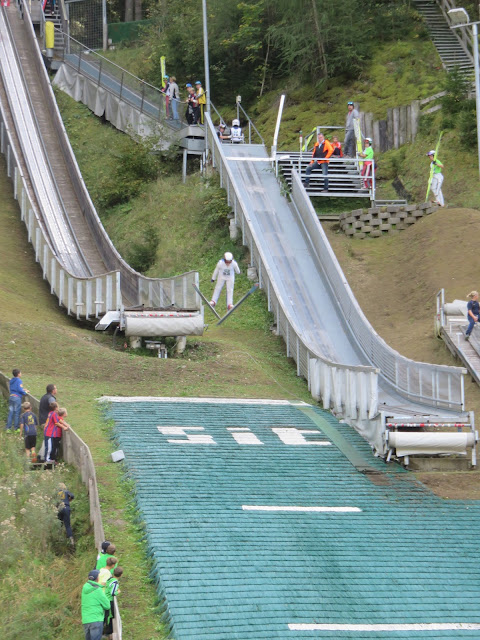

Child launched off the ski jump
Innsbruck's cathedral is striking, even after the damage cause by the war.  From the baroque and intentionally deceptive outer windows to its pretend-domed ceiling the artwork is something to admire (I might have even hurt my neck!).  The gleaming alter and its center-piece surrounding the Maria Hilfer were reminiscient (for us) of the Santander cathedral.  Little wonder that this is another place pilgrims on the Way of Saint James have and do visit on the long road to the Compostela de Santiago.  We visited as part of a walking tour.  Our guide was brilliant, although she had to manage two groups at once, a German-speaking and the smaller Australian-speaking group.  The other Australians were a friendly couple who were on their own 6-week holiday mainly of the battlefields of the Western Front, they were on the tail-end of their holiday, visiting Innsbruck before returning to Münich and then home to Sydney.

The tour was quite short in distance covered, but not on the detail.  It focused a lot on the Roman Emperor Maximillian I, who seemed to manage a lot through his various titles in the late 15th to early 16th century - a period of 60 years. That was a time when country borders looked nothing like today, and where marriages to secure treaties and hold over land were still all the rage.  I actually lost track of all the arrangements he made, both for himself, his children and grandchildren - at one point even marrying Anne of Brittany by proxy (PROXY!)
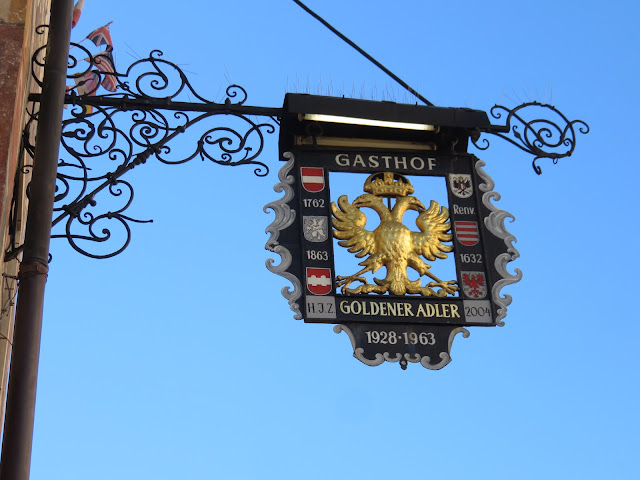

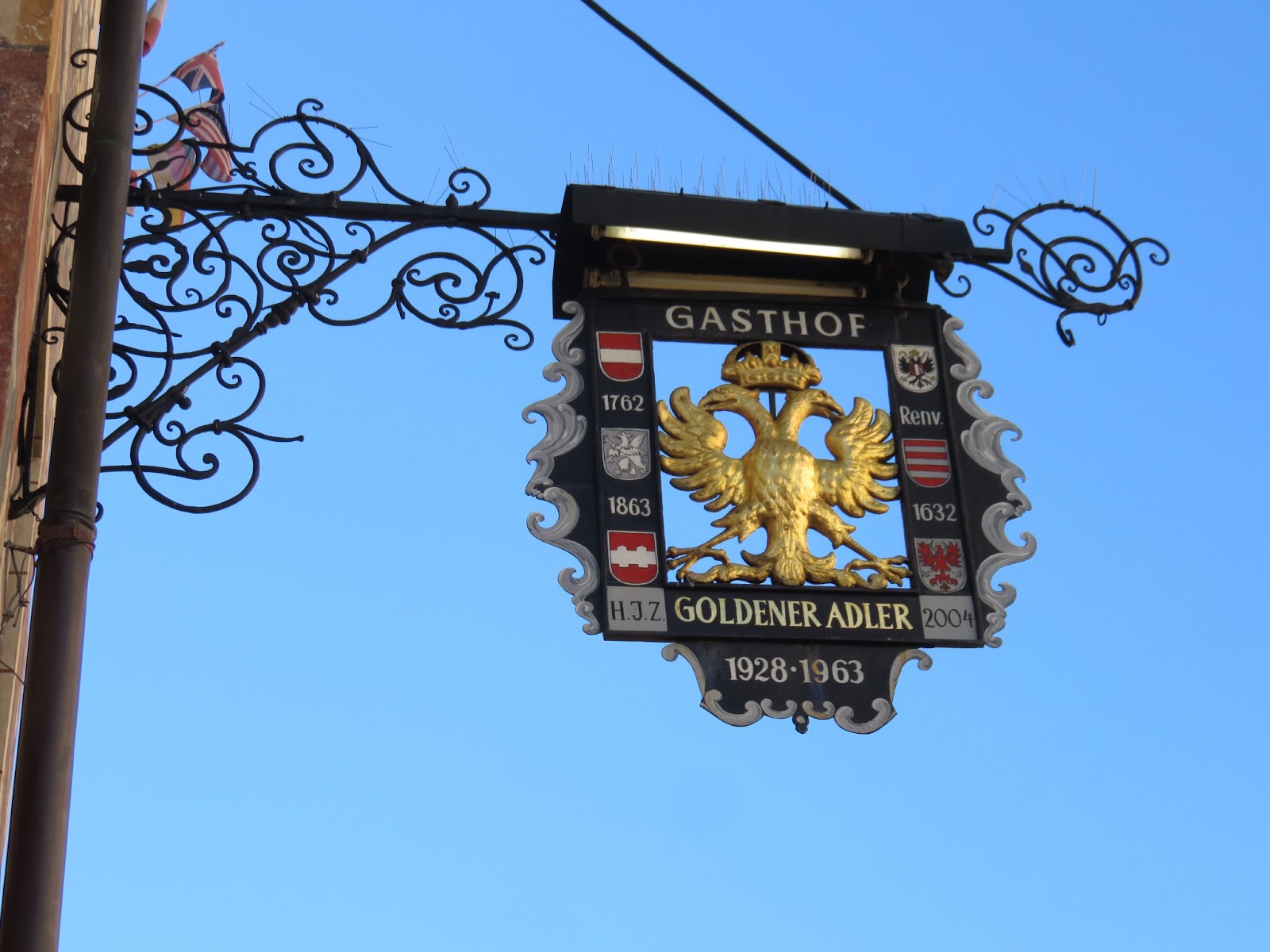
Regular meeting points, a coat-of-arms is a bit easier when you cannot read!
Max left a big imprint on Innsbruck and built the Golden Roof, a central landmark overlooking the activity of the market in what is now "Old Town".  It sits just by the City Tower, which survived the 22 air raids Innsbruck suffered WWII.  We climbed the Stadtturm (City Tower) which is taller than it looks, and enjoyed great views of the nearby cathedral, town and surrounding mountains (but, really you can see them from anywhere in town).  From here the city watch was to declare the hours and watch for fires, the last city watchwoman only retired in 1967.
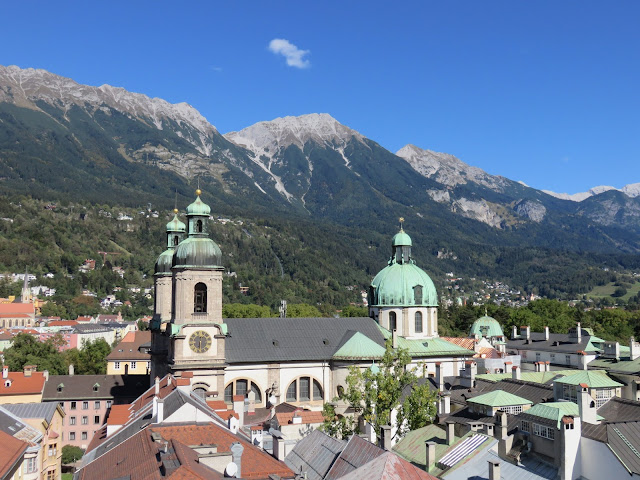

The Cathedral from the Stadtturm
The Golden Pavilion from the Stadtturm
Innsbruck has a population of some 130 000, of whom 30 000 are students.  There was certainly a lively feel about the place, and it was so easy to get around by bus.  Actually, one day whilst waiting at the bus stop a woman stopped on her way to offer us plums! Typically Kat had been told not to eat fruit until she was better so had to refuse. I solely reaped the benefits of the mountain plums- well, I have assumed the source of the fruit based on the lady's enthusiastic gestures- and after gobbling one, she offered me another. These are the moments we often forget to blog about, but are probably the ones we will always remember. 

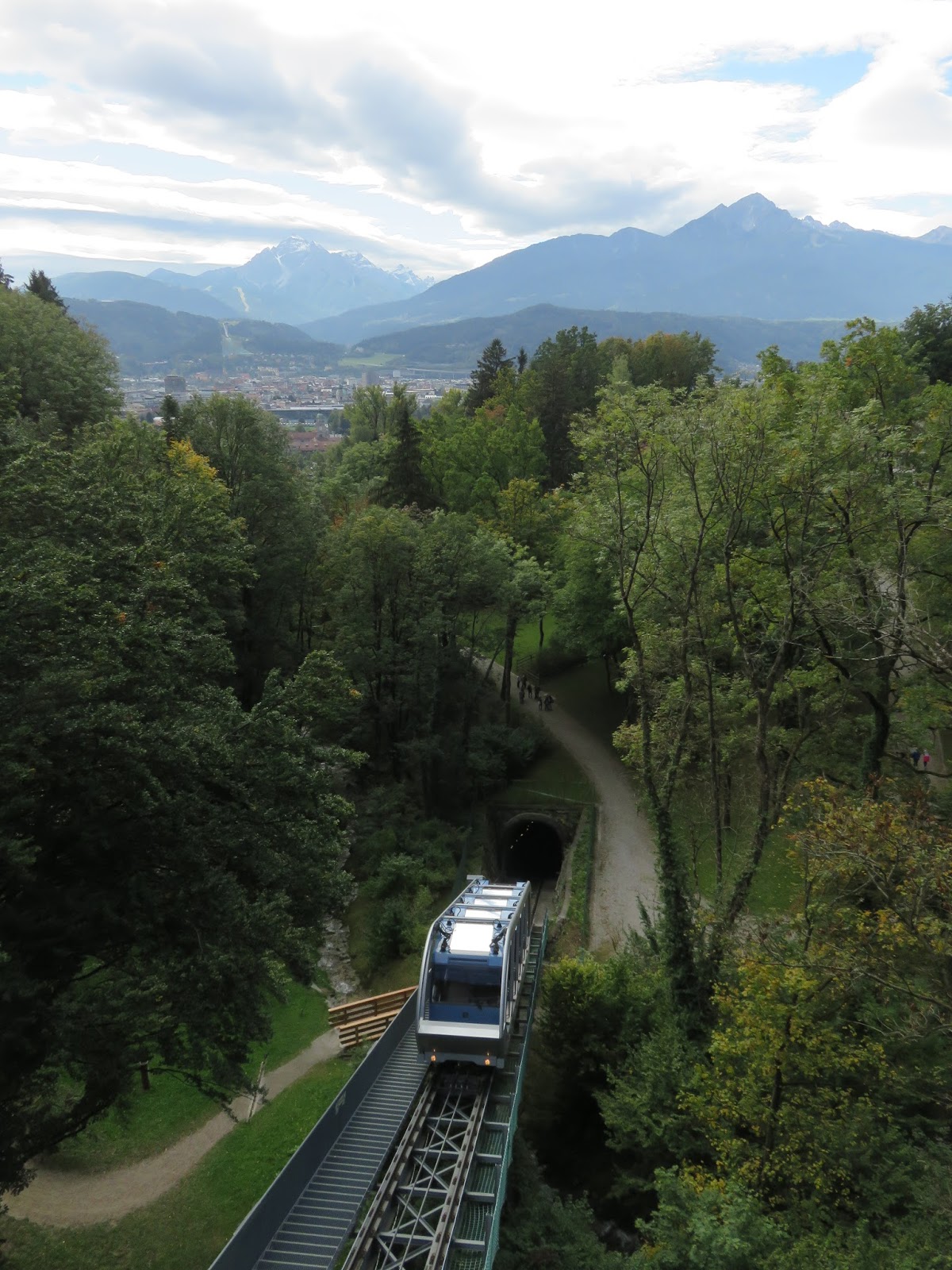
Our best experience (after the plum lady) was on the cable cars and looking down on Innsbruck from Hafelekar station.  Within an hour, you can take a ride on the cable car train from the Congress station past the Alpen zoo to Hungerbergbahn, from there you change cars and ride up to Seegrube and with a final change, ride on up to Hafelekar.  Making a 1600m climb in what feels like no time at all. 


A departing cable car/tram/train/rollercoaster
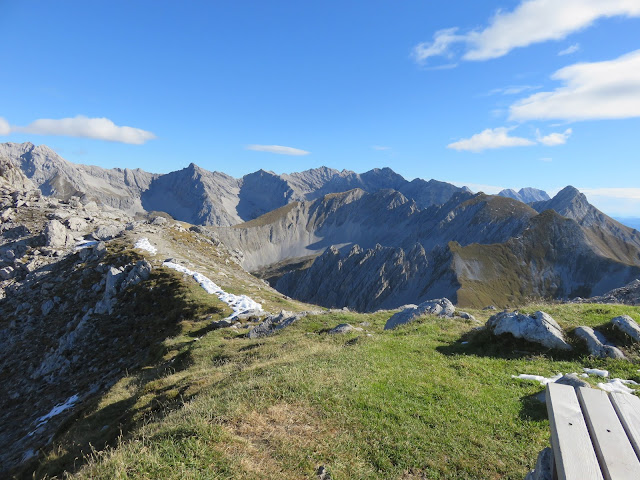
Once at the top we could see across to Germany, and were free to wander from the Hafelekar station to the peak Hafelekarspitze with a view over Innsbruck but also to walk down to the free ropes course where eager climbers can embark on a 3-5 hours fixed rope climb.  We satisfied ourselves with walking, and learning about the rock formations and how they developed.  
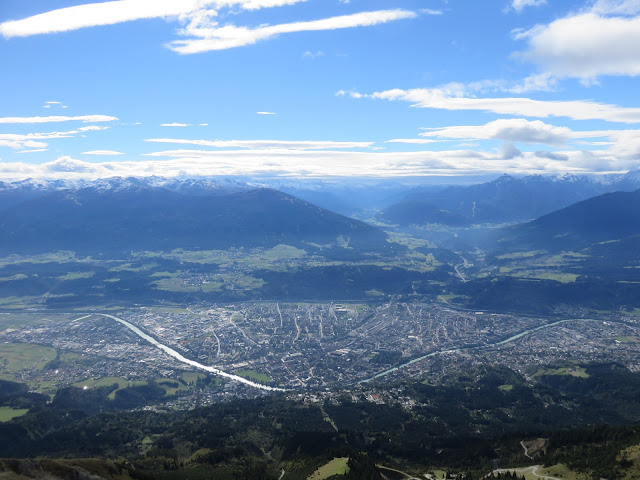

View of Innsbruck from Hafelekar
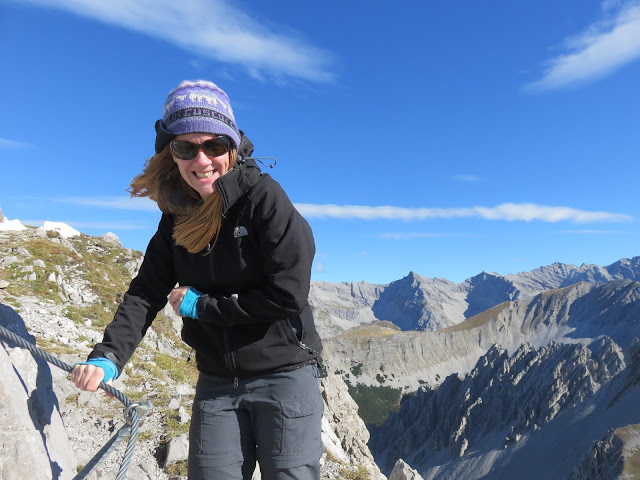
We picked a windy day, glad for cable hand-holds!
It used to be a coral reef!
Maybe one day we'll be back to see the place in winter!

Saturday, 3 October 2015

While I was in the bathroom

While I was in the bathroom, Kat and Laurel hatched a plan for us to spend the day in Liechtenstein! Kat had originally thought it would be nice to walk across a country and, understandably had considered Liechtenstein a top contender. She was chatting to Laurel about it and Laurel kindly offered us her car for the next day instead!

What a present!  A car to have to independence to travel around Switzerland and Liechtenstein for the day!  We set out (not too early) for Vaduz, a simple 2 hour drive from Laurel's at Kilchberg only stopping to pick up our train tickets to Innsbruck for the next day. Our hastily manufactured plan was mainly focused on doing a walk along the "Prince's Way", above the Liechtenstein Castle.  First we stopped off for a map and a drink, wandering the street in Vaduz and poking around to learn a very little bit about the place.  I learned more than I did from watching The Knight's Tale but I do not think I am likely to win any history awards for this region of the world.


Not enough castles have views these days

Kat loved this statue in town
I wanted to understand how Liechtenstein could become such a wealthy independent nation (with unemployment as low as 1.5% in 2007) with a parliament and a popular monarchy that still holds a lot of power.  The key to the wealth is obviously low corporate taxes, with more corporations registered there than there are citizens.  But I am not sure how they really became or developed their independence from the nations around.  Of course, it turns out that it is "kind of complicated".  From what I understand, when Napolean "took over" the Holy Roman Empire, he banished many of the pre-existing structures.  And then, when Napoleon was deposed, the vaccuum left behind allowed Liechtenstein's monarchy to do some clever politicking, to set itself up first as part of Austria-Hungary and then independently but linked with Switzerland.  Really, it would just be better if you read the wiki, and if you really want to understand it, probably go and find an better source of information!

It was a beautiful sunny day, and we were counting our blessings as we wove Laurel's car up the mountain road to Geifels, the start of the Fürstensteig (The Princes' Way) walk. It was great how quickly we left Vaduz behind on the small winding road, only once having to back downhill to let a fat bus through.  The walk was cold in the shade and toasty in the sun, once we cleared above the treeline, we could see over the Rhine Valley where Vaduz sits.  It was fresh and beautiful up there and another throwback to Nepal where sometimes we had to grab onto a cable while walking/scaling across a rocky area.

We didn't make it all the way to the Three Sisters but did enjoy sitting up in the clean mountain air, admiring the tiny country in front of us.  Fun fact: a survey in 2006 using updated technology found that Liechenstein's borders are actually 1.9km longer than previously thought!

Probably the best outcome from any bathroom trip I've made.


Views on the way up
Channeling my inner donkey whisperer
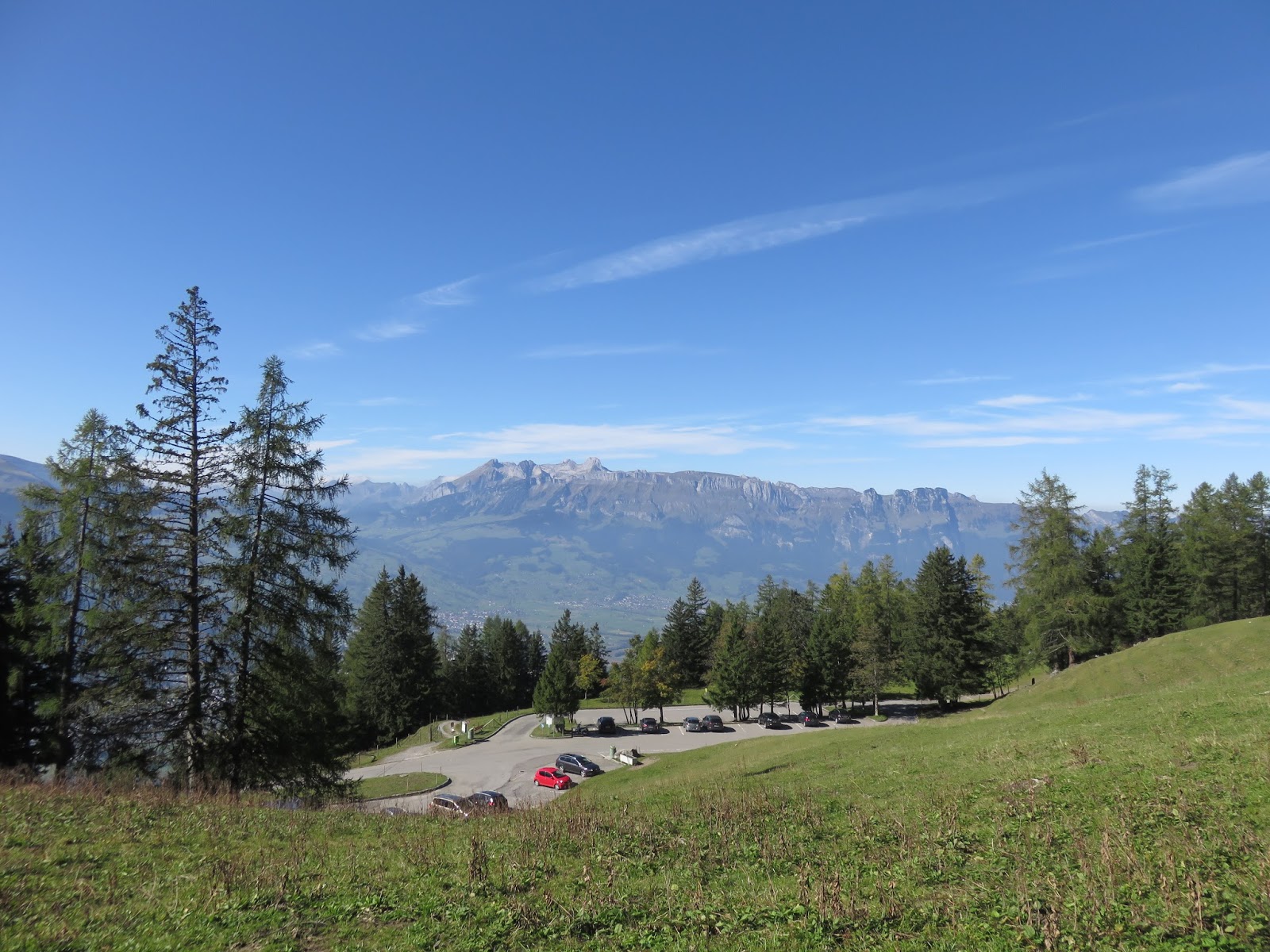
Best view from a car park since the Bernina express (which was less than 3 days before!) 


We were not crushed by falling rocks


Not bad 'eh?
Looking out


Top of the world!
Spot the Kat
Looking down


Bliss


What a walk!
Still with an eye out for rocks above
A final look back at Vaduz as we left
We could even take them with us in the car

Friday, 2 October 2015

Zurich and Lucerne

After hopping off the Bernina Express in Chur, still in awe, we looked for our fourth train of the day to Zurich. Initially we were spoilt with another scenic journey but before long tunnels and the departure of the sun limited our view. We set to some blogging and soon found ourselves in Zurich.

We were met at the platform by Laurel, Rob’s friend and our amazing host. It was great to hear an Australian accent (though our neighbours on the Bernina Express were from Melbourne!) and a friendly face. Laurel has called Zurich home for a decade and gave us a wealth of information on the city, what it is like living there and on the international school scene. We were also extremely lucky to be shown around Lucerne.


Rob & Laurel
Lucerne
In Lucerne we climbed up the battlements and the walls and went up the clock tower that was there, giving us a nice view of the city on one side, and, strangely, an athletics track on the other. Laurel took us to great lunch where Rob ordered the opposite of what he said he wanted! We were entertained by an Italian lady that tried to sit everywhere except where she was supposed to. Unfortunately the famous Chapel bridge of Lucerne was under repair so we couldn’t see its well-known paintings that depict Swiss life in the 12th century and tell the history of the city and the story of William Tell. It was the oldest wooden bridge of Europe but was burned down in a 1993 fire and was then rebuilt. We loved the murals on many of the building in Lucerne.


Clock tower
Creepy man with a camera lurking behind a tree...
Inner workings of the clock and if you look closely you can see Ghost Rob
Lucerne city wall
Lunch venue and an amazing family tree
Public murals

Public murals
Chapel Bridge from afar


We missed this one on the way in!


You have to look UP in Lucerne
Travelling to and from Lucerne, Laurel took us to her favourite viewpoints, including a church with a bright pink interior. Unfortunately access to the church was blocked by one of the many cycling events that are following us around the world! It was lovely to see the colourful Autumn leaves as we drove between towns.


Autumn is upon us!

Zurich
I hadn’t realised that Zurich is a relatively small city with only around 400 thousand people in the city proper. The villages or suburbs of Zurich are spread out around the lake. It doesn’t feel like you are in the biggest city of a country, even though you are. The quaint little villages and the beautiful lake with views of the alps are what I think makes Zurich special.


Views across Zurich lake (unfortunately alp visibility is low in this shot)
On our walking tour of Zurich, our guide told us that though Berne is the government headquarters of Switzerland, it is not the capital. In fact, Switzerland is a confederation of Cantons without an official capital. In roman times Zurich was a tolling station along the Linmat river. One of the most historic parts of Zurich is Linderhoff, a central hill and viewpoint over the river and city and at one time a Roman fort. Whilst on the hill the guide told us an interesting story about Zurich in the 15th century. There were no men left in the city as they were off fighting battles. With an army converging on the city, some women decided to dress in men’s battle gear and stand on the Linderhoff so approaching armies saw the town was protected and left without a fight.  This is supposedly the origin of the female national personification Helvetia, the woman in flowing robes bearing a spear.  Although, when we researched it, we couldn't find anything about this myth.


Helvetia
View from Linderhoff
View of Grossmünster from Linderhoff
A random fact that I learnt on the tour: Helvetica font was invented in Zurich. Maybe I should change the font of this post in honour of this discovery! (Changed!)

The walking tour took us by a number of churches and recommended eateries. One of the churches, St Peter’s, has the largest clock face in Europe. Another, Fraumünster, is an old gothic church with beautiful and unique window paintings by Marc Chagal. We went up the  Grossmünster ('great minister'), a Romanesque-style church, for some lovely views of the city and took the guide up on a recommended café. Despite being sick I could not resist the urge for a hot chocolate, or trying some new Lindt chocolate varieties. I was in Switzerland after all!

Fraumünster
Autumn at Linderhoff


Largest clockface in the world


Grossmünster


View from Grossmünster 


View from Grossmünster


Faces in-between clock faces

Traditional house around Zürich lake

Aside from exploring Zurich and its surrounds, the best part about our time with Laurel was chatting and watching no less than the three movies! The Zurich film festival was actually on whilst we were there but we opted for the comforts of Laurel’s home. Besides, what better place for a viewing of Chocolat than the neighbourhood of the Lindt factory? (Well, except maybe a small village in France!)
Provision of chocolate samples:
That's when good neighbours become good friends!