Friday, 23 January 2015

Kinabatangan River and Jungle Trip

The "jungle mafia" were everywhere but others characters were more elusive and sightings of them were perhaps more rewarding. Journeying along the Kinabatangan River, we thoroughly enjoyed spotting a range of wildlife. We were informed early that we would not be stopping the boat for the common maquaque monkeys (referred to as jungle mafia) or the Egret (white birds) that were interesting to watch but ever present.


"Jungle Mafia"

Gibbon's were not easy to capture on film

Our group was privileged to have had fleeting visits with gibbons, orang utans (especially Gary the first orang utan named by Kat), and even crocodiles. Our excellent guide Teo was very knowledgeable and managed to steer the boat to optimum position whilst providing information on scientific classifications, interesting facts and, at night, shedding some light on the situation while simultaneously looking up birds in his book.

Stork-billed Kingfisher
Gary the Orang Utan
Oriental Pied Hornbill
Male proboscis monkeys prefer to hide 
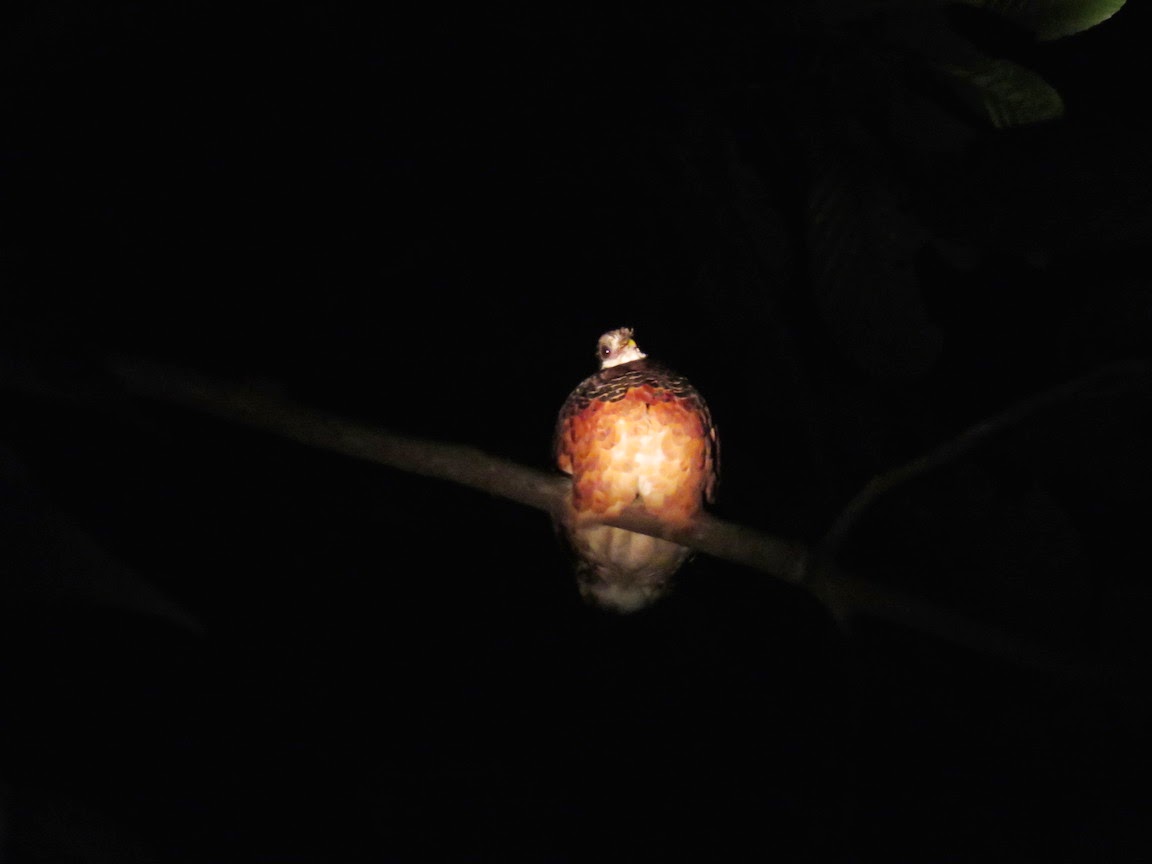
As we set out on Uncle Tan's 3-day, 2-night itinerary, Kat was most excited about seeing the proboscis monkeys and Rob was keen to view an orang utan (outside the sanctuary). We were both surprised how much we enjoyed spotting a range of native birds. This was especially amazing during our pitch-black night trek through mangroves when we got up close with sleeping birds that didn't bat an eyelid. Rob also found a partridge everyone else had missed (no sign of a pear tree) over his head at one point.


One of our more drizzly boat outings 
One of the sleeping birds 
Rob's partridge


Proboscis Group & Teo
It took us a little while before we really introduced ourselves to our co-travellers and guides on the jungle tour.  We were a motley group of Swedes, Chinese, Germans, English, Americans, a Canadian, Danes, Australians and a Malaysian.  Broken into two groups (the Proboscis Monkeys and the Crocodiles) we also took on this arrangement for meal times (which was totally un-necessary, but seemed to just develop on its own).  In our group (Proboscis), we had Gloria, May, Goodwin (from Qingdao, China), Anna & Simon (from Sweden).  `


TEAM PROBOSCIS!


Our wonderful guide Teo


We were lucky enough to have Teo as our guide for each of the trips river cruises and jungle treks, while the Crocodile group had Dis (AKA “Jungle Dis-co”) .  He was incredibly knowledgeable and never seemed to display a boredom of describing the same animals and plants over and over again, or searching for them on the banks of the Kinabatangan.  He could spot a tiny kingfisher from 200m away and knew the tree that the dollarbirds loved to frequent. Nothing better describes his sincerity for the subject matter than this photo of him as he tells us about a dead cotton spider.

Although he has a serious face in every photo we have, he was a very jolly bloke, easy to laugh, quick to make a joke and entertained us each night with endless rounds of karaoke as he played along on the guitar.

Program Activities
Kat spotted a few frogs
During our stay in the jungle we took part in two night boat safari’s, two morning boat safari’s, and afternoon jungle trek and a night trek. Each one was rewarding in different ways. The first night boat trip was easily the most exhilarating. We discussed how neither of us would ever feel that good about directing a speed boat on a river through pitch-blackness with only the aid of a torch. Once we decided it was unlikely we would end up on the river bank on our next turn since Teo had probably done this a million times, we quite enjoyed the ride. The stillness and serentiy of the morning boat trip contrasted with the excitement of a jungle coming alive after dark on our night trek. Initially Kat did not enjoy the night trek due to the abundance of mosquitos and spiders however she was soon absorbed in spotting an array of frogs, insect and birds.


Red jungle millipede on mossy log

The Accommodation
For 2 nights we lived on mattresses under mosquito nets in huts built on mangroves.  It was a little muggy but not without some luxuries, such as electricity from 7-midnight (from a generator), sit down toilets and if you wanted, you could have enjoyed a cold bucket shower (although as the water was quite brown on account of coming from the Kinabatangan, we opted to wait for our return to Sandakan).  Items such as wet ones, deodorant, and anything with a fruit smell had to be stored in sealed plastic tubs to protect them from ransacking by rats or maquaques.  If you are a 5-star hotel gold member (and live by that), you might not enjoy this experience but we really loved it. 

We shared our hut with Gloria, May and Goodwin – who were lovely company.  Gloria’s English was very good (so good in fact that she could translate our complex Uno rules for May) and made up for my lack of anything but “xie-xie” and Kat’s primary school-level Mandarin, it was also a pleasant surprise to find that they also were staying at the same hostel on our return to Sandakan.  Gloria generously extended an invite to stay with her should we pass through Qingdao when we get to China. Anna and Simon did the same for Sweden.
 
As the website says "It is a Wildlife Camp you are visiting
 - NOT A RESORT & SPA
"
Sunset on the Kinabatangan River


Highly Recommended
We really enjoyed the secluded location of Uncle Tan’s and would highly recommend it as probably the best thing we have done in Sabah. (Thanks to Scott and Bianca for recommending it to us!) Within our whole trip it was just us 15 visitors, the staff and the wildlife. Very occasionally we also saw people from the local village but no other tour groups.


A great place to visit in Sabah


Booking and Prices
Uncle Tan’s can be booked online (no deposit required) and all the necessary information is on their website. Payment is cash only (don’t be the people who need to take a special additional taxi ride back to Sandakan for more cash) and RM420 per person plus a RM10 conservation fee. It includes accommodation, all meals, tea/coffee and activities. The staff operate a co-op that sells water, soft drink and beer, sometimes chocolate, at reasonable prices. (We spent RM15.)


Monday, 19 January 2015

Kinabalu National Park and the Poring Hot Springs


Still holding onto various symptoms of illness, on Saturday 17th, we moved in a haze to the Kota Kinabalu bus station hoping to both find an ATM and buy our tickets to the “D’Villa Rina Ria”, our accommodation which we knew to be somewhere near the gate of the Kinabalu National Park.  I say somewhere near the gate, because D’Villa’s website did not really provide an address as much as it did directions on how to get there.  I don’t like directions so much as I like to look things up on Google Maps and understand where they are.  In this case, D’Villa was in either of 2 places, one inside the park, and one outside a few kilometres from the park entrance – should the map be believed. 

In standard Dolphin Sands Road style, there was a problem.  Every ATM within coo-ee of the bus station was out of order and the bus left in 15 minutes.  We didn’t want to take a later one as we actually had quite a lot planned for the day, so on we hopped with about 40 Ringgit left to our names.

The bus was one of the most comfortable I have ever travelled on, even on the top floor along those ridiculously windy roads.  Kat had no sign of her travel sickness and my back pain was starting to subside. It would have been lovely to take that bus all the way through to Sandakan, but after only 1.5-2 hours we had arrived at the Kinabalu National Park gate.  The conductor told me we were the next stop and we prepared ourselves.  It turned out that the next stop was about only 500m down the road.  Before we knew it, we were standing next to a tiny little shop with one of those funny kids’ toy dispensers at the front, with our bags at our feet in a gathering cloud of dust as the bus started to push on the remaining 5 hours to Sandakan.

At this point, Kat said “well, we’re obviously in the wrong place”.  I laughed at her and then grabbed this photo as the bus departed and cleared the view across the road.

Finding D'Villa Rina Ria
After dropping our gear we bee-lined for the Kinabalu NP to look at some of the walks.  We had already decided against attempting to summit the famous Mt Kinabalu due to cost, our pending visit to Nepal and our lingering illnesses. While it would have been quite the spectacle, there’s also a lot of trails to investigate down below, and only a small number of tourists to share it with. (Most appearing to prefer to take photos with the sign outside rather than walking in the park!)

Mt Kinabalu from the top (what we missed!)
 
We chose to do the Pandanus and then the Kiau View trails.  Rather short walks on their own.  As we were now much higher than the muggy Kota Kinabalu, it was refreshingly cool and the mist floated through the trees giving our walk a mystical appeal.  Here was where we really started putting the camera through its paces, as the sounds of the cars, buses and trucks faded away, we were alone in the jungle. 


When jungles attack
All this we managed to achieve before lunch which we decided to take in Ranau, after finding an ATM to pay for it.  Here’s where the next problem developed.  We needed to get to Ranau first. 
Most of the buses travelling through this road are going to Sandakan, and most have already passed through by 11am.  We spent a solid 90 minutes from 12.45-1.15 waiting for a “mini-bas” or “bas ekspress” that didn’t exist to come, because we were too stubborn to pay for a private bus, or a taxi (and we couldn’t afford it at this point anyway).  This waiting was not uneventful, as we were joined by a limping American (who had also explored the trails at the base of the mountain) and wanted to see “how the transport system actually worked” – I don’t know that we were really suitable subjects for his study.  Not only that, but Kat took the opportunity to STEAL A BABY! (Not true, the woman below asked Kat for a photo with her baby, while I was taking another photo for a group of guys, I turned around and BHAM!  Kat had a baby). 

Stealing babies

Eventually we hitched a ride with a lovely young guy called Benny.  Or at least he seemed lovely, he wasn’t that talkative, I wonder if perhaps he just pulled over to have a story of two strange Australians he picked up on the road to Ranau. 


Successfully extracting cash from a helpful hole-in-the-wall, we enjoyed a yummy lunch of Tom Yum soup and Nasi Goreng and then attempted the next challenge, getting to Poring Hot Springs.  Being 2.30 in the afternoon, saying that we were already pushing it would be an understatement.  Long story short (too late), without being able to find a bus headed in that direction, our only real option was to hire a taxi both to get us to Poring, and then hang around for the return trip to D’Villa, which he promised to do for less than any bus service available at Poring.  The driver was a cheerful guy named Steven, whose car was a mobile advertisement for Apple (with stickers all over it), although I noted he used a Samsung mobile phone.

The development of Poring Hot Springs was actually influenced by the Japanese occupation (from 1941-43).  They are also the site of an amazing canopy walk and butterfly park.  We enjoyed the canopy walk before relaxing in the deep and very simple-to-use-except-for-the-plug baths. 
A view of the forest canopy
We met a number of other tourists either just there for the day or who were recovering from the mammoth climb up and down Mt Kinabalu. 
Successfully pulled out the plug
All in all, we would have liked to:

a) Been a little more savvy about the travel arrangements, paying more than you need for taxis just makes you feel a little silly. This whole adventure would have been easier with our own car/motorbike, or even with a larger group of people that could keep costs down. (Mind you, this area is not really set up for independent travel.)
b) Do more of the lower altitude Kinabalu NP walks, we could have allowed a little more time for this and not been sick.
c) Remembered the limping American’s name (he had been living working in China for the last 4 years and sounded like he has some interesting stories to share).


 Costs worth talking about:
  • Bas Ekspress – RM30 – KK >> Kinabalu NP.
  • Taxi - RM40 Ranau >> Poring Hot Springs.
  • Taxi - RM60 Poring >> D’Villa Rina Ria (Kinabalu NP gate) – Steven gave us RM10 off his quoted price, because he was nice or over-quoted us in the first place, you decide which.
  • Kinabalua NP entry – RM15 (also gets you into the Hot Springs if same day).
  • Poring Canopy Walk – RM10 + RM10 camera fee.

Saturday, 17 January 2015

Kota Kinabalu, Sabah

When I get to a new place one of my favourite things to do is walk around and just see what I can see without any particular goal or destination. Though we did have the Kota Kinabalu night market in mind as we set off on our first afternoon in Sabah, it was some time before we actually stumbled on it. First we were rekindled with the feeling of sticking out like a sore thumb, wanting to take a shower every ten seconds, the usual cocktail of nice and putrid street smells, as well as a lot of welcoming smiles and greetings. Yep, travel smacked us in the face and we (mostly) loved it!

KK Night Markets
Kota Kinabalu night market has a great atmosphere and lots of interesting, tasty, food and drinks on offer. Our first trip dinner consisted of a range of market snacks, many of them turning out to be desserts. We enjoyed the people-watching and community and decided to return the following night. Rob was especially thrilled with something on a skewer that we suspected wasn’t chicken but something more like a cross between squid, a baby octopus and an alien. We were the tourists that scampered away from the market stall to the sounds of laughter at the discovery of what was left on our plate.
"Chicken" and unidentified things on sticks
Rob making a purchase


Market juice
 I like to think that the first day we wrote off to illness was more to do with acclimatisation than anything we ate or drank at our market outings. However, if that was the cause, it was well worth it. Our third day in KK was spent almost entirely at our very comfortable hostel (Masada Backpackers) recuperating from our different illnesses and ailments. 

Something fishy is going on
Boulu Kukus - a steamed sponge cake
Perhaps we had jumped into our adventurous state all a bit too quickly in terms of walking, eating and breathing the local life. Prior to falling can’t-face-the-outside-world-ill, our second day in KK started early with a somewhat planned, somewhat accidental 10km walk around town and up to Signal Hill. It was interesting to see some different neighbourhood and I love to get a birds-eye view of a town. There was not much of a view of the harbour but it was good nonetheless. On our walk we also visited the Atkinson clock tower, a very out-of-place reminder of the British influence on North Borneo. During breaks I introduced Rob to Malaysian fruits I have enjoyed on previous visits, my favourite being mangosteen.

Initially we had planned on 2 full days in KK but it was extended to 3 when our trip to Sapi island became a daytrip. We decided to visit the Museum of Islamic Civilisation and Sabah Museum despite the less than promising reviews on both. The first really needs a new title because it was rather less about Islamic Civilisation as a whole, predominately narrowing in on Islamic dress and betel boxes. That said, we definitely found it thought provoking and I mostly find tourist experiences like books: you can usually find something to take from it even if you would not rate it highly.

We had quite the discussion about how dress customs are influenced by different religions and how important they can be to one’s identity and beliefs.

The Sabah Museum was broken into different sections, some better than others. The History section was the most fascinating for me and I would recommend it for that alone.


KK was a great starting point for our trip to ease us into things. Locals are friendly, helpful and English is wide-spread. Many tourists use it purely as a launching pad for beach trips and trekking, but due to its multicultural community and people I think it deserves a look-in for at least a day or two.

Friday, 16 January 2015

Pulau Sapi (Sapi Island)


Tourist warnings for the jellyfish - "Watch out for Humans!"
Our primary activity for 15 January, 2015 was a very enjoyable visit to Sapi Island.  Only a very brief boatride away, our research let us know that it should be good for snorkelling, swimming, camping, monitor lizards, sunbaking, a brief walk, ziplining from the neighbouring Pulau Gaya, and of course, watching tourists in their native habitat. 

Kat enjoys the secluded back-beach
We found this very helpful and insightful blog, a mere 2 years old, telling us of the wonders of being alone on Pulau Sapi, after 4pm, when the day tourists board their boats and return to their air conditioned hotel rooms on the “mainland”.  They told wonders of an island teeming with beauty, of monitor lizards, crawling through camp and a beachside camping spot to die for.  The tourist websites, posters and tour agencies also told tales of a magical glistening island of marvels you have never seen.
With our adventurous hearts excited at the prospect we did some background work on whether or not we would need our own tent.  Spending a night alone on a tropical island has some appeal, after all! A few false leads and we worked out that it was actually possible to borrow one on arrival.  We verified this through multiple independent sources (the crew from The Newsroom would have been pleased).
 
We’d talked with hostel guests, with our hostel hosts, with taxi drivers, with the guy that sold us the tickets, with the boat driver, with the park ranger (who did charge us the RM5 camping fee) and no one ever batted an eye at the mention of camping overnight on Sapi.  Some said “oo very beautiful”.    We made it to the counter (“just up there, straight then left”) where you hire such oddities as snorkels, fins, umbrellas, life jackets (for swimming in) and, as sure as I am writing this, tents, it was even there on his sign.
That was the point where we least expected to be disappointed.

Guy at counter: No tent.
Rob: No tent…huh… No tent because it is not available? No tent because it is broken? No tent because you just don’t have one?
GAC: Huh? No tent.
Protect your lunch!
Further pressing on the issue led nowhere, so I eventually returned to the park ranger who offered to refund the camping fee if nothing else could be arranged.  A very confusing conversation then took place where at least 4 different people started calling other people on their mobile phones, shouting at one another in Bahasa and I’m pretty sure that at one point I interjected with an “ahem, yes, that’s right…camping”.
 
Eventually the smiley bloke who could only be described as the leader of this collective group of helpful foreign language-telephone-everyone-they-know-type people summarised their enquiries: “sorry, today is not your day, my friend”.  And that, as they say, was that.   

The snorkelling was nothing to complain about, but I would not rave about it either.  It was a perfectly enjoyable way to spend the afternoon and certainly helped to take the heat out of the day.
 
Do the walk (if nothing else)
Far more impressive than the snorkelling was the walk around the island - I’ve read it suggested that you could do this in 45 minutes.  Perhaps this is true, if you ran marathons daily, did not own a camera and cared little for the scenery; for those following in our footsteps, or choosing to make your own, I’d suggest allowing 90 minutes to really take it in – and go clockwise. For you will discover clifftop views of the South China Sea along with a secluded and non-tourist infested beachfront.  It was amazing, I actually wish we had gone around a second time.

On completion of the beautiful walk, we joined many of the others (their numbers depleted after lunch); soaking in the sun, flopping about in the water (inhaling some through a snorkel) and taking selfies. We were certainly impressed by our first contact with the any wildlife in Malaysia – spotting three terrifyingly big monitor lizards, a pig, and a rather angry grey fish that pecks at your feet if you stay still too long.
 
For those planning their own adventure, my tips your own successful Sapi visit:


  • Bring your own tent (to be sure) if that’s your thing.
  • Don’t try to over plan this thing, the boats leave both Jesselton Ferry terminal in KK and Sapi frequently.  Don’t stress, you’re on holiday.
  • Do the walk.
  • Give yourself enough time (some people island hop – Sapi deserves more than 45 minutes).
  • Stay after 1pm when the lunch tourists leave.
  • Tickets are cheap and the island is easy - do it without a tour company.
  • There’s both package meals (for tour bookings) and a cafĂ© (with reasonable prices) on the island.
Costs (for the things worth talking about) - per person:
  • Snorkel/Fin hire - RM15
  • Boat Fare (return) - RM23
  • Conservation fee - RM10
  • Camping fee - RM5
  • Jesselton terminal fee - RM2-3
  • Gaya zipline - RM60 (we didn't try it but it looked like fun)
Palau Sapi map


Wednesday, 14 January 2015

Packing hand sanitiser for a year?

Choosing what to pack is never that easy for me. However, when the time came I was pretty certain about what was going to make the cut and what wasn't. Here is a rundown:

Things that were never going to make the list:
High heels
Hand sanitiser for a year (my dentist's burning question was how to pack this for such a lengthy trip!)
Make up
Our fantastic camping coffee machine! 

Items of contention:
Tent (considered very early on)
Sleeping bags (made the cut)
Bottle opener (came along)
Leggings (Did not make it. They're not pants yet I've worn them travelling before)
Yoga mats (Surprisingly yoga mats made the cut!)
Rob's Tigers (Took out last minute)
Hair dryer (Yep. Update on usage to follow.)

Items we perhaps forgot:
Tiny stove (We think we intended to bring this!)

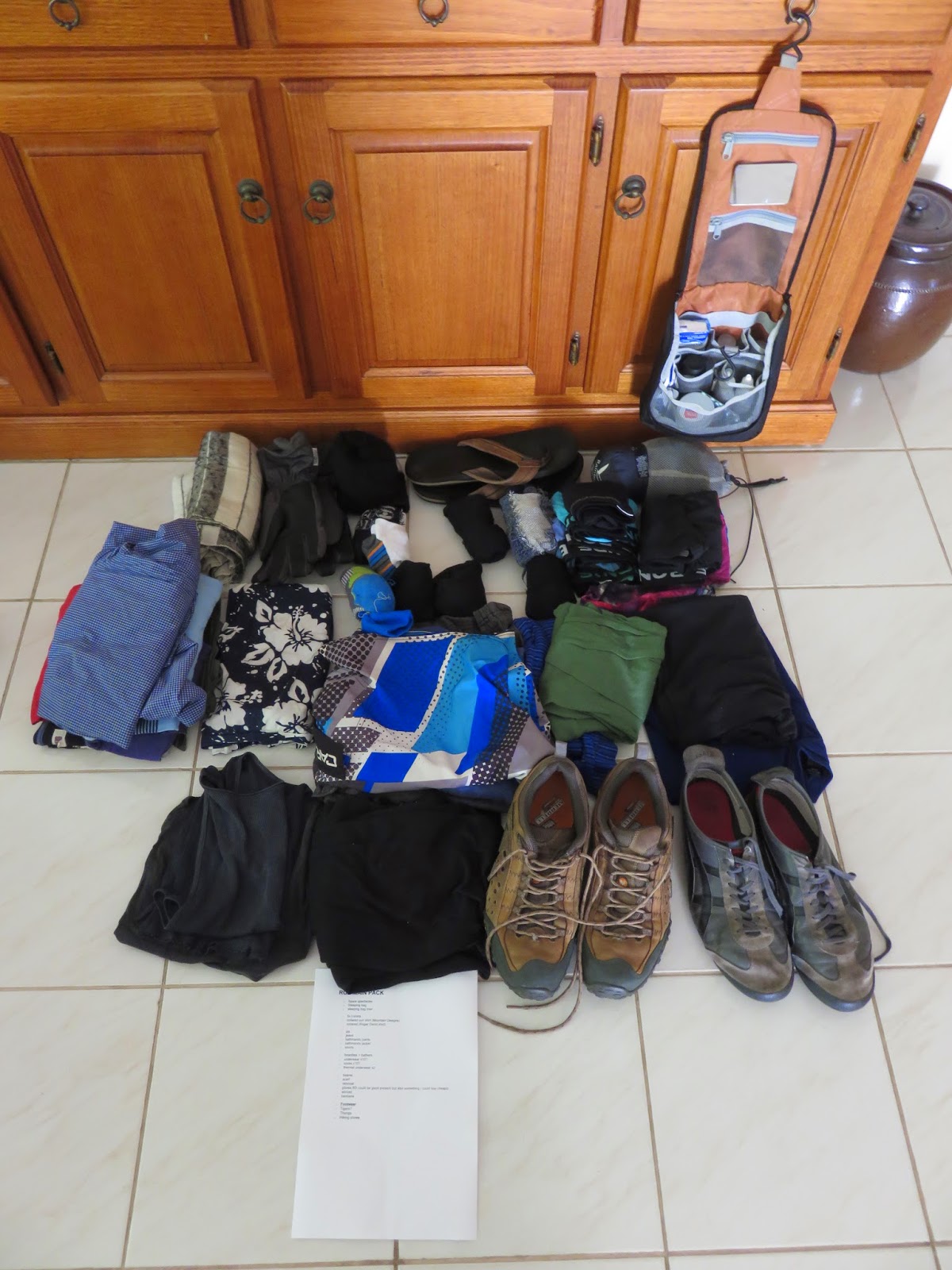
All considered, only a few days in, I think we have packed fairly well. Today we have made a good dent in our first aid kit with both of us somewhat sick with different ailments. As well as our sleeping bags and first aid, electronics and toiletries took up much of our packs. Once rolled, our clothes packed down well into compartments.

What made the cut, clothes and shoes excluded
Kat's clothes and shoes
Rob's clothes and shoes
The resulting suitcase as we got ready to jump on the plane pictured below...we wish! Packing evaluations to come.


Tuesday, 13 January 2015

Outgoing Passenger Card

Date: 13 January, 2015


Country you will board this flight: Australia

Country you will disembark this flight: Malaysia

Country you will spend most time abroad: Vietnam

How long will you spend abroad: 01 year(s) 01 month(s) 00 days(s)


Activity you are most looking forward to: Crossing Russia by train


Kat and I opened our “Round The World” travel account in August 2011, and as we were throwing our gear in the car last night, in my head I knew we were about to start on another life defining trip.  But it just felt like getting in the car any of the million other times we have done it in the past few months.  I got a little wobbly kneed as my brain told the rest of my body that this was actually happening.  Right in that moment it finally felt like we were leaving and wouldn’t be coming back for a while.


Now I’m sitting in KL, waiting for our flight to Kota Kinabalu, tired but excited.  For everyone else this is probably just another day.  Here’s to Malaysia and Borneo and the first new stamp in my freshly minted passport!


Sunday, 4 January 2015

Life as in-betweeners

The storm before the cyclone

With only 10 days until we leave on our adventure, I seem to switch by the moment from a sense of disbelief, excitement, anxiety and anticipation. On the 15th of December 2014 we moved from our unit in the northern suburbs of Melbourne to live with my mum and sister to the east of the city. It has been a busy time with us selling many of our possessions, moving and storing what was left, preparations for the big trip, a range of Christmas and New Year celebrations, a trip to Toowoomba, (Queensland) to spend time with Rob’s family and friends and a short beach "holiday before a holiday”. Tomorrow we drive back to Brisbane for our final Queensland visit and then fly to Melbourne for one final week that includes my brother and his fiancee's wedding. 

2014: selling and moving phase!
Rob and I have talked about our adventure many times over the past year to many different friends, families and even strangers. It has been very odd as it has gotten closer and our story has changed from a trip that is starting in 50 days, to one beginning in a month, to only a fortnight and now just 10 days. As it draws nearer to us doing what we have both dreamt of doing for a long time I have felt more and more disbelief that the day will arrive. It is amazing that we have the opportunity to journey to other parts of the world. We both feel very lucky that we are able to take on such an adventure and do it together. At the same time, our trip has been a long time in the making and part of me is raring to go whilst the other anxiously questions if we are actually ready. One moment I think we have done a good level of planning whilst leaving a great deal of flexibility still in place, another part panics when I realise we still only have our first night of accommodation in our first stop: Kota Kinabalu, Sabah, and only a vague idea about going to the beach and seeing some wildlife. That, however, is what good travel is made of. Vague dreams and opportunities for spontaneous adventures with people and places. Additionally, making the best of every opportunity is a good travel mantra, which really is no different from daily life. Money helps, and hopefully our saving efforts will serve us well.

Getting into travel mode at Tabletop
Mountain, Toowoomba


In-betweeners and goals

It has been a fantastic holiday period seeing our family and friends but it is also a very in-between state for us. I feel like we are already travelling in some regards then something reminds me we are still in very familiar territory. I have had a few moments where I have thought about whether this is what I/we “should” be doing right now, but have then remembered that I don’t believe there are “should’s” in life. A timely news article that I read yesterday provided advice to what people should be doing in their 30’s. (You know, the kind that appear around this time of year.) It was probably confirmation bias but everything I read affirmed my ideas about travel, this stage of life and what I want from life in general. The key messages I took out of it were:


Don’t be afraid of taking risks.

Society tells us by 30 we should have things “figured out” but this isn’t true; all adults are   winging it.

By chance, I got "The World" in 
a Christmas White Elephant!

You must continue to grow and develop yourself.

and something I vividly remember pondering whilst travelling in Italy:


The biggest regrets are most likely to be things you did not do rather than those you did, i.e. try everything.


These messages will inform the goals and dreams of 2015 for me as we set out on our big adventure. 


Volunteering hopes

I found out today about a potential volunteer opportunity in Ho Chi Minh. We are both keen to volunteer in Vietnam somewhere if we can be of use and despite our lack of Vietnamese. This good news made me even more excited about our time there. I am sure Rob will find something too, either before or when we land. We were keen not to end up in a more “voluntourism” type role that can sometimes mean an experience for the tourist and very little for the community, often at a hefty price tag. Not that I am against putting money into good causes, but sometimes it is hard to ensure it is getting to the people that need it nor do I wish to pay for a “feel-good experience” if that is all it is. It will be interesting to see if my opinions on this change over the trip. Perhaps I am over-cynical. At the moment these kinds of views are what has prompted us to find volunteering roles through our connections and/or when we arrive in the country.