Monday, 13 April 2015

SaPa and surrounds (Travel Dream!)

Seven years ago I first heard about SaPa from a fellow traveller in Hanoi. I researched the place and was sad to conclude I could not do it justice with the remaining time I had left in Vietnam. Since then I had hoped to come back to visit the rice terraces and people of SaPa. In fact, it was one of my main travel dreams for our big 2015 trip. We decided to spend 5 days hiking and relaxing in the area.

A view from the top
The views in and around SaPa were spectacular and it was fantastic to be outside hiking in fresh air again, even in the extremes of weather we experienced. Our first day hiking along and up rice terraces was extremely hot. Then at one point on the second day you could not see more than 5 metres in front of you due to the fog. After that, the weather was decidedly chilly but our time was still enjoyable.


Rice terraces filled with water
We decided to hike what is a fairly typical route to the south-east of SaPa. Hoping to avoid some of the crowds we often opted for the “hard way” over the “easy way.” It really wasn’t so busy, however, and I think even in peak season the crowds would not spoil the view.


Living the dream!
Rob balancing along


Slippery slope
Though the scenery is what draws many people to SaPa, for us, the best part was finding out about our guide, Chai, SaPa Sisters and the H’mong people. Only slightly before we arrived in SaPa I had found out about a trekking company called SaPa Sisters. They were linked with the hostel we stayed at and turned out to be an excellent organisation. It became very clear to us that becoming a trekking guide with SaPa Sisters is a great means for a woman to find independence. Though many H’mong women act as guides for treks around SaPa they often see little of the tourist dollar, with it instead going to tour companies in Hanoi. SaPa Sisters is run out of SaPa and the guides are paid directly by the customers and are entitled to maternity and sick leave and generally see more of the profits than they would at another organisation. Chai had worked with the company for five years, learning English from tourists and was very independent.

Our wonderful guide Chai
In SaPa we visited a museum which told us a bit about H’mong culture. If a man wants to marry a woman he will “kidnap” her. During this process she stays with him and his family and both parties decide if the marriage will go ahead. Chai told us about her views on the process. In addition to the fact that she was trekking on a day when women traditionally get “kidnapped”, she said she didn’t like the method and if a man had tried, she would not have considered marrying him. She said her husband was a good man and together they had a young toddler. I found it incredible she was 7 months pregnant with her second child during our trek! She said with her first child she had wanted to stop at 8 months but her Mum told her it was good for the pregnancy to walk. Perhaps the proof was in the pudding, so to speak, as her labour period was very short.

On the first night of our trek our homestay host was Ms Thanh in Lao Chai. Also there was a Newfoundland guest, Aimee, and her guide, May. It was great to talk to them and hear May’s perspectives on life. May actually worked for another company were the pay was not as good but she filled in with Sapa Sisters when they needed her. H’mong women are expected to marry and start a family young. May was about 19 years old. She and Chai told us that at 21 a woman is considered to be getting to old to marry. Chai originally did not want to marry and was 21 herself when she eventually did.

Ms Thanh, May, Chai and Kat
During our hike Chai pointed our some plants that were unique to the area. I was very excited when she showed us a plant whose leaves closed up when you touched it. It was an interesting defence mechanism and we couldn’t stop trialling it! In fact, I think it is so great that I have started to use the leaves folding in as a way to indicate when I feel sad or defeated. We also tried some berries and grass that Chai gave us. She warned us against a particular plant’s poisonous leaves because if you eat it you would need your stomach pumped or it will kill you.


You can eat these berries
On our second night we stayed at a larger family-run homestay in Ban Ho. A group of Americans and a couple of French were also guests that night. The duck I said hello to on the way into the house turned out to be dinner. I chose not to watch it being killed. As with the first night, we tried some of the local rice wine. This time it came paired with a confusing card game that no one really had a good handle on. (It was no UNO special rules!)

The family we stayed with in Ban Ho were Tay people and the village was made up with H’Mong and Dao people as well. There are seven minority groups in the surrounding areas of SaPa. I find it incredible that they so many groups living so close to each other that have each kept there culture so strong. It is hard to know exactly which ways the Vietnamese government and the Vietnamese influences their lives but Chai gave us a few indications. For one thing, generally the H’mong do not consider themselves Vietnamese.


A Red Dao woman at work
Little person at our Ban Ho homestay


Chai told us many more things about the lifestyles and traditions of the people in and around SaPa. When a woman marries they must move to live with their husband and his family, leaving their own community behind. This means many changes for the woman, especially if they are marrying into a different minority group and have to give up their culture.

This travel dream certainly turned into a memorable experience. It made me reflect on how lucky I am to have such opportunity in my life. I find the stories of Chai and the SaPa sisters inspiring and in a world where there is still much inequity between men and women (see recent UN Women report), they provide me with hope for the future.


Kat and Chai
Tips for visiting SaPa and surrounds:

*TREKKING: SapaSisters: we cannot recommend them enough. Chai was an excellent, knowledgeable guide and we liked their business model! 

*ACCOMMODATION: Graceful hotel was good value for a double (USD $16) and a nice home base.

*FOOD: BBQ on the street near the market for a tasty and cheap meal. We loved the deep-fried, pumpkin balls.


*GETTING THERE: In my opinion the relatively comfortable overnight train between Hanoi and Lao Cai is superior to the awkward day-time sleeper bus between SaPa to Hanoi. It doesn't waste your day time and the extra money can be considered your accommodation.

It is not too difficult to get in a mini-bus from Lao Cai to SaPa but make sure you have an idea of the costs before you get there as they will try to capitalise otherwise. 

Transport costs:
Train Hanoi to Lao Cai: ~ 600,000 dong per person
Mini-bus Lao Cai to Sapa: 100,000 dong per person
Bus SaPa to Hanoi: 294,000 dong per person

Sunday, 5 April 2015

It's Been a Long Time Since Binalong Bay

Our next adventure was a whirlwind day trip to the famous Ha Long Bay.  Our pictures can't really do this place justice.  

We started later than one might expect with a bus to the bay (about two hours) and then an immediate sit down lunch while out boat floated out into the bay making its way through the craggy rock eruptions that make the bay so scenic.  If I had to describe it through comparison (which is difficult) I would say it was like Milford Sound in NZ meeting the 12 Apostles in Victoria and yet bigger, wider and probably formed by completely different geological factors. Kat also found it similar to El Nido in the Philippines.

Ha Long Bay's craggy rocks

At this point, I surely must explain the odd title of this post.  Any time on this trip that we say "it's been a long time since...", we end up saying "It's been a long time since Binalong Bay" a place we visited when riding down the east coast of Tasmania.  That trip of course, was where we found the name for our blog, "Dolphin Sands Road!".  In this case, because Kat had been to Ha Long Bay before, I was asking "it's been a long time since you were here, what's changed?"  She didn't think a great deal was different, though she had remembered the dock being more hectic. Rather than a day-trip, last time Kat spent overnight on Cat Ba island. Though this gives you a bit more time to explore (Kat did a fun hike whilst there), we found Halong Bay was certainly was 'achievable' as a long day trip.

Dennis & Kat awaiting lunch
Our lunch companions were two Chinese salesmen, who introduced themselves as Dennis and Andy and we had a very pleasant time trying to determine what it was we were eating and whether or not all the food had finished coming out.  It transpired that they were actually from Guangzhou, our next major destination - however their only advice was that there was nothing to do there for adult tourists!

In between the scenes of "Chicken Rock" and another formation which makes for the image on some of the Vietnamese currency, we escaped the boat for a kayak through the arches of some of the limestone formations and was surprised to find a peaceful lagoon-like area with waist deep water and silence but for the occasional thump of inexperienced kayakers running into one another.

Rob showing how to sit in a
Vietnamese sized kayak
while his pants get wet

At mid-afternoon, we came to giant caves that have only been recently discovered and opened up to tourism.  Apparently, some fisherman were seeking cover from a storm, and followed a monkey into the cave (yet another Monkey Magic story!) and it was only once inside that they realised just how big they were.  While you could hardly say that they are in their natural state, the lighting and paths and garbage bins probably improve the experience because of the sheer numbers of visitors that file through.  I'm not sure I can remember an experience like it.  Those with an active imagination could spend hours discovering crocodiles, tigers, elephants, dragons and other animalisations of the rock. Kat was somewhat displeased by our guide's propensity to fix on only one animal for each rock. She felt it was a bit more subjective than that!

The return trip was lovely, if a little stressful, as we needed to be back to take our overnight train to Sa Pa. I enjoyed sitting on the roof (when I was allowed up there) watching the scenes go by, contemplating how long these formations had been here without people to explore them, all the while completing the essential task of trying to dry out my only pair of pants.


My imagination leads me to believe that this is an evil
tooth monster who couldn't afford to go to the dentist

Saturday, 4 April 2015

The Worst Experience Yet

Thinking back to my comment on 'shiny new visas' in our post on Chinese Visas for Australians (Phnom Penh), you might be forgiven for thinking that I spoke too lightly of how the visa run is the bane of existence of the long-term backpacker.  It gets worse.

Once we got to Vietnam we decided to alter plans somewhat so that we could visit Phnom Penh at the same time as Tim and Steph, and then return to Vietnam for a visit to Hanoi and Ha Long Bay before China. If we had planned this in advance, we would have acquired a multi-entry visa.  Instead, while in Ho Chi Minh City at the start of our Vietnamese adventure, we approached a travel agent to acquire a new visa for our return trip in early March.  

Paying more than we thought we should for the service, and persisting through some difficult communications with hand gestures and sulky looks, we walked away with two new single-entry visas after a protracted processing time. We then spent the rest of our time in Ho Chi Minh and Cambodia before flying out of Siem Reap for Bangkok.

After a harrowing overnighter in Bangkok (including a heart-stopping 130km/h ride with a nasty taxi driver who pretended to be lost) and a delayed flight, we finally made it to Hanoi on April 3. Tired and hungry it was only passing through immigration that we realised that there was anything wrong with the visas we had purchased all those weeks ago.  According to Immigration, what we thought were (and I still insist look like) new single-entry visas, were in actual fact visa extensions on our original entry visas (which had NOT been stamped as cancelled). This means that we had no visa on which to enter Vietnam.  Without the local language skills to negotiate or explain properly, we were faced with a frustrated, grumpy and 'you foreigners do this all the time' attitude  immigration official who was who was dis-inclined to sympathy, particularly when a nice fat $$$ sign was flashing in his eyes when he looked at us.

I didn't feel like shaking my fist in the air and screaming "Dolphin Sands Road!", I was too busy trying not to burst into tears but I was screaming so loudly inside I thought I would psycho-symptomatically go hoarse.

Waiting three hours at Immigration, with no one talking to us except the occasional official who would take our passports away and not give them back for a disconcerting amount of time was nerve-wracking and incredibly uncomfortable.  It was not an experience I wish to relive. We saw another couple just prior to our arrival shouting and getting quite angry at the Immigration staff, which obviously got them nowhere. Determined to maintain an appearance of calmness, we managed to work out our 'options'.  

Option 1 - Return to Bangkok

Option 2 - Purchase a conveniently available 'Hanoi City Tour' which comes with immediate visa approval and processing.  

You don't need to stretch your imagination too much to understand the implications of option number 2.  Insulated from such corruption in Australia, and in uncomfortable circumstances, it took us a little while to fully process it, and really it was not an easy decision to make. Feed the corruption to continue with booked plans and commitments, or give it up and find some alternative way to spend the time, with the cost of a new flight thrown in to boot.  

It ended up being probably the most expensive tour (that goes nowhere) you've ever seen.

The process, if that's what you call it, was relatively simple, and involved paying cash for our 'Hanoi City Tour'. Visas took less than 10 minutes and we were out the door with some tips from the remarkably helpful and polite VietJet staff member Ms Pham (who had been trembling when it came to any interaction with the intimidating Immigration team on our behalf).  

On the way out, I asked the 'travel agent', (with a cynical smile) "when will you pick us up for the tour?"

Her response was a knowing smile, "Haha. No." And she walked away.

Friday, 3 April 2015

Siem Reap, Cambodia

I really didn't know what to expect when heading to Siem Reap.  I knew it was coming and Kat had been before so I was kind of hoping to ride on her coat tails a bit.  What I really did not understand is just how big the temples are, how far away they are and how free you can be to explore them at your own pace.

We broke up our temple exploring over 3 days more or less geographically.  

Day one we spent visiting the temples and sights to the far north - so far away that we would not come back in the heat of the day.  We started the day with a very long tuk-tuk drive (with a hotel-based tuk-tuk driver, Mr Rhet) at Bantey Srei.  Bantey Srei was hard to really get a handle on as we only purchased a guide book after passing through, but there were enough other tourists to crowd the space and make me want to move on rather quickly.  I did spend enough time to be truly impressed how much detail Hindu people can fit into their temples and stone carvings, much like in Nepal, except that most of the wood carvings have been looted or rotted away.

A linga is a phallic-like rock, and at Nbal Spean ("The River of a Thousand Lingas"), thousands of them have been carved into the rock that forms the base of the river.  In the rainy season, the lingas along with other carvings of Shiva, Vishnu and Brahma are totally covered by running water. While I missed seeing this (oh how good it would have been for some rain) I really enjoyed the experience - both for the nice long walk to get there, but also because it was unlike anything I have seen before. Kat also really liked the pleasant hike and she had not visited Nbal Spean on her previous trip here.

The afternoon was eye-opening in a new way.  Cambodians, like the Vietnamese, have been through horrific experiences in recent decades through US/allied bombing, the disturbing rule of the Khmer Rouge, ongoing civil war and Vietnamese invasion.  Near to Bantey Srei is a Landmine Museum, opened by a man now known as Aki Ra, with a horrifying exposure to it all.  After experiences as a child soldier for the Khmer Rouge, and adult soldier for the Vietnamese army, and a man who never knew the name his parents gave him, he came to know land mines very well.  While both countries were trying to rebuild, he found his best way to participate was by disarming land mines, and the museum is a testament to his effort.  Everything in there (disarmed explosives in the tens of thousands) have been personally disarmed by him.  He has also started an orphanage and school there, specifically helping the victims of landmines and their families.  To support their efforts, please visit http://www.cambodianselfhelpdemining.org/ and give generously (they are a legitimate Cambodian-run NGO).  There are still millions of live explosives spread through the countryside of Cambodia on people's farms and in village's backyards.

Another remarkable thing we learned there was the world wide treaty on Land Mine use, to which China, Russia and the US are not signatories (they also happen to be the biggest producers).  Interestingly, according to the museum, the US' reasons for not signing is that there is no "North Korea exclusion-clause".  Apparently, the use of land mines in the "demilitarised zone" between North and South Korea is a key element in the US & South Korea's defence strategy, as the most effective means for preventing a North Korean invasion.  I've actually discovered that the US has agreed to the terms of the treaty with the exception of the Korean peninsula (South Korea is not a signatory for the reasons stated above, see wikipedia).

Taking it all in

Our second half of the day adventures were greatly improved by studying our new guide to the temples.  It certainly prevented us from "templing out" as you might be wont to do if you are just seeing without learning.

We finished off day one at Bantey Samrei, which was practically deserted.  I found the detail of the carvings remarkable, but the most memorable the image of the god Rama riding (Hanuman) while surrounded by the monkey army.  I think it was so memorable because of throwbacks to my childhood and the stories of the Journey to the West or better known as "Monkey Magic" - a great Japanese TV drama of the late 70's! (Sadly, I cannot find a youtube link).

With the heat in March being oppressive our plan was to explore temples in the morning and afternoon, while resting and swimming in our hotel's pool during the day.  This was such an important part of the plan that our hotel choice was based on it. However, we were to discover that our hotel didn't work like that and dis-satisfied with their strange method of calculating tuk-tuk fees, on day two we said goodbye to Mr Rhet. Kat also found it rather disappointing after the excellent driver she and her friends had in 2008...well apart from the tuk-tuk accident. On Day 2 we were to say hello to Mr Widget (or that's what we think his name was) whose services we acquired without the help of the hotel.  

Sunrise through the gate at Banteay Kdei
above Srah Srang
Our prior-to-sunrise departure took us to Srah Srang, a beautiful spot that was probably once a lovely balcony to an impressive temple overlooking a dam.  The sun's reflection on the water would have been impressive, could we see it through the haze. Whilst waiting for sunrise, Kat told me about plans to build a cafe amongst the ruins. Totally in support of such an idea, she let me go a little way with it before letting me know it was April 1st. 

Before long we thought it much more appealing to explore the nearby Buddhist temple Bantey Kdei while there were fewer other tourists about.  This was a far less grandiose, almost intentionally understated place that many tourists seem to overlook for the nearby and more famous Angkor Thom and Angkor Wat.  To top things off, as we left to the east at about 7am, we had a remarkable view of the now risen sun, above Srah Srang.

Following this, a visit to a place with probably the most shared photos of the region I have seen - Ta Prohm.  At this temple, silk-cotton trees (the husks of which we was used to float down the river in Chitwan) have taken over the walls and temples, such that it now looks like they are holding it together.  I can't help but wonder if this was a natural development, or whether someone intentionally did this.

One of Kat's favourite temples

Mr Widget seemed enthusiastic about our midday break, because it meant that he could collect his wife and go an get a scan done (she's pregnant) before picking us up again in the afternoon.  

The afternoon we used to explore Angkor Thom, the grand Elephant Terrace, and the well-famous Bayon "face-temple".  Although these ancient Khmer temples were built over a period of about 4 centuries (from 9th to 13th) - while the Christians in the west were off crusading - they were all made within a rather small area.  Each king trying to outdo the efforts of another even if those efforts were actually borne by their poor subjects.  

Hard-working elephants eternally uprooting lotus plants
On the last day, we were headed to where everyone heads at some point.  Sunrise at the famous Angkor Wat.  Except, that Mr Widget didn't show up.  We truly hope that he and his wife are OK, but we had no way to get in touch.  Instead, we had to do a last minute shuffle (at 5.30am) and find a new driver, enter Mr Widget 2 - he actually had the same name, we didn't just call him "number 2"! 

As Kat had told me, sunrise and sunsets at the temples are often hazy - early mornings are more about missing the heat of the day than seeing a sunrise. sometimes, its just best to get a photo of a beautiful woman instead.  

Kat at the famous Angkor Wat

Churning for eternal life
Our particular day at Ankor Wat was far too hazy and there were too many people eager to step into our carefully selected shot, so we focused more on exploration.  The bas-reliefs on the south side of Angkor Wat really were amazing, but further improved by our trusty guidebook.  Without that, or a guide to explain them to you, you could be forgiven for thinking of them as repetitive images of Vishnu.  I think the great highlight was the "Stirring of the Ocean of Milk", a great story that I think ties nicely in with that of the Rainbow Serpent.

A second, perhaps grander (although not as well preserved), version of the
Stirring of the Ocean of Milk
Mr Widget 2 was only too happy to give us a ride out to the airport for a few extra dollars, where a storm was brewing before our flight to Bangkok.  It was certainly a packed three days, but we really enjoyed it, I'm glad Kat was willing to come a second time.

Tips for the temples:
  • Don't be a fool, climbing around the temples in the middle of the day is not fun - especially in March.
  • We stayed at the Lotus Lodge Villa - I recommend you don't.  There's not one thing that leads me to say this, but the combination of a thousand tiny things (to which they have not seen fit to respond to).  I've received better service for $4/night at a guest house.
  • Get a guide book dedicated to the temples - it's worth the investment.
  • Don't try to do too much - take your time.

A happy face at Bayon

Wednesday, 1 April 2015

S-21 Prison, Phnom Penh

Cambodians, like the Vietnamese, have been through horrific experiences in recent decades through US/allied bombing, the disturbing rule of the Khmer Rouge, ongoing civil war, Vietnamese invasion and the nasty vestiges of war.  The eastern part of the country was heavily mined to restrict the movements of the Vietcong and the process of mining continued throughtout multiple regimes, as a way to maim but not always kill enemy combatants. The 'logic' behind this is that injuring a soldier takes two  enemy combatants out of action but killing only takes one.

Somehow while growing up, I either never learned or somehow blocked my mind to these tragedies.  When I did hear of Pol Pot, I imagined some far off dictator, some regime in South America, something that happened long ago.  But the truth is so much closer in time and geography.  Some of these heinous crimes occurred before I was born, but much of it so close that people on the street, little older than me must have suffered through the experience in one way or another, and many of those much older could have been directly involved with them, as perpetrator or victim.

S-21 Prison is actually a school that was used as a prison and torture facility after the Khmer Rouge came to power (1975) and drove most people from the cities to the fields.  Their brand of communism (like many others I suppose) was the belief that labouring in the fields was a glorious pursuit and that intellectuals and artists were a threat to the regime.  People would be brought here for "re-education" or "re-training" if they were not of use in their prior role, if they were somehow a threat to someone in power, or if they were suspected of being a CIA spy (or perhaps that last one was just used as a way to getting rid of people the Khmer Rouge didn't want around).  People were whipped, drowned, electrocuted, starved and executed within the walls of this school.  If they did survive the prison, many were taken out to the killing fields to be executed.

In one remarkable room, there was a section dedicated to a visit, in the late 70's, of a Swedish journalist who came as one of Pol Pot's guests to Cambodia, and left writing about what a glorious place Cambodia was.  He wrote about a classless agricultural communist state could thrive. He now writes about how horribly wrong he was, how ridiculous it seems that the wool had been pulled over his eyes, with he a willing participant. None of the others in his party have similarly stated these revelations. Kat found this display especially fascinating as it was a new addition to since her visit in 2008. It certainly raised questions as to whether we are turning a blind eye to the various conflicts or dictatorships around the world at the moment.

During our visit, we saw a documentary, where two of the only seven known survivors of the camp told of their experience, along with a "prison guard" who told of his role at the prison, and at being forced to murder someone at the killing fields to prove that he was an "absolute" follower.

Now setup as a quasi-museum to expose these crimes for what they were, a visit here is a sad, soul-crushing experience, leaving you to (again) wonder how humans can be capable of such atrocities.  Even after being driven out by the Vietnamese invasion in the late 70's, the Khmer Rouge continued a guerilla war to 1991. Disturbingly, the court cases against men like Pol Pot and his cadres have only recently commenced, with the man himself dying in 1998, before justice was done.

Stories we have read and seen are reflective of tragedies elsewhere where people under a dictatorship have been forced to do horrendous things to save loved ones or themselves. It is impossible to know what lengths one would go to in these circumstances. Although evidence perhaps points to the contrary, one would hope we as humans can learn from the devastation of war or turning a blind eye to our neighbouring countries and avoid any sort of repetition of these events. Cambodia is showing tremendous strength in rebuilding their communities with such fresh memories and resulting (and ongoing) pain of a truly horrifying time.

Tuesday, 31 March 2015

Hello! Sue sdei! Where do you go? I don’t know!


Hashing in Phnom Penh
Rob has been talking about the Himalayan Hash House Harriers since the day I met him. Hash House Harriers is an international group of non-competitive social running clubs. Hashing involves following a path laid out by a Hare through all sorts of obstacles. Traditionally it is paired with the drinking of beer, which I less eagerly anticipated! 
 During Rob’s year in Nepal he was a regular Hasher. We had hoped to do a hash in Kathmandu whilst we were there but the stars did not align and we were not there on a Sunday (hash day). We vowed to look out for future opportunities and Phnom Penh turned out to be the city to host us!

We invited Tim (who we had been staying with in Ho Chi Minh and whose travel dates coincided with our stay in Phnom Penh) to join us. It was his first Hash too which meant we initially followed-the-leader rather than the white spray-paint that indicated the path. It also meant we were required to stand in the middle of the circle during the drinking songs and the end of the hash.


The hash got off to a very slow start. Meeting at the deserted train-station of Phnom Penh we were to wait a good hour before hopping on a cattle truck that took us to the ferry. Our hash was to be out in the country-side and after reboarding the cattle truck on the other side of the river, a few wrong turns, several tree branches in people’s faces, numerous bumps in the road and many looks of disbelief from locals, we arrived at our starting point: a primary school.


Tim and I on the way to our first hash
Our group was diverse, consisting of expats (or immigrants), locals and tourists aged from 25-60 with a wide range of backgrounds. Some were walkers (one of them showed up in dress shoes but everyone was relieved he had sneakers in his bag) and others ran. Our route involved rice paddies, temples, someone’s backyard, a boat crossing, roads and alleyways. Farmers stared at us; probably wondering why we weren’t in our hammocks at this time of day. I used my miniscule amount of Khmer to greet a farmer and it turned into a little rhyme:


Sue sdei!

Hello!

Where do you go?

I don’t know!


It must be very odd to find foreigners running in your fields looking like they are on a mission but realising they actually do not have the faintest idea where they are headed! 

The first crossing of the hash
Serenity

What are you people doing?

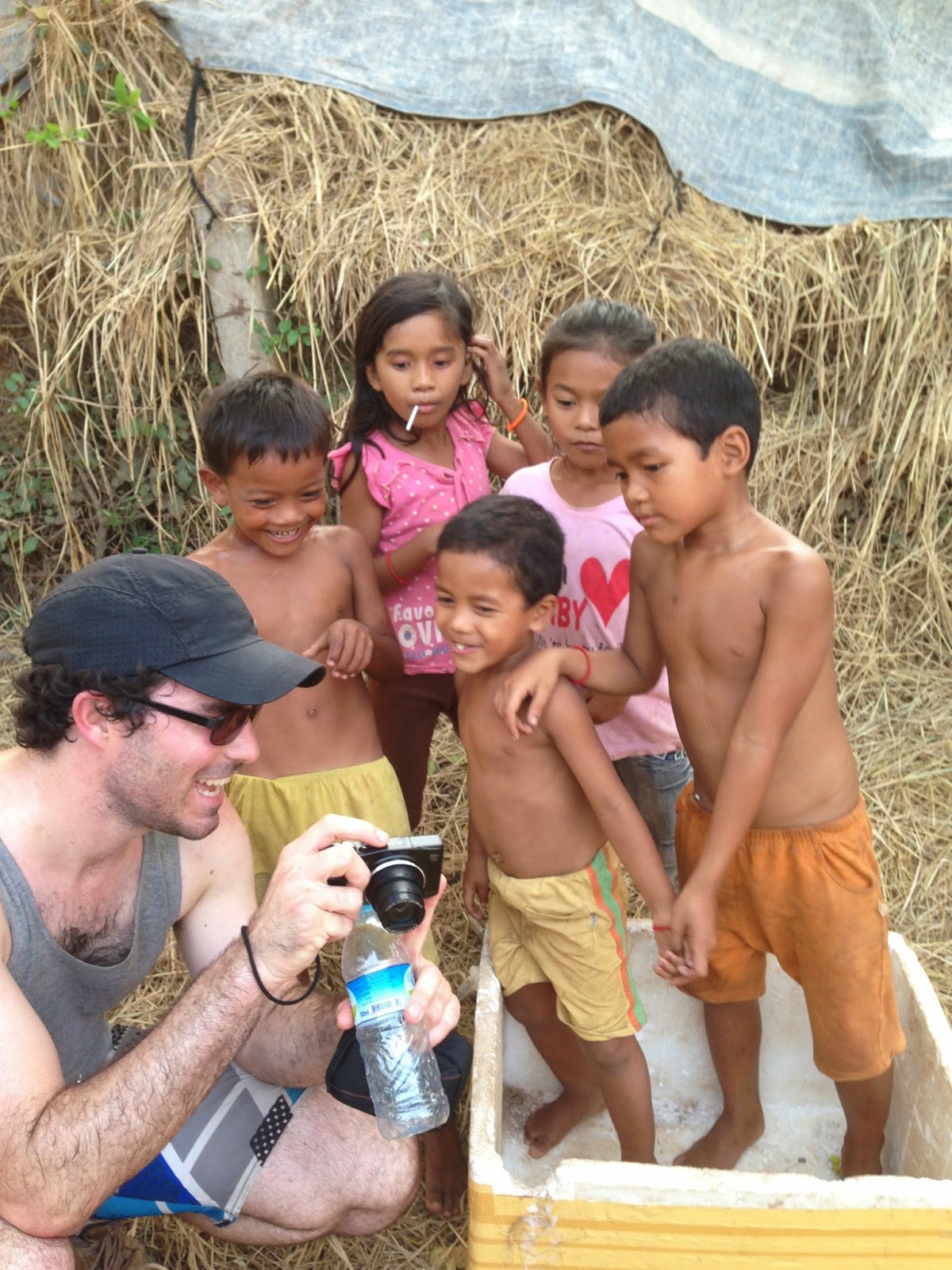
We passed through villages with many friendly waves and giggles from children. Towards the end it felt like we were finishing a marathon with the reception we got. Children waved tree branches and cheered and I felt like I should be more exhausted than I was! Don’t get me wrong, though it wasn’t a marathon; it was certainly a challenge. It was a very hot day and it has been awhile since I ran at all, let alone on uneven trails in scorching sun!

Marathon crowd :P

Smiley kids

Take my photo!

Taking a look at the previous photo

Once we reached our final destination the drinks were handed around and we formed a ceremonious circle. I opted for an electrolyte drink, until I was pulled in the circle and given a cup of beer. It felt rude not to take part. If someone from around the circle sat down on the ground they would be forced to sit on a huge ice cube in the centre. Rob had mouthed off early so also found himself in the middle of the circle with a pipe around his arm. His drink was a bit harder to swallow.


Rob's challenge, Tim and my beer that tasted like...beer

Circle time went on a bit too long for me with far more drinking songs than you can poke a stick at. We had told poor Steph (Tim’s wife) that we would be back before dinner but it was going to be much later by the time we took the journey back to Phnom Penh. Nevertheless, I enjoyed being surround by the local kids playing as the sun went down. 

Kids, probably wondering what one earth we were doing


We hope to do more hashing in other places this year and would recommend it to other travellers. It is a great experience, incorporates some exercise and the costs are minimal (US$5 in Phnom Penh). Visit the PP site here!

Ready to hash another day!